Because the original screenshots are incomplete, there’s no way to fully reconstruct what happened back then. Some parts are written from memory. I’ve also filled in up-to-date screenshots and noted what has changed about the facilities since.
Table of contents
Table of contents
- TL;DR
- Where the Dream Began
- Taking Shape
- The Oil Industry Sets Off
- A Durable Rare Earth Alloy
- The Oil Industry Goes Further
- The Start of the Nuclear Industry
- Extracting the Essence
- The Transformation of Nuclear Fuel
- Element 126
- A Little Chernobyl
- Inexhaustible
- Freeing My Hands
- The Power of Lasers
- Under Vacuum
- Cohesion
- The Strongest Fuel on Earth
- Sweetness in the Sour
- Approaching the Speed of Light
- A Puddle of Sludge
- Another Path to Fusion
- A Fresh New Look
- The Space Program Takes Off
- Sending the Little Guy into the Sky
- Panning for Gold
- Endless Energy
- Super Armor
- The Ultimate Energy Storage
- Extra 1: Uranium-233 Freedom
- Extra 2: The RBMK’s Road to Revival
- Extra 3: A Gift from the Moon
- Extra 4: Treasure from the Asteroids
- Extra 5: Making the Most of Everything
TL;DR
In early September 2026, I started yet another survival world in HBM’s Nuclear Tech Mod, and this time I finally didn’t give up halfway.
Starting from a combustion generator, I worked my way through the oil industry, nuclear reactors, the fusion reactor and the ICF, and wrapped it all up with the Gerald construction android, the DFC and the FEnSU.
Along the way I had a few meltdowns, loaded a few backups, and even blew up my own home, but I made it to the finish line in the end.
The FEnSU now holds 2.5 PHE of energy. That’s more power than I could use in a lifetime.
As for the extras after the ending, where I went looking for things to do, just put them down to me being bored.
Where the Dream Began
In early September 2026, with nothing better to do, I started yet another survival world to play on my own.
I went in intending to beat it, but I had no idea whether I’d give up halfway like last time.
Taking Shape
At first there weren’t many machines at home, so a simple combustion generator was enough to keep the power on. It only ran at 50% efficiency, but it held up.
Back then my main machines were the assembly machine, the chemical plant and the shredder. The shredder breaks ores into smaller pieces, which increases yield.
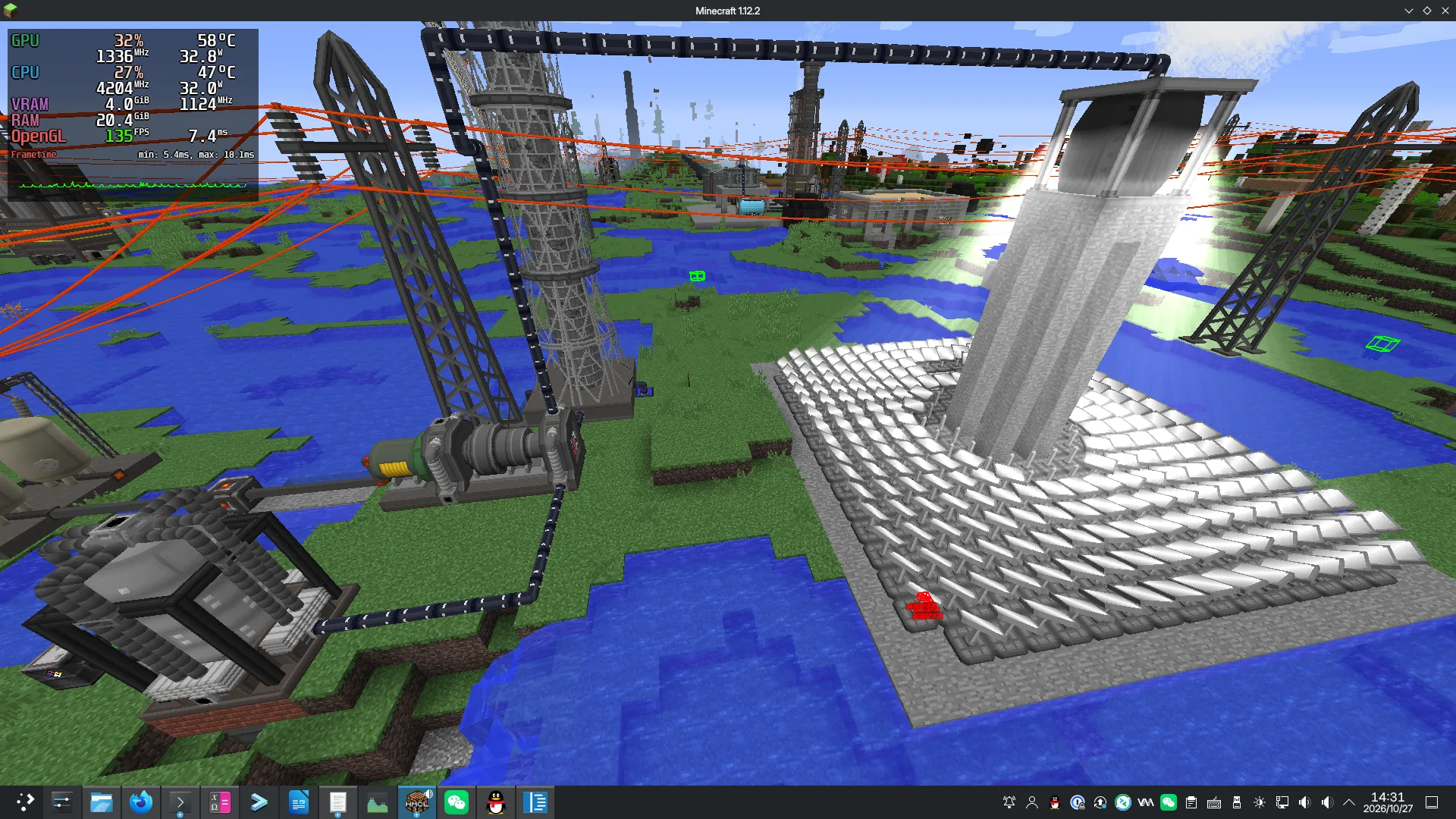
Later, as I progressed, power usage kept growing, until I had no choice but to bring in a solar tower boiler. After that I combined a thermal power station with the solar tower boiler: solar power during the day, burning fuel to get through the night.
The thermal power station uses a boiler to put the heat from burning fuel to work, boiling water into steam. A steam turbine then turns the steam into electricity at 100% efficiency.
The Oil Industry Sets Off
In real life, oil is called “the lifeblood of the economy”. In HBM’s Nuclear Tech Mod, oil is just as important a resource.
To progress in the game, there’s no getting around polymer bars. In HBM’s Nuclear Tech Mod, 2 coal powder, 1 fluorite and 1000 mB of petroleum gas (note: mB here means millibucket, i.e. one thousandth of a bucket, not the MB used as a computer data unit) make 4 polymer bars.
To find an oil field, I crafted an oil detector. After a great deal of effort, hard work finally paid off and I found one.
For convenience, I built a refinery right next to the oil field. Once a boiler heats up the crude oil, refining can begin.
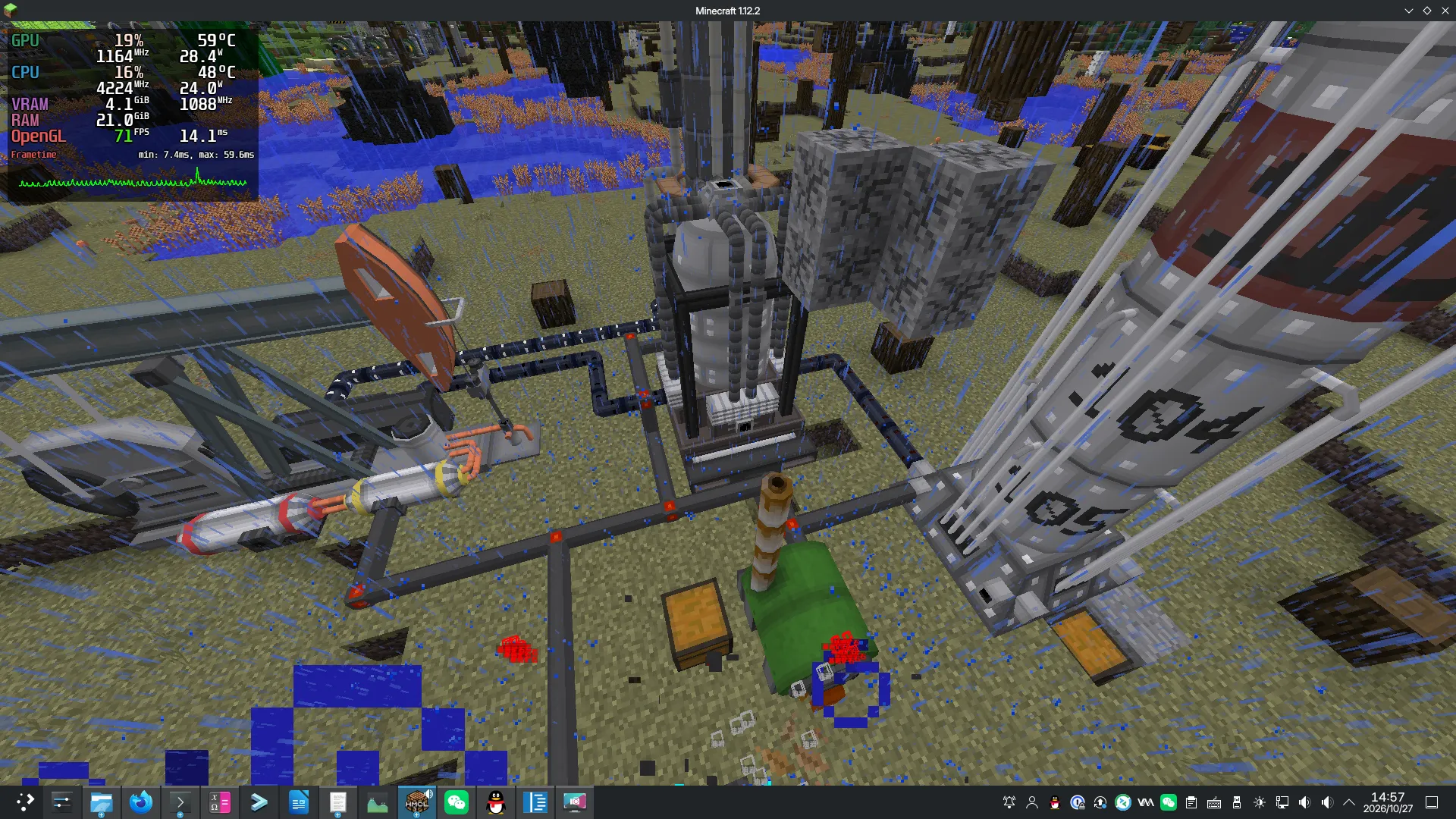
Refining regular crude oil yields heavy oil, naphtha, light oil and petroleum gas, plus sulfur as a solid byproduct.
At first, since I was making polymer bars, only petroleum gas was really useful. As for the leftover heavy oil, naphtha and light oil, I fractioned them into heating oil, diesel and kerosene, and then just burned them.
These things would become useful later, but back then distant water couldn’t put out a nearby fire.
The solar tower boiler doesn’t generate power at night, and fixing the nighttime power shortage was urgent, so I had no choice but to build an industrial combustion engine to burn all of it.
Of course, not every fractioning product got burned, since some of them can’t be burned at all. I stored those in fluid barrels.
The bitumen was originally meant for paving roads, but I never got around to it before the world was finished.
The lubricant couldn’t be burned and I had no use for it at the time, so I stored it too.
A Durable Rare Earth Alloy
In HBM’s Nuclear Tech Mod, Desh is an alloy made of various rare earth metals. It’s very useful in the game, but it’s fictional.
The early shredder, and the centrifuge I built after the oil industry got going, already improved ore processing. But as later industries needed more and more ore, improving ore processing further became a top priority.
So building an ore acidizer became my next task. The ore acidizer treats ores with acid to crystallize them, and putting the crystals into a centrifuge increases the yield.
But the ore acidizer needs Desh ingots. To make Desh ingots in the chemical plant, I needed Desh blend, light oil (yes, the same stuff I’d been burning) and mercury.
To get Desh blend, you shred rare earth ore chunks (which drop when you mine rare earth ore) in the shredder, and rare earth ore isn’t easy to find. It took me quite a while to collect enough rare earth ore chunks.
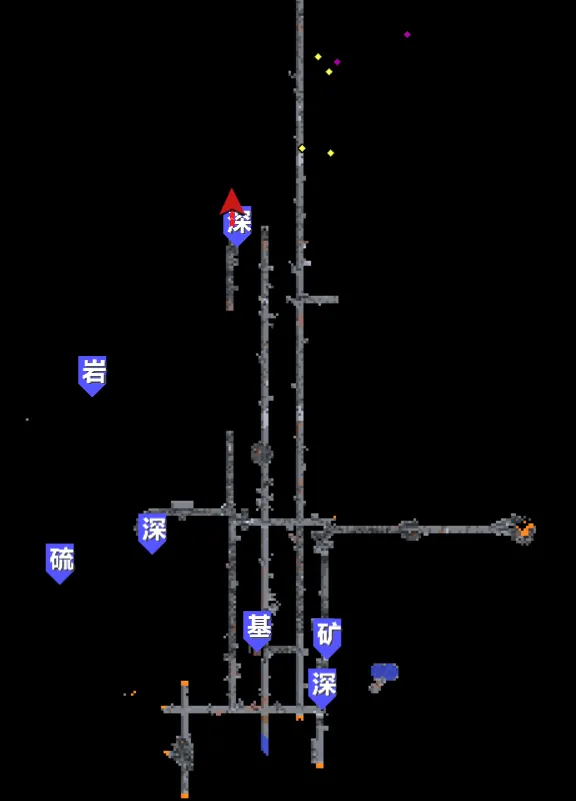
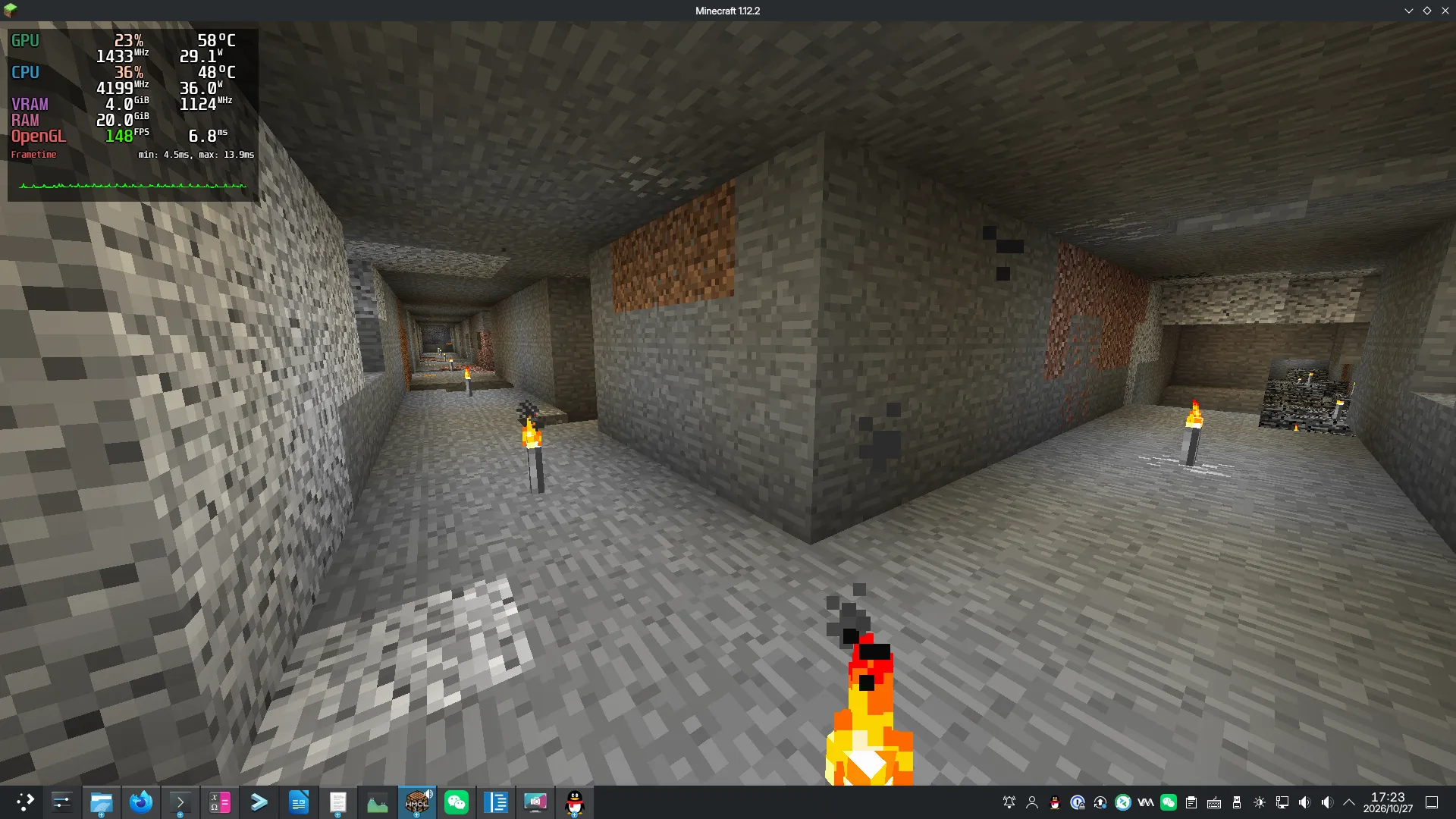
Getting mercury wasn’t simple either. I had to go deep underground (close to bedrock) to find deep cinnabar ore, and then put the cinnabar into the coke oven.
Deep ores are very hard. Ordinary pickaxes can’t mine them (you can only blow them up), so I also made mining charges for this.
After a thoroughly satisfying round of blasting, I’d collected enough cinnabar.
Desh isn’t only for the ore acidizer. It’s also used for the hydraulic fracking tower (for tapping bedrock oil deposits for endless oil), the catalytic cracking tower (more on that later), the gas centrifuge (for enriching uranium-235) and other machines.
What’s more, Desh tools have infinite durability, which mattered a lot to me (especially the pickaxe). Even though the Desh pickaxe only mines at the same level as an iron pickaxe, its strengths far outweigh that flaw, and I could finally dig mineshafts to get more ore.
The Oil Industry Goes Further
Later, I built a catalytic cracking tower and pumpjacks, found another oil field, and started exploring the other route of the oil industry.
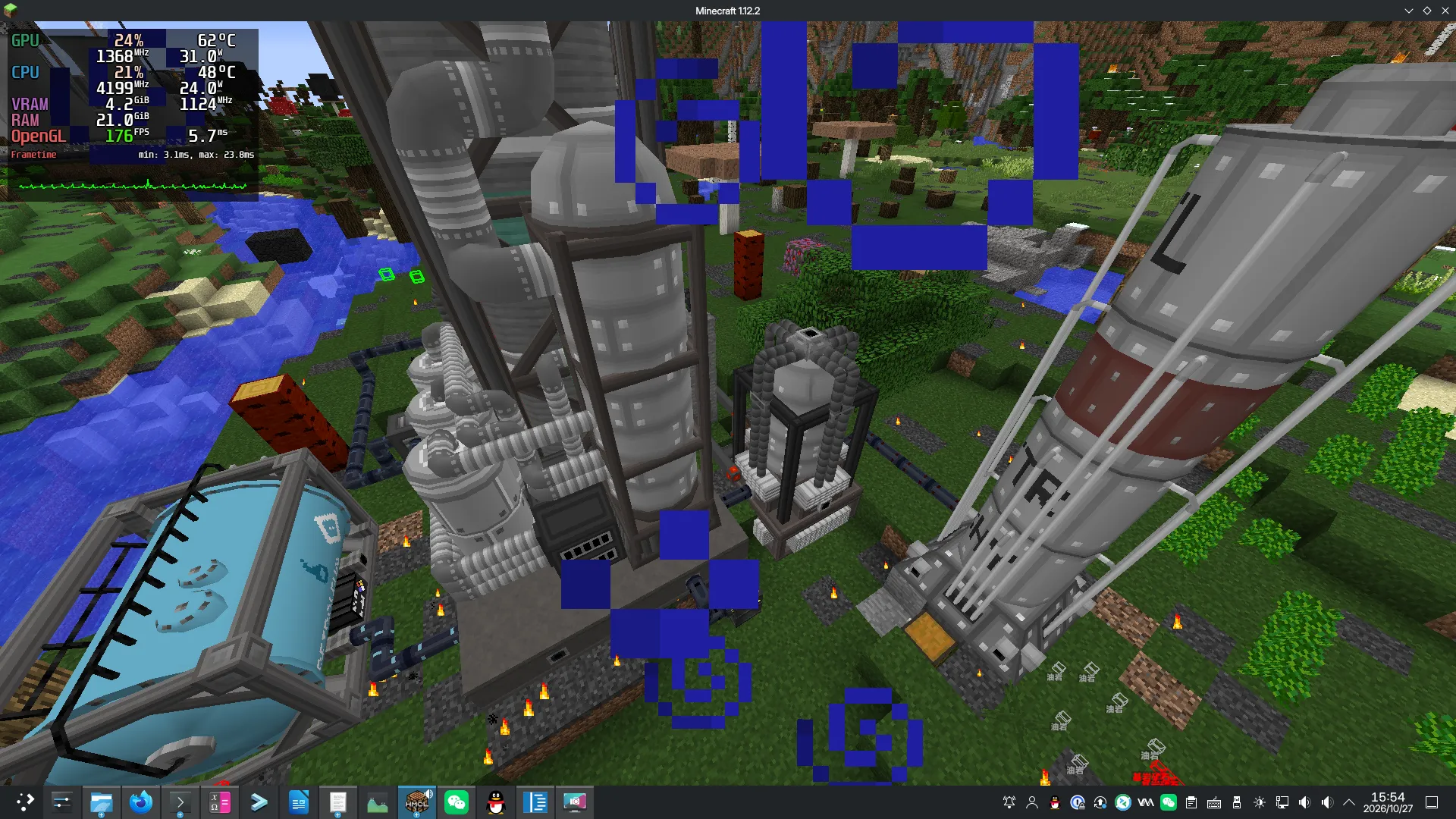
Cracked crude oil gives different products when refined: cracked naphtha, cracked light oil, aromatic hydrocarbons and unsaturated hydrocarbons.
At this point, cracked naphtha and cracked light oil got almost the same treatment that heavy oil and naphtha got early on: I fractioned them into heating oil, cracked diesel and kerosene, and burned them all.
One difference, though: fractioning cracked light oil also gives petroleum gas, which regular light oil doesn’t.
Aromatic and unsaturated hydrocarbons are both crucial.
The former can be combined with petroleum gas to make bakelite bars, a cheaper replacement for polymer bars.
The latter can be combined with sulfur to make rubber bars.
Both the ZIRNOX and the PWR nuclear reactors need rubber bars, and so do machines like the electric press, the industrial steam turbine and the cyclotron.
The Start of the Nuclear Industry
As my base became more and more industrialized, the solar tower boiler and the coal-fired thermal power station alone were no longer enough to keep the machines running.
So a “more advanced” way of “boiling water” became especially important, which opened the chapter on nuclear power plants.
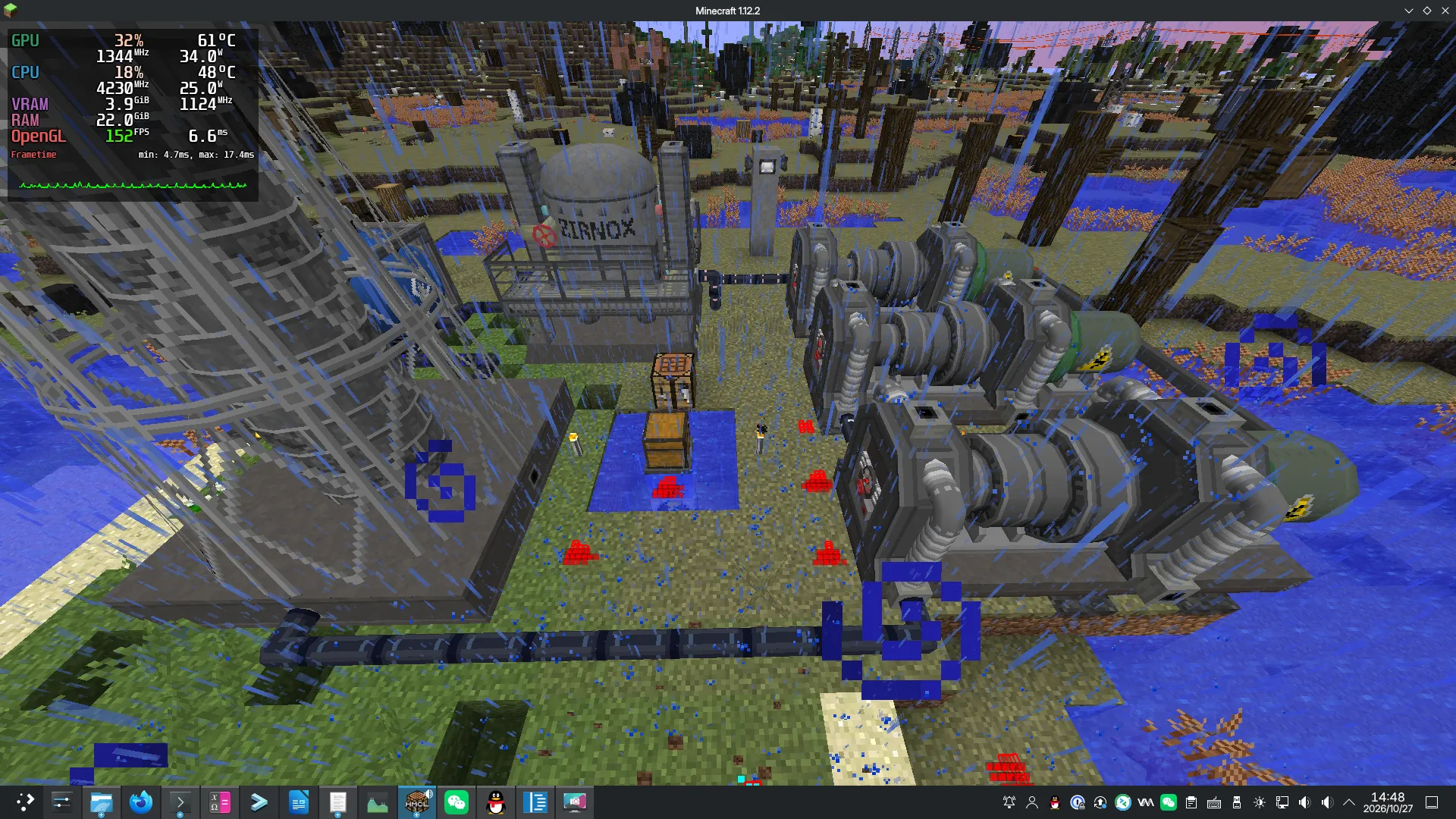
At first, my base ran on the ZIRNOX, a nuclear reactor in HBM’s Nuclear Tech Mod modeled on the Magnox reactor (a first-generation reactor design).
This reactor is fairly cheap to build and generates a decent amount of power.
It uses carbon dioxide as coolant to carry heat away from the core and pass it on to water. In other words, it’s just another way of boiling water.
In HBM’s Nuclear Tech Mod, steam comes in four grades: steam, dense steam, super dense steam and ultra dense steam. Steam turbines turn higher-grade steam into lower-grade steam, until ordinary steam becomes “low-pressure steam”, at which point it needs a cooling tower to turn back into water and complete the water cycle.
Since the ZIRNOX outputs super dense steam, I hooked up three steam turbines.
Once the ZIRNOX was up and running, I finally didn’t have to worry about power at night.
Extracting the Essence
For a nuclear reactor, using natural uranium directly as fuel isn’t always a good idea. To enrich uranium-235, I built four gas centrifuges (four of them in series are needed to separate out pure uranium-235).
However, gas centrifuges can’t separate uranium-235 straight from uranium ingots. The uranium first has to be made into yellowcake, and then into gaseous uranium hexafluoride.
Once the gas centrifuges separate the uranium hexafluoride, you get a lot of uranium-238 and a little uranium-235.
Uranium-238 isn’t as suitable as uranium-235 for direct use as conventional fission fuel, but it still has plenty of uses, such as crafting hazardous material tanks (which hold small amounts of dangerous fluids), containment boxes (put radioactive items inside to block their radiation) and ducrete (a high-strength building material).
Still, uranium-235 makes up only a small fraction of natural uranium, and I didn’t have bedrock ore yet, so I didn’t use uranium-235 directly to make highly enriched uranium-235 fuel rods.
Mixing uranium-235 and uranium-238 in a certain ratio gives medium-enriched uranium fuel.
Uranium fuel can be used directly as nuclear fuel, or mixed with plutonium-239 to make MOX fuel.
Of course, uranium-238 can also be mixed with reactor-grade plutonium (a mix of plutonium-239 and plutonium-240) to make lower-concentration plutonium fuel.
The only problem was that I didn’t have any plutonium yet, so that was out of the question.
The Transformation of Nuclear Fuel
What can you do with spent nuclear fuel? Once processed, quite a lot!
I’d been worrying about where to get plutonium, so I built a PUREX to process spent nuclear fuel.
Of course, you can’t just throw spent fuel into the PUREX. It also needs kerosene and nitric acid. Nitric acid can be made from niter + sulfuric acid, and kerosene comes from fractioning light oil or cracked light oil, but I’d burned all of that.
Fortunately, after some fiddling around, I finally extracted a little reactor-grade plutonium, as well as technetium-99, from spent uranium fuel.
I’ve already mentioned what plutonium is for. Technetium-99 can be combined with steel to make technetium steel. This alloy is needed for everything from technetium steel barrels (which hold highly corrosive fluids) to the vacuum refinery, the hydrotreater, the Leviathan steam turbine and huge storage tanks.
But technetium-99 was still scarce at the time, and processing spent uranium fuel alone clearly couldn’t meet later demand.
Luckily, with plutonium in hand, I had another way to get technetium-99: the ZIRNOX’s ZFB (Zirconium Fast Breeding, a series of fast breeding fuel rods) MOX fuel rods.
These fuel rods produce relatively little heat, so naturally they don’t generate much power, but the upside is that you can fill the whole reactor with them without worrying much about a meltdown.
More importantly, ZFB MOX fuel rods deplete quickly, and processing those depleted rods for technetium-99 was exactly what I needed.
Regular MOX fuel rods aren’t bad either, but I didn’t have enough plutonium at the time. In comparison, I preferred using ZFB MOX fuel rods to produce technetium-99.
Element 126
Schrabidium-326 (Sa326) is another fictional resource in HBM’s Nuclear Tech Mod. It’s supposedly a superheavy element sitting on the island of stability, but in the game its radioactivity is anything but weak. It can even blind you: without protective gear, it’s easy to lose your sight.
Getting Sa326 is no easy feat either. It takes a lot of material (mainly uranium ore), and a lot of luck.
Processing spent nuclear fuel produces some nuclear waste, which can be packed into nuclear waste barrels.
Detonating a nuclear waste barrel with explosives creates a radiation zone, and uranium ore caught in it has a tiny chance of turning into Sa326 ore.
When I tried it, only 5 out of several stacks of uranium ore were converted. Looks like I really am not that lucky.
Sa326 is mainly used to make nuclear fuel, but it has other uses too, such as making more advanced gear.
Still, since this Sa326 had been so hard to come by, I didn’t rush to use it. Instead, I acidized and centrifuged it (to increase the yield) and stored it.
Before building the fusion reactor, I had no way to get ionized particles, so I had no chance to turn this Sa326 into schrabidic acid.
Schrabidic acid is needed to extract Sa326 from spent plutonium fuel. Since it turns a little into a lot, I also call this “duplicating”.
Of course, this process also needs organic solvent, which needs naphtha and aromatic hydrocarbons. Sadly, I’d fractioned all my naphtha into diesel and heating oil and burned it.
So this Sa326 couldn’t be put to use for the time being. After all, I didn’t want to kill the goose that lays the golden eggs; that wouldn’t be worth it.
A Little Chernobyl
The RBMK is one of the most important nuclear reactors in HBM’s Nuclear Tech Mod. The Soviet Union’s Chernobyl nuclear power plant also used the RBMK.
An RBMK meltdown is extremely violent, but the RBMK not only generates a lot of power, it can also produce important resources through its irradiation channels: for example, irradiating thorium-232 to make thorium fuel (which can be used directly in nuclear reactors), irradiating chlorinated paraffin to make high-performance solvent (needed for processing bedrock ore), and irradiating lithium to make tritium (one of the main fusion fuels).
To push bedrock ore processing forward as soon as possible, and to take the oil industry further, there was no getting around high-performance solvent, so I built an RBMK.
Of course, the RBMK produces huge amounts of ultra dense steam, which industrial steam turbines can’t handle. So at the same time, I also built four Leviathan steam turbines.
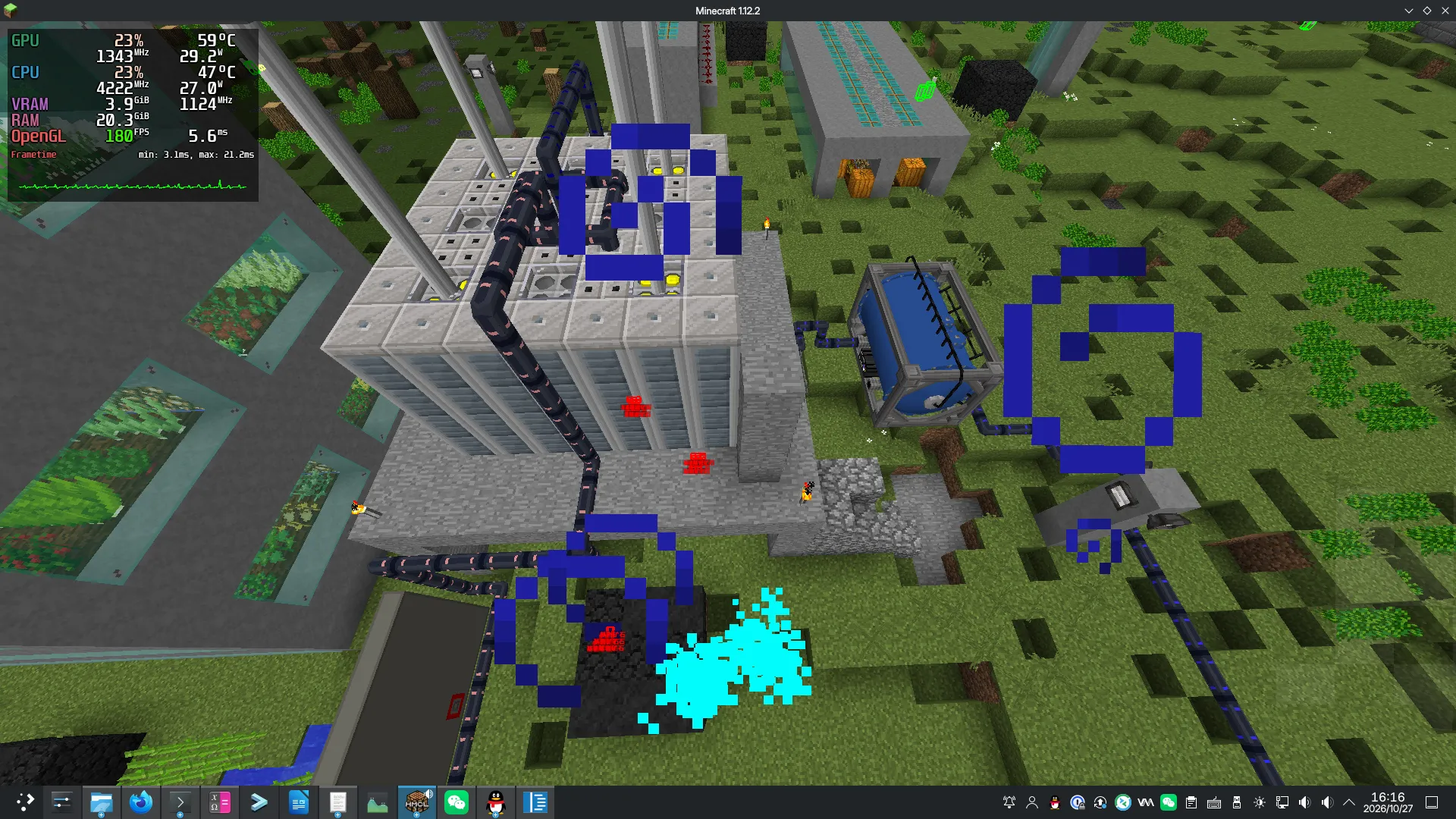
Conditions were fairly tough at first, so I could only use uranium fuel billets to make medium-enriched uranium-235 fuel rods.
Later, once things got better, to balance irradiation and power generation, I first mixed medium-enriched uranium-235 fuel rods with MOX fuel rods, and finally switched entirely to MOX fuel rods.
Although the RBMK’s power decays over time, a starved camel is still bigger than a horse: the RBMK can feed the grid for hours on end, which is better than the ZIRNOX.
The one drawback was that lithium-ion batteries don’t store much energy, so a lot of power went to waste. Only after the cyclotron came online did all that surplus power finally find a use.
To get high-performance solvent through irradiation, I first needed to make chlorinated paraffin from chlorine and paraffin wax.
Paraffin wax isn’t hard to get. Fractioning heavy oil gives bitumen (yes, the same bitumen that never got used for roads) and industrial oil. Fractioning the industrial oil again gives heating oil and lubricant, and solidifying the lubricant gives paraffin wax.
But where does chlorine come from? Sodalite! I was going to make sodium-iron batteries later (one tier above lithium-ion batteries) anyway, so I acidized the lapis lazuli ore in my storage first.
Acidizing gives lapis crystals, and putting them into a centrifuge gives some sodalite. Putting sodalite into the coke oven then gives sodium and chlorine, both of which I needed.
With high-performance solvent sorted, I started on mining and processing bedrock ore.
Inexhaustible
In HBM’s Nuclear Tech Mod, bedrock ore is tedious to process, but it provides an inexhaustible supply of ore.
Bedrock ores spawned in different chunks have different parameters, and these parameters determine how abundant each component is in the raw ore mined there.
The first bedrock ore I found was right near my home. Sorted by amount, its components were rare earth (2.71), actinides (2.68), light metals (1.91), heavy metals (1.16), crystals (0.79) and non-metals (0.16). These numbers show how much of each component you get, on average, per raw ore processed.
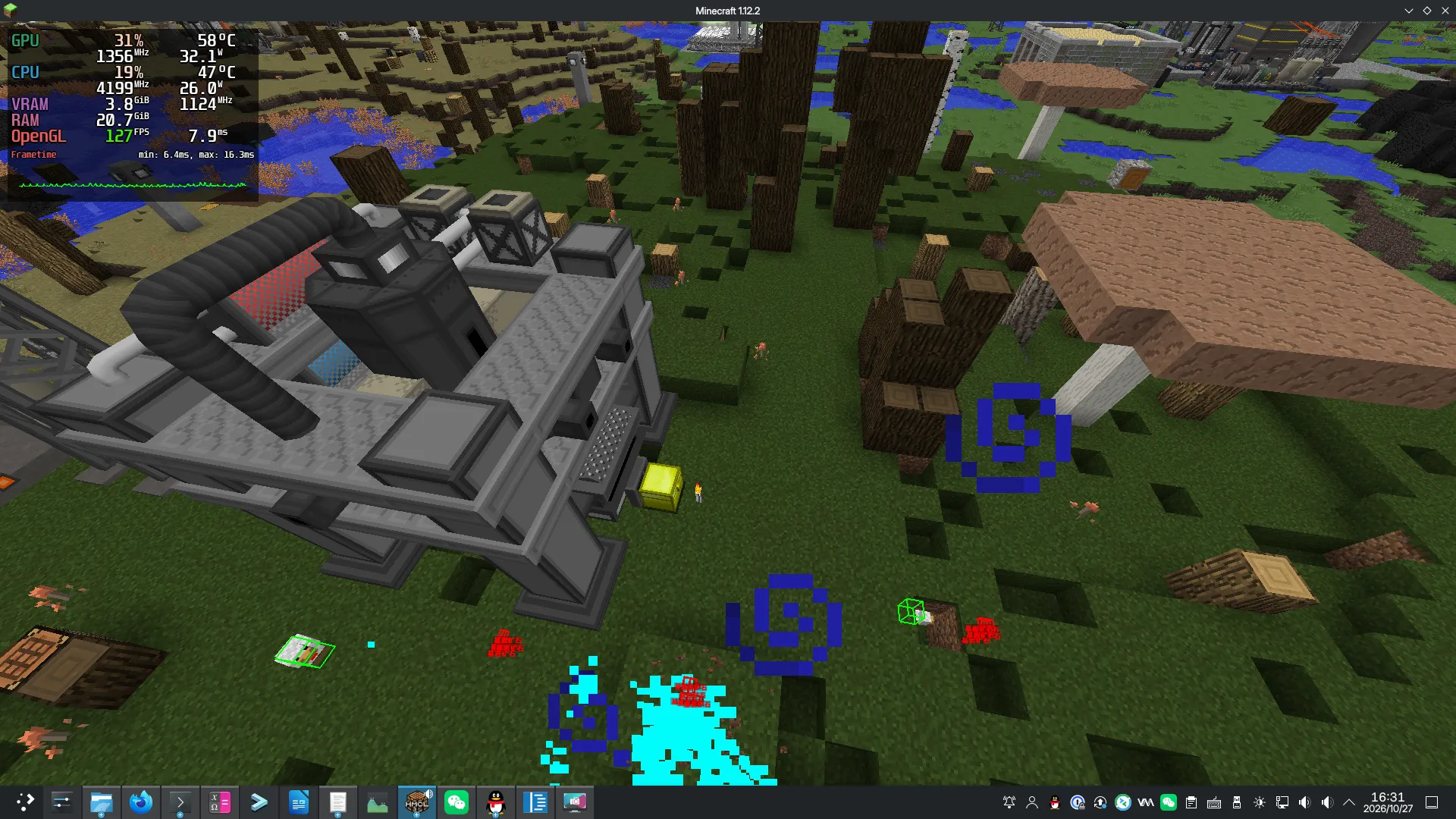
To take the oil industry further, the first thing I processed was the heavy metal component. It’s not a large share, but it’s not ridiculously small either.
After treating the heavy metal component with high-performance solvent, I went through a series of tedious processing steps and finally got bismuth, tantalum and gold. Bismuth was the mineral I needed to push the oil industry forward.
Of course, I processed the other bedrock ore components later on too. To hold all those batches of final products, I built a mass-production warehouse.
The mass-production warehouse is divided into several zones, each with several mass storage units.
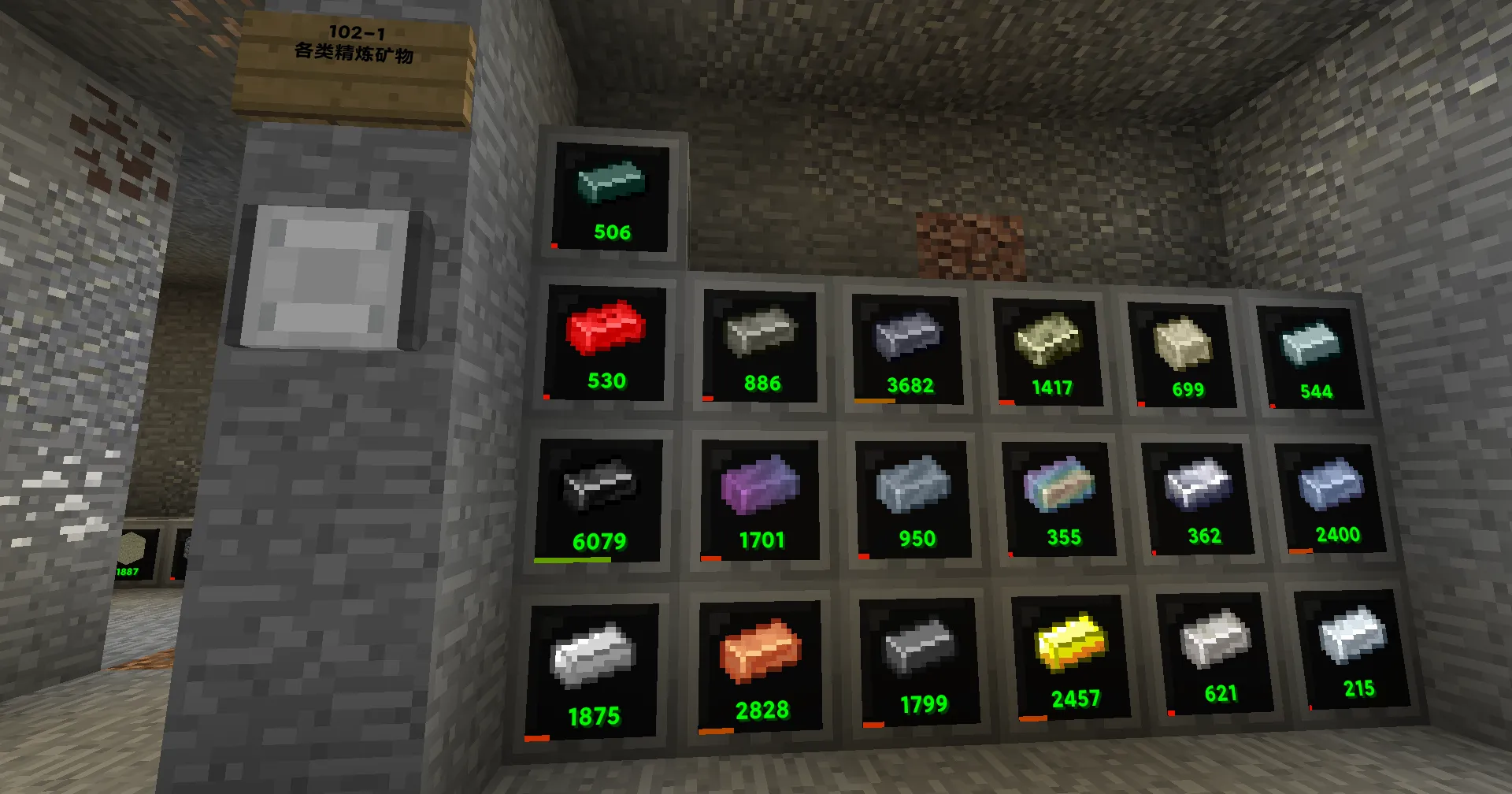
In HBM’s Nuclear Tech Mod, a mass storage unit stores large quantities of a single kind of item. Each zone of the mass-production warehouse is laid out 6 × 5, which means each zone can store up to 30 kinds of items.
The final products from bedrock ore all went into zone 102-1 (refined minerals of all kinds).
From then on, whenever some resource reached mass production and no longer fit in the old storage, the mass-production warehouse came in handy.
Freeing My Hands
Sometimes you need to feed a big batch of items into a machine, but each recipe takes time to process, and feeding items in while you wait is very inefficient.
This is where pneumatic tubes really shine: they can move items from a container into a machine, and the other way round, from a machine into a container.
But pneumatic tubes need compressed air to shoot items through.
So I set up an air intake and a compressor in my base’s air distribution room, dedicated to pressurizing these pneumatic tubes.
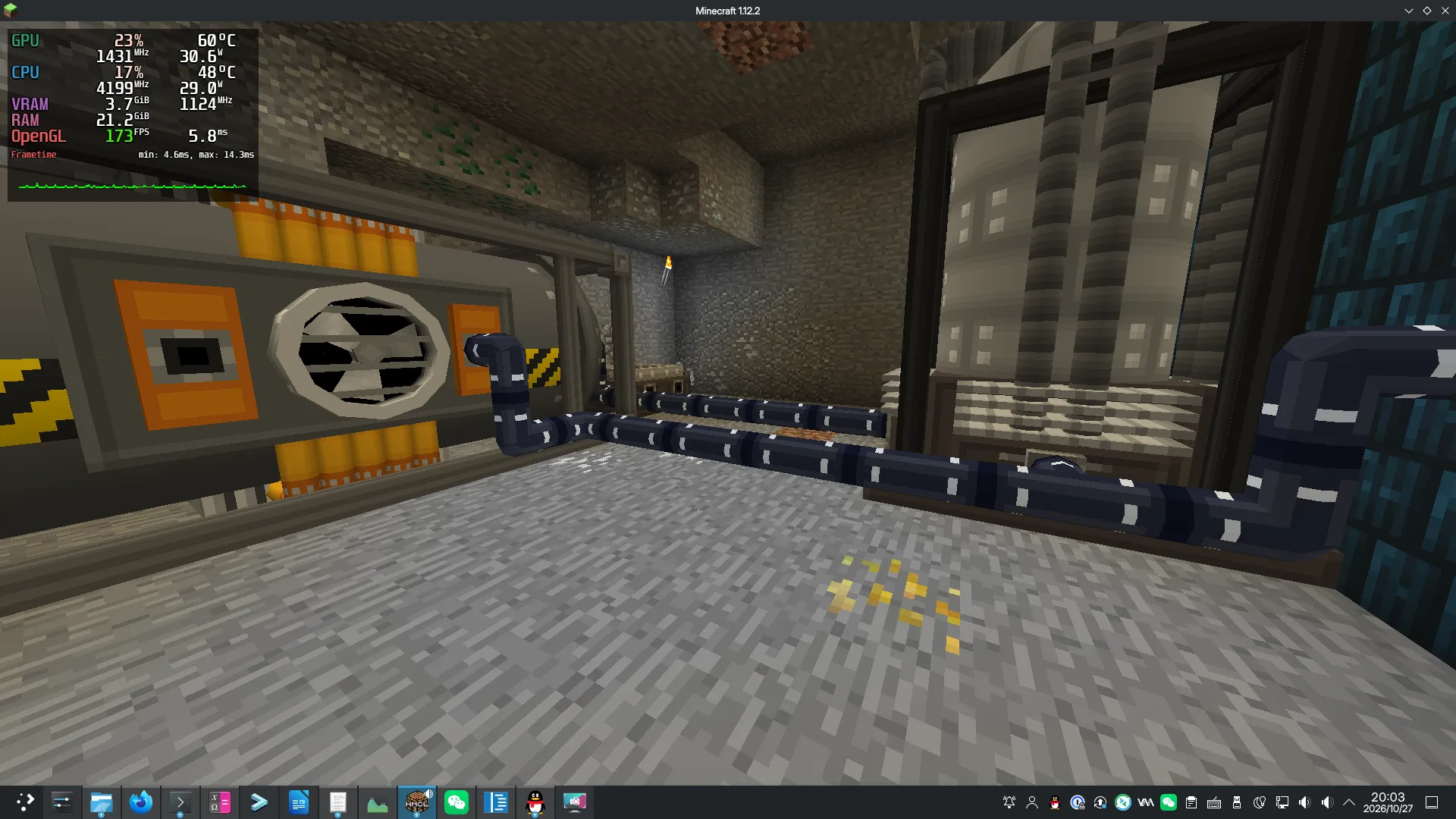
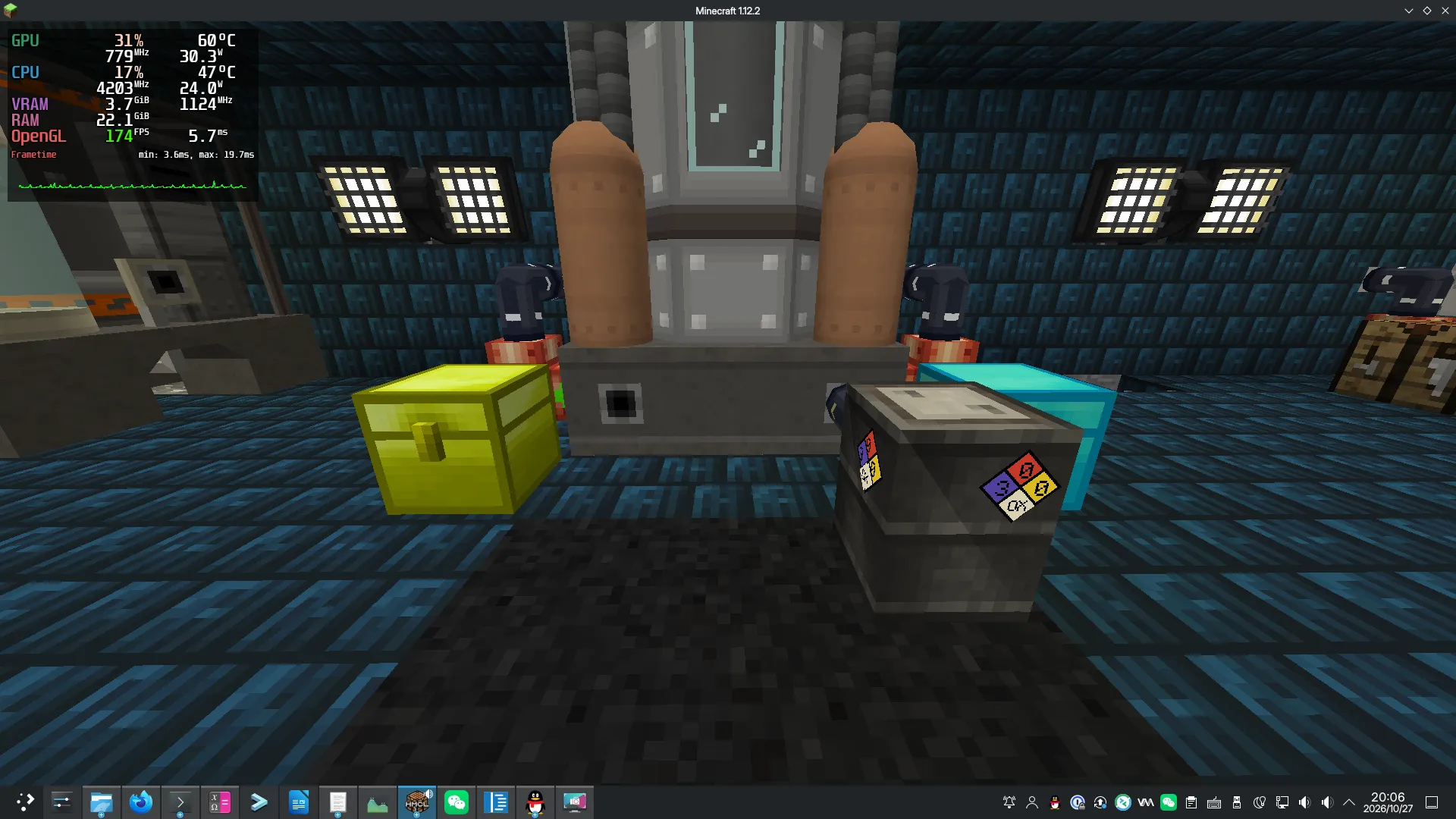
Take the ore acidizer: I wanted to process several stacks of ore, but it only holds one stack at a time. Every time it finished one stack, I had to put in another myself, and take the products out first.
With pneumatic tubes, though, I can put two chests next to the machine: one holds the ore, which the tubes shoot into the machine, and the other receives the products the machine shoots out.
The Power of Lasers
The RBMK differs from the ZIRNOX in one way: its spent fuel has to be processed in the laser isotope separation chamber (SILEX) instead of the PUREX.
The SILEX itself doesn’t need power, but it needs a laser aimed at it, and the laser does need power.
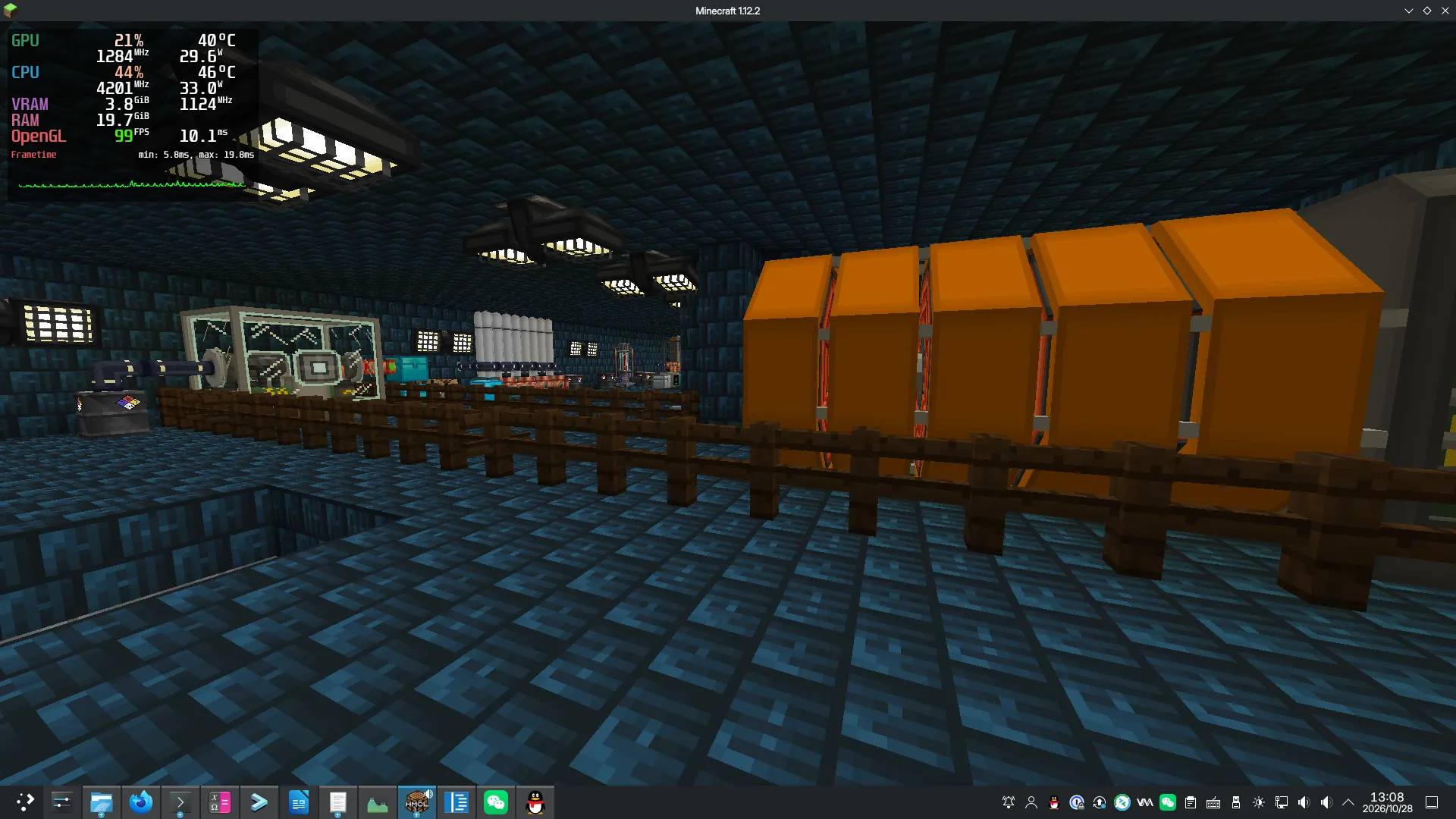
The laser can hold different kinds of laser crystals. At first, only the infrared crystal is available.
Besides processing spent RBMK fuel, the SILEX has another advantage: it can enrich uranium-235 in bulk much more efficiently.
In the SILEX, uranium ingots don’t have to be made into yellowcake, then uranium hexafluoride, before enriching uranium-235.
Of course, separating isotopes in the SILEX requires hydrogen peroxide.
The bedrock ore near my home happened to be rich in actinides, so I used liquid hydrogen to raise the share of its heavy fraction. The heavy fraction here is mainly uranium, while the light fraction is thorium.
Combined with pneumatic tubes, I could put batches of uranium ingots into a chest. That way I only had to leave the game running while I slept, and in the morning I’d find the chests full of uranium-235 and uranium-238.
Under Vacuum
Now that I had bismuth, what next? I used bismuth nuggets to make versatile integrated circuits, then versatile circuit boards, and finally a vacuum refinery.
Since the hydraulic fracking tower had yet to make an appearance, I gave it its chance here.
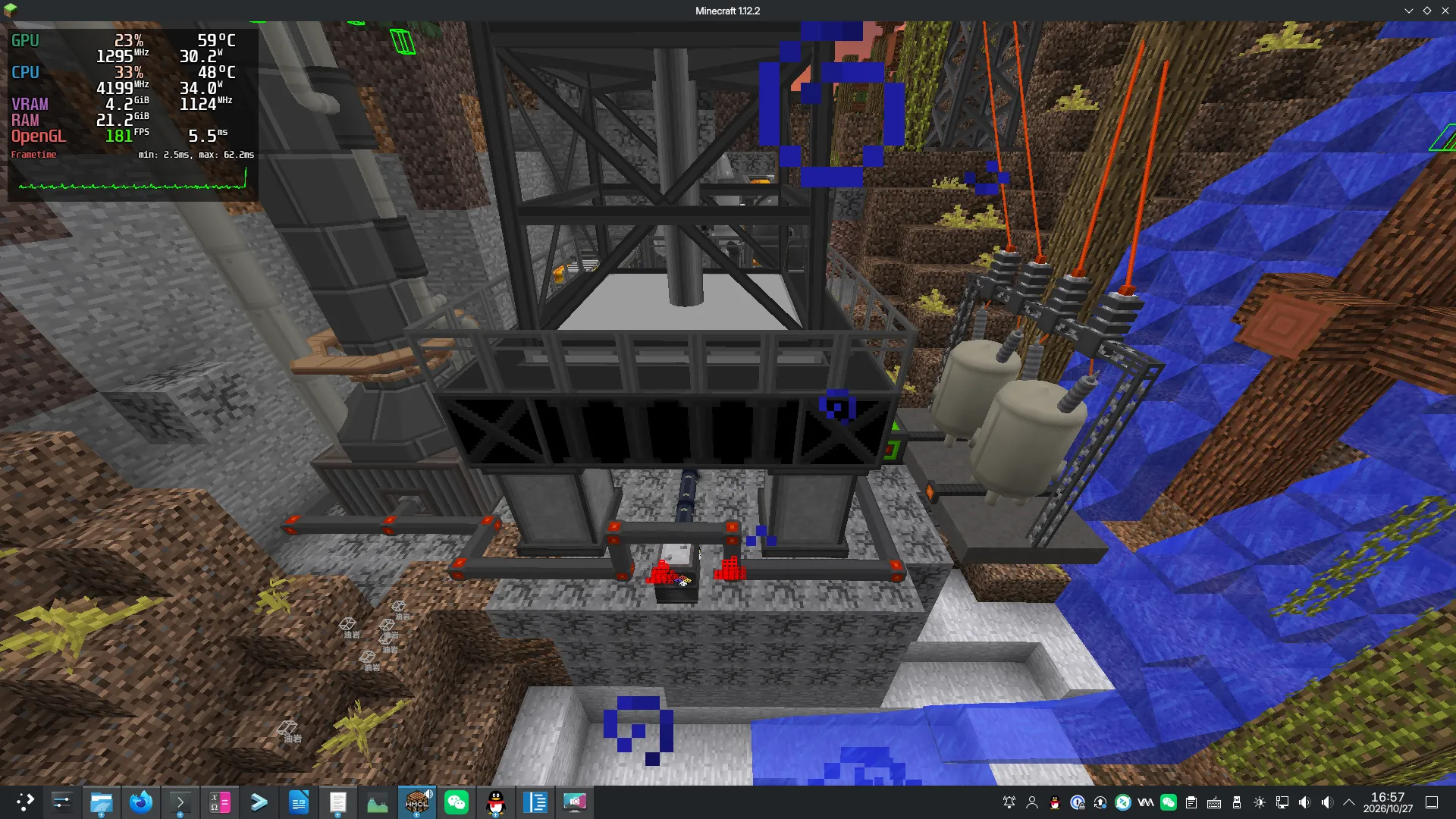
After all, I’d need plenty of oil products later on, and at the time I also planned to relocate my other production lines and set them up with hydraulic fracking towers.
Of course, its debut didn’t come free.
First I used the oil detector to find a bedrock oil deposit at least 300 m away from home, because the hydraulic fracking tower pollutes the environment and makes the land ugly.
The fracking fluid it needs isn’t hard to make either: just sulfuric acid and petroleum gas.
Unlike the regular refinery, in HBM the vacuum refinery doesn’t need the oil to be heated. Instead, the oil has to be pressurized to 2 PU.
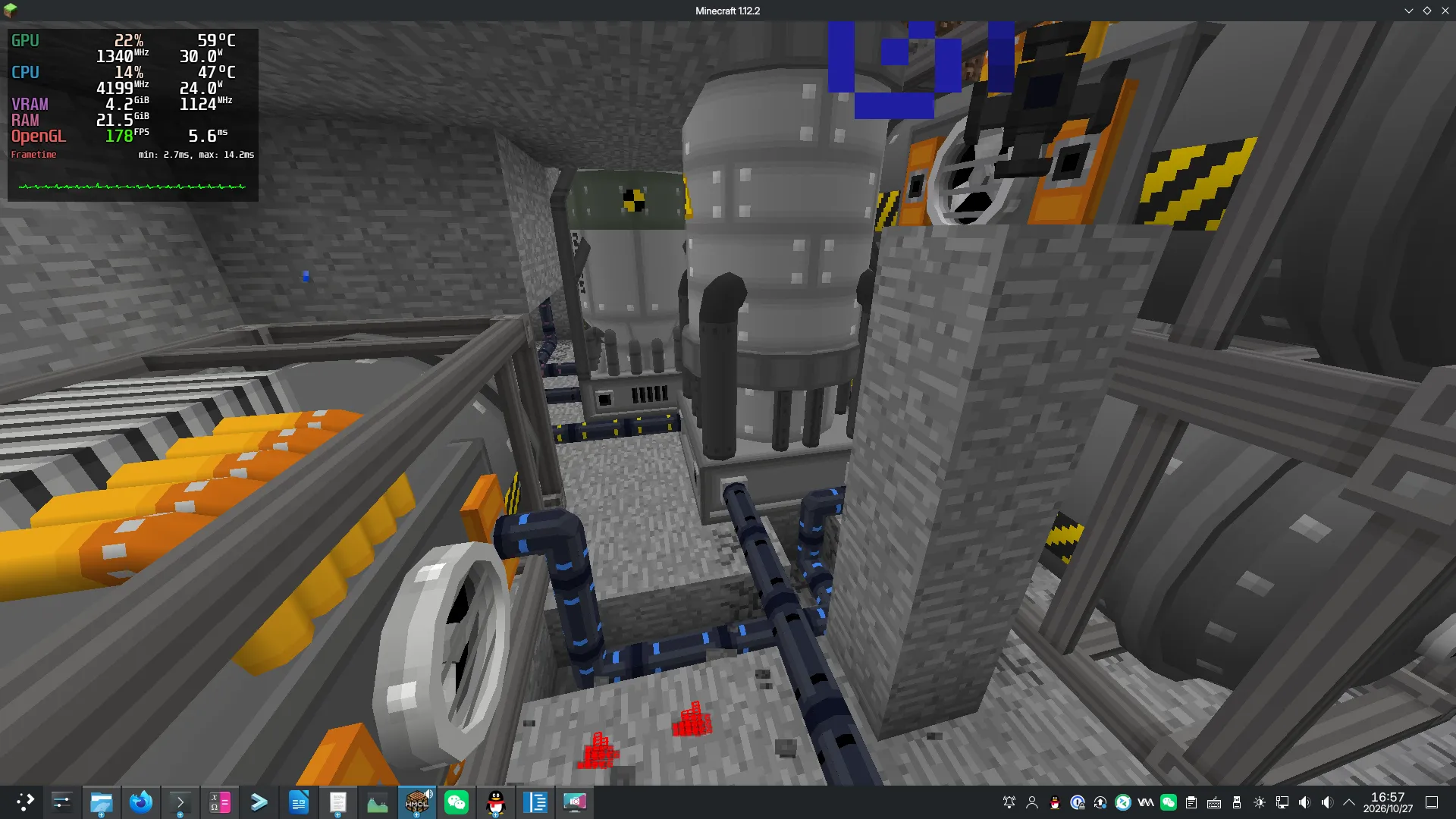
Processing regular crude oil in the vacuum refinery gives vacuum heavy oil, reformate, vacuum light oil and sour gas.
What I valued most was reformate, because fractioning it gives aromatic hydrocarbons and BTX.
I’ve already mentioned what aromatic hydrocarbons are for. BTX can be combined with phosgene (made from chlorine and unsaturated hydrocarbons) to make hard plastic bars.
This material is very useful in the late game: sodium-iron batteries need it, and so do the pyrolysis oven, the fusion reactor and the particle accelerator.
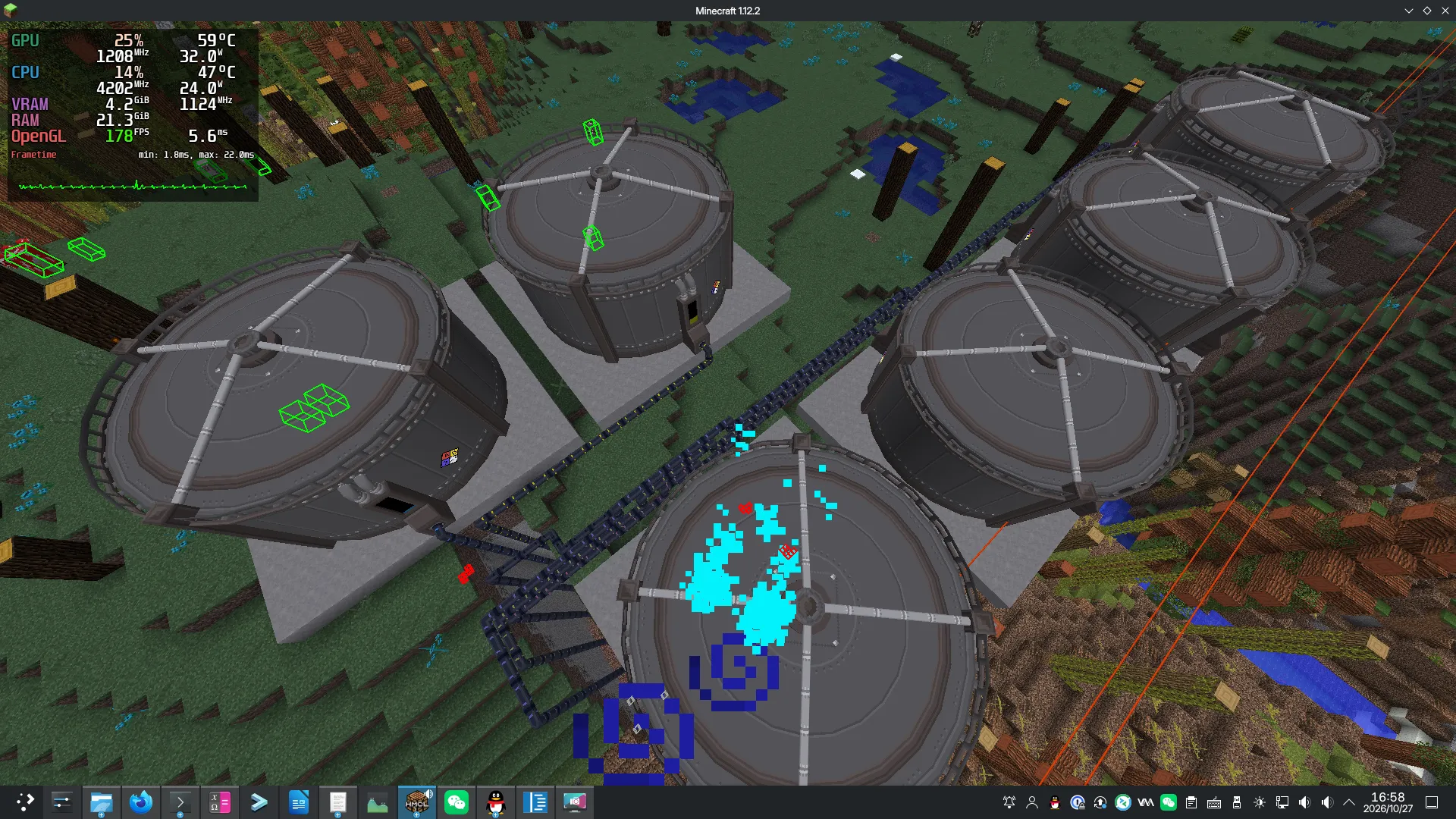
However, hard plastic bars aren’t the only option. There’s a substitute: PVC bars.
PVC bars don’t need BTX, but they do need cadmium powder, which can be obtained from mustard willow leaves.
Interestingly, mustard willow has to absorb environmental pollution to mature.
Since the hydraulic fracking tower pollutes anyway, I built a mustard willow farm near the oil field, trying to put that pollution to use.
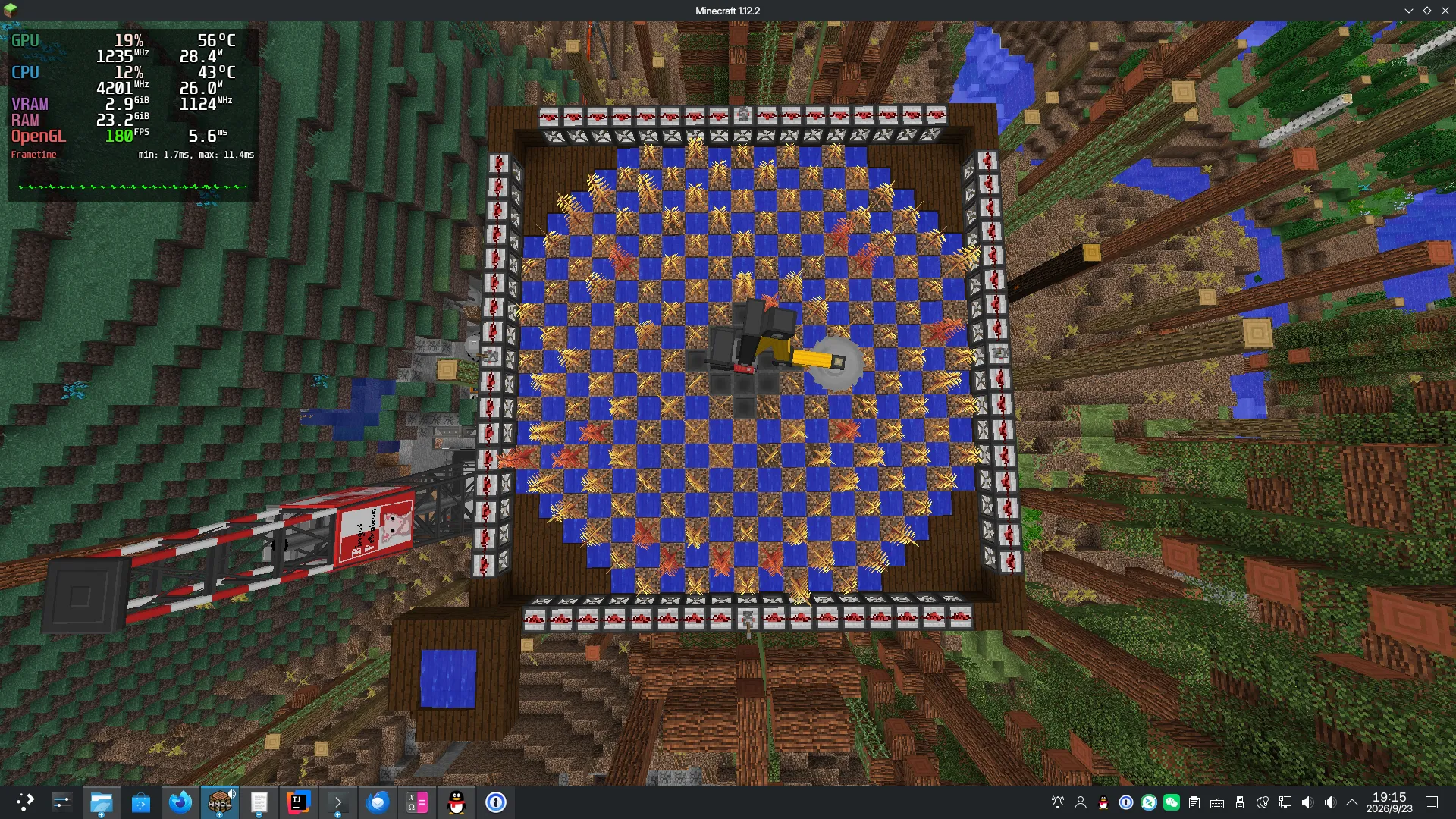
Unfortunately, the mustard willow farm wasn’t very efficient, and in the end I only made a handful of PVC bars.
Cohesion
Lots of things need ionized particles, such as schrabidic acid and quantum batteries.
But where do ionized particles come from? You need a fusion reactor.
Using tritium and helium-4 as fusion fuel gives ionized particles.
Tritium isn’t too hard to get; it mainly comes from irradiating lithium in the RBMK.
But what about helium-4? Helium-4 also needs a fusion reactor, plus deuterium.
To get deuterium, I built a deuterium extraction tower, which extracts heavy water from water.
Electrolyzing heavy water gives a little deuterium.
Since all of this depended on a fusion reactor, I decided to go all in and threw myself into building one.
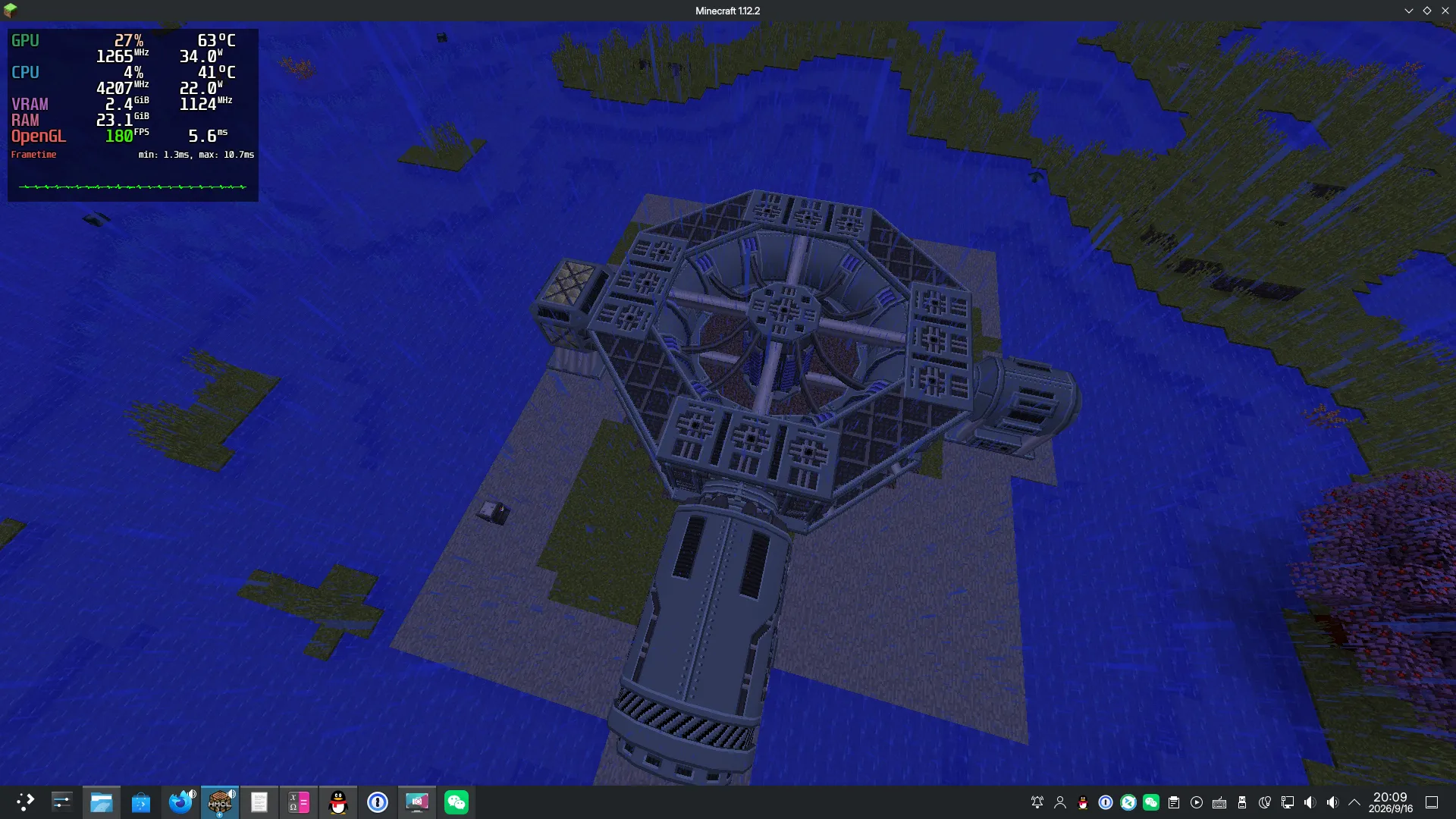
A fusion reactor can’t be used the moment it’s built; it needs a large amount of power to start up.
It also needs cold perfluoromethane for cooling, which is perfluoromethane pressurized to 2 PU.
Perfluoromethane needs petroleum gas, unsaturated hydrocarbons and fluorite, and the first two happen to be products of catalytic cracking.
As for power, I worried the old RBMK might not be able to handle it, so I later built a PWR.
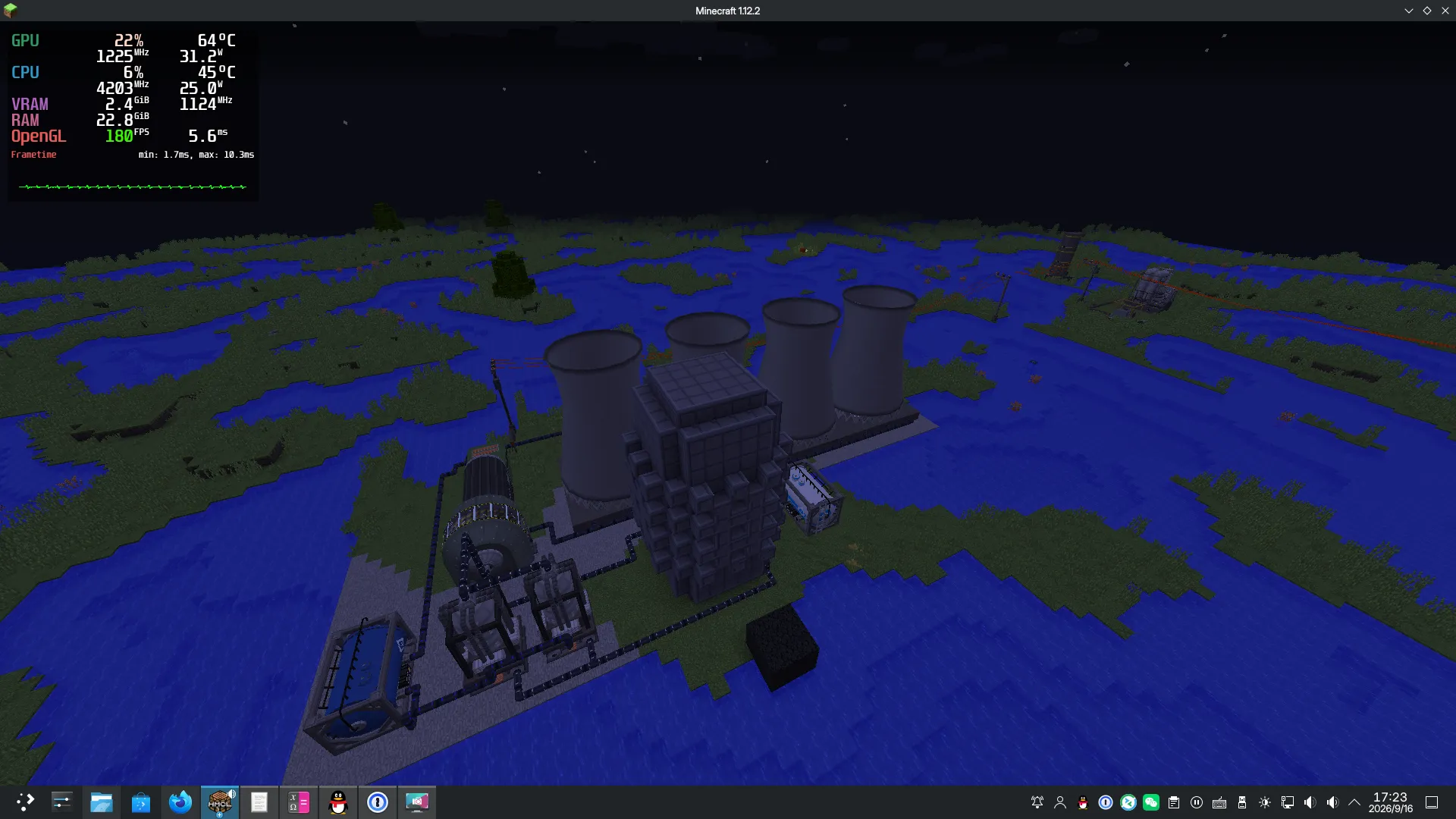
The best coolant for the PWR is liquid sodium, so I processed the light metal component of the bedrock ore and put the sodium I got from it into the liquefactor.
Liquid sodium sorted, but what about fuel rods?
In the PWR, medium-enriched uranium-235 fuel rods don’t work well, but I still needed to keep my uranium-235.
Since I also had quite a lot of thorium-232, I put it into the RBMK’s irradiation channels to turn it into thorium fuel.
I later used this thorium fuel in the ZIRNOX, and once it was spent, the PUREX could recover uranium-233 from it.
Then I made that uranium-233 into PWR fuel rods.
With the power and raw material problems solved, I started on helium-4.
To get helium-4, you can use deuterium alone as fusion fuel, or deuterium and tritium, which halves the deuterium consumption.
Once you have helium-4, using tritium and helium-4 as fusion fuel gives ionized particles.
With ionized particles, I could finally start duplicating Sa326.
A steady stream of Sa326 let me craft a set of schrabidium armor.
Schrabidium armor has great radiation resistance, and it gives buffs too.
I made part of the remaining Sa326 into low-enriched schrabidium fuel and stored the rest.
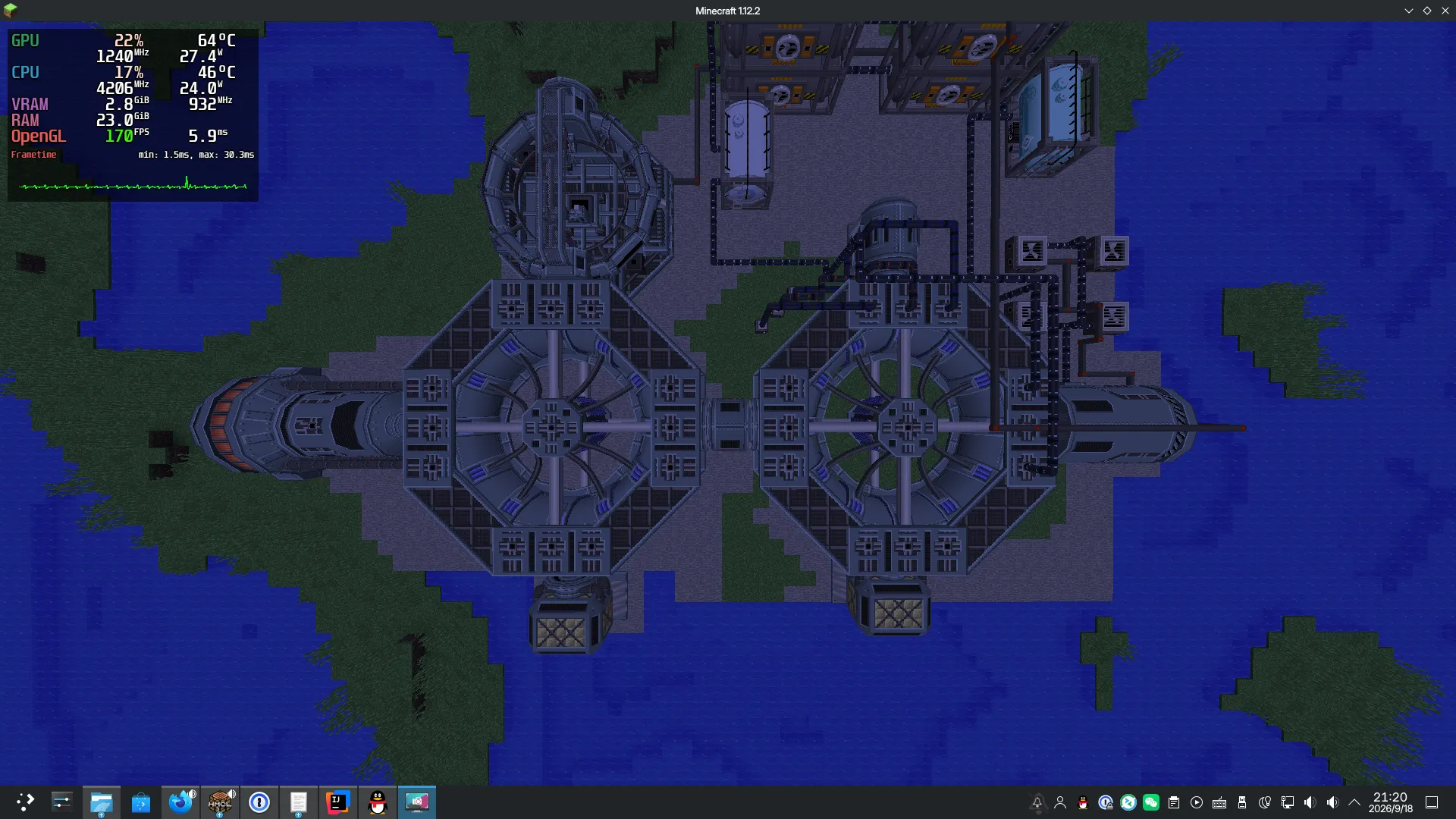
Later, I connected two fusion reactor vessels in series and added an MHD generator, and it could finally generate power.
The Strongest Fuel on Earth
In HBM’s Nuclear Tech Mod, balefire rocket fuel is the strongest of all fluid fuels.
But making balefire rocket fuel needs kerosene and balefire egg shards, and balefire egg shards need thermonuclear ashes.
How do you get thermonuclear ashes? The fusion reactor can make them from balefire rocket fuel and antimatter, but that turns into a chicken-and-egg problem.
Later I looked it up: you deplete an RBMK flashgold fuel rod, then break it down in the SILEX to get thermonuclear ashes.
Making a flashgold billet takes a gold-198 billet and antimatter.
Gold-198 ingots aren’t hard to get; you just irradiate gold ingots in the RBMK.
Antimatter is a bit harder.
Antimatter usually comes as a byproduct of the cyclotron, or from the particle accelerator, but I hadn’t built a particle accelerator yet.
On top of that, storing antimatter needs a magnetic antimatter containment cell, or it explodes.
Once I’d sorted out the containment cells, I didn’t know what to use the cyclotron for.
But since schrabidium fuel needs neptunium, I just kept making neptunium powder from uranium powder and lithium powder cubes.
After collecting some antimatter, I started making flashgold billets.
Next, I made them into RBMK fuel rods.
But at the time I must have had a brain fart: I put them right next to highly enriched uranium-235 fuel rods, and the reactor blew up.
I had no choice but to load a backup, losing some progress.
This time I was smarter and put them next to low-enriched australium fuel rods (the number of neutrons these fuel rods release doesn’t grow without bound), and it finally ran.
I left the game running for a whole day and night, and finally used them up.
After that, I used the thermonuclear ashes from breaking them down to make balefire egg shards, then mixed them with kerosene to get balefire rocket fuel.
Since I also had a jetpack, I used up the remaining fuel in it and refilled it with balefire rocket fuel.
I have to say, it flies a lot faster. No wonder it’s the strongest fuel.
I planned to put the remaining balefire rocket fuel into the fusion reactor, but then I found I didn’t have enough antimatter.
Sweetness in the Sour
Reformate gas is needed for the high-performance solvent used in processing bedrock ore and extracting fullerenes, the welded CMB steel plates the ICF needs, the welded osmiridium plates needed in the late game, and making saturnite ingots.
I used to get reformate gas mainly by fractioning vacuum light oil, but that clearly wasn’t enough for my needs.
Later I brought in the hydrotreater. Hydrodesulfurization produces desulfurized crude oil as its main product, plus sour gas as a byproduct.
Processing desulfurized crude oil in the vacuum refinery also yields reformate gas, which boosted my reformate gas output further.
By the way, the high-sulfur natural gas is called sour gas because it contains a lot of hydrogen sulfide.
Later, I found another bedrock oil deposit, set it up with a hydrotreater and a catalytic cracking tower, and started processing desulfurized crude oil.
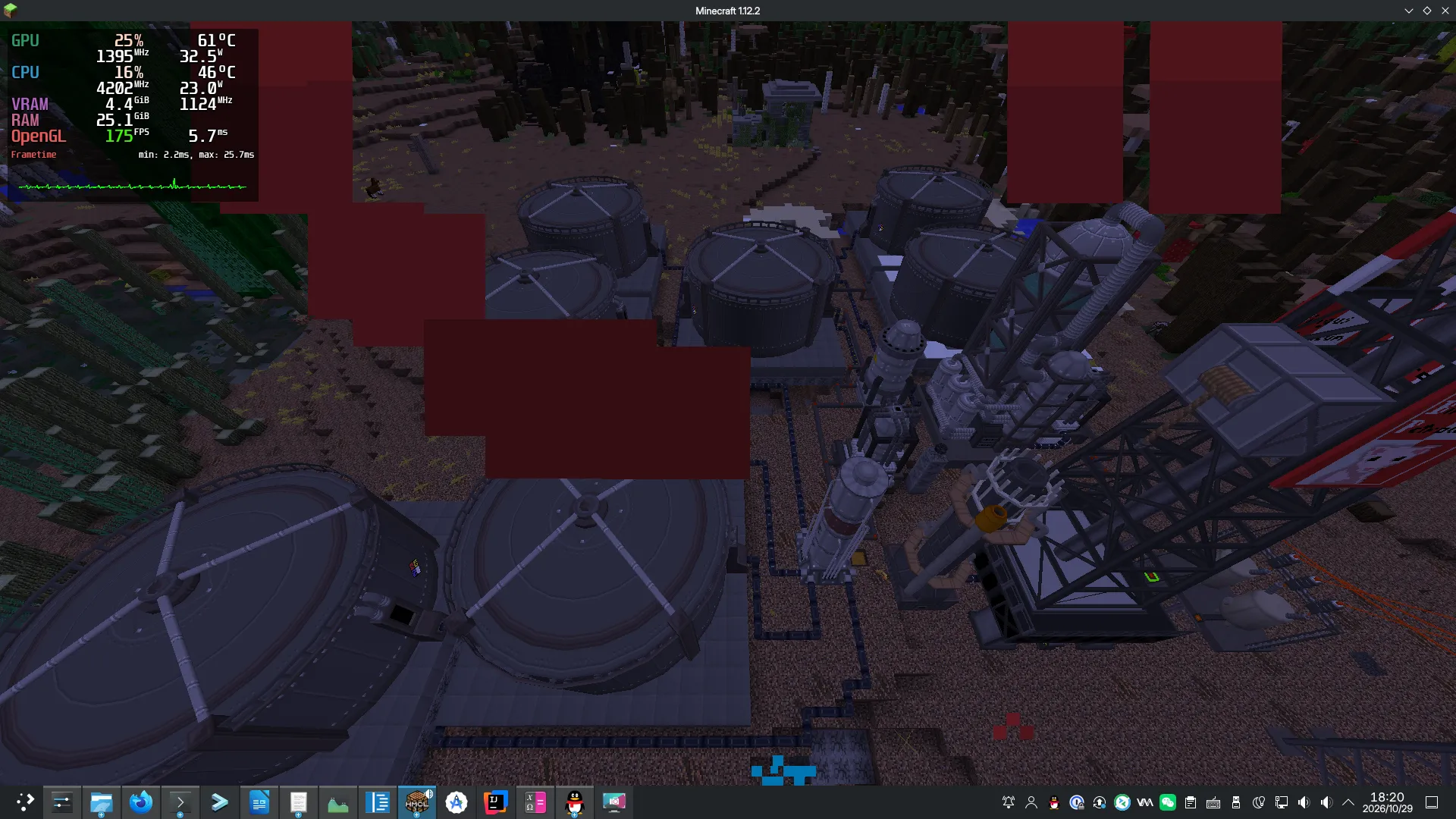
This route yields desulfurized naphtha, desulfurized light oil, aromatic hydrocarbons and unsaturated hydrocarbons.
Desulfurized naphtha can be fractioned into BTX and high-cetane diesel, while desulfurized light oil can be fractioned into high-cetane diesel and jet fuel.
For me, BTX was the more useful one. As for those fuels, they don’t perform as well as balefire rocket fuel, but at least they can still be burned, so they’re not wasted.
But just expanding the oil fields wasn’t enough. To make better use of all the oil products, I also built an oil processing base, with a radiolysis chamber, a catalytic reformer, a coker unit, and multiple fractioning towers for different recipes.
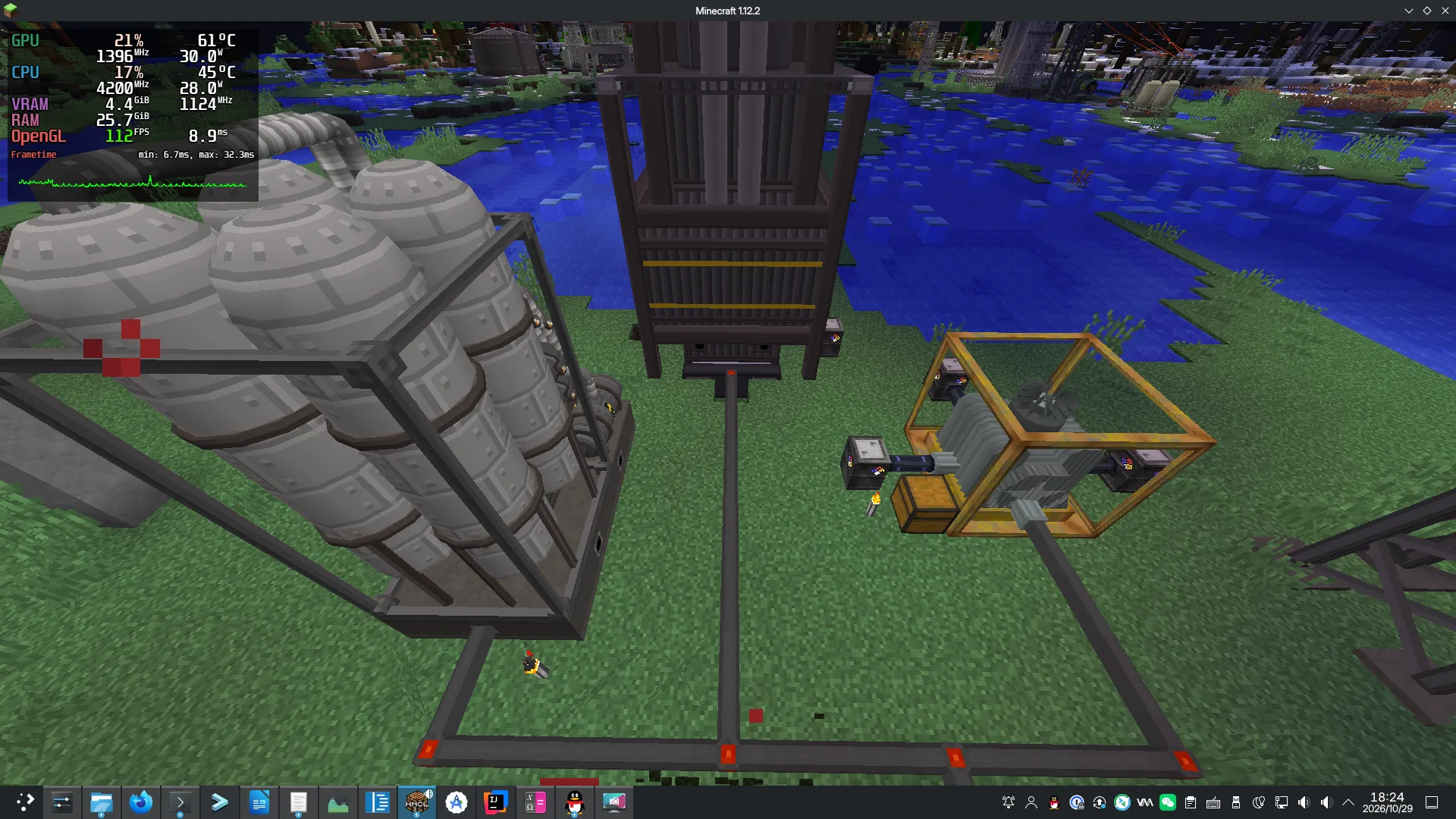
The radiolysis chamber is a special one.
It uses RTG pellets to crack oil products. It’s only half as fast as the catalytic cracking tower, but it generates power at the same time.
As it happened, a lot of polonium had piled up in the mass-production warehouse from processing actinide bedrock ore earlier. So I made that polonium into RTG pellets for the radiolysis chamber.
It’s not the most efficient option, but at least it put that stockpile to use.
The coker unit is valuable too. It turns oil products into petroleum coke and, depending on the recipe, also produces coker oil, coker naphtha or coker gas.
Coker gas is one of the ingredients for weapon steel, which is exactly what I’d need later to make weapons and take on bosses.
Besides that, the coker unit can also get reformate by processing vacuum heavy oil, which was good news for me too.
As for the catalytic reformer, it can turn one oil product into a more useful one.
For example, it can turn naphtha into reformate, or turn sour gas into sulfuric acid.
What’s more, whichever recipe it runs, it also produces a little liquid hydrogen. That liquid hydrogen can go into the hydrotreater or be saved for other uses.
And so, I gradually built up multiple oil processing routes.
In particular, by cracking reformate and running desulfurized crude oil through the vacuum refinery, I finally broke free of relying mainly on fractioning vacuum light oil for reformate gas.
Approaching the Speed of Light
Making more balefire rocket fuel needs a lot of thermonuclear ashes, and getting them in quantity means relying on the fusion reactor.
But where would the antimatter come from? The old cyclotron did give antimatter, but far too little.
That’s when I thought of the particle accelerator.
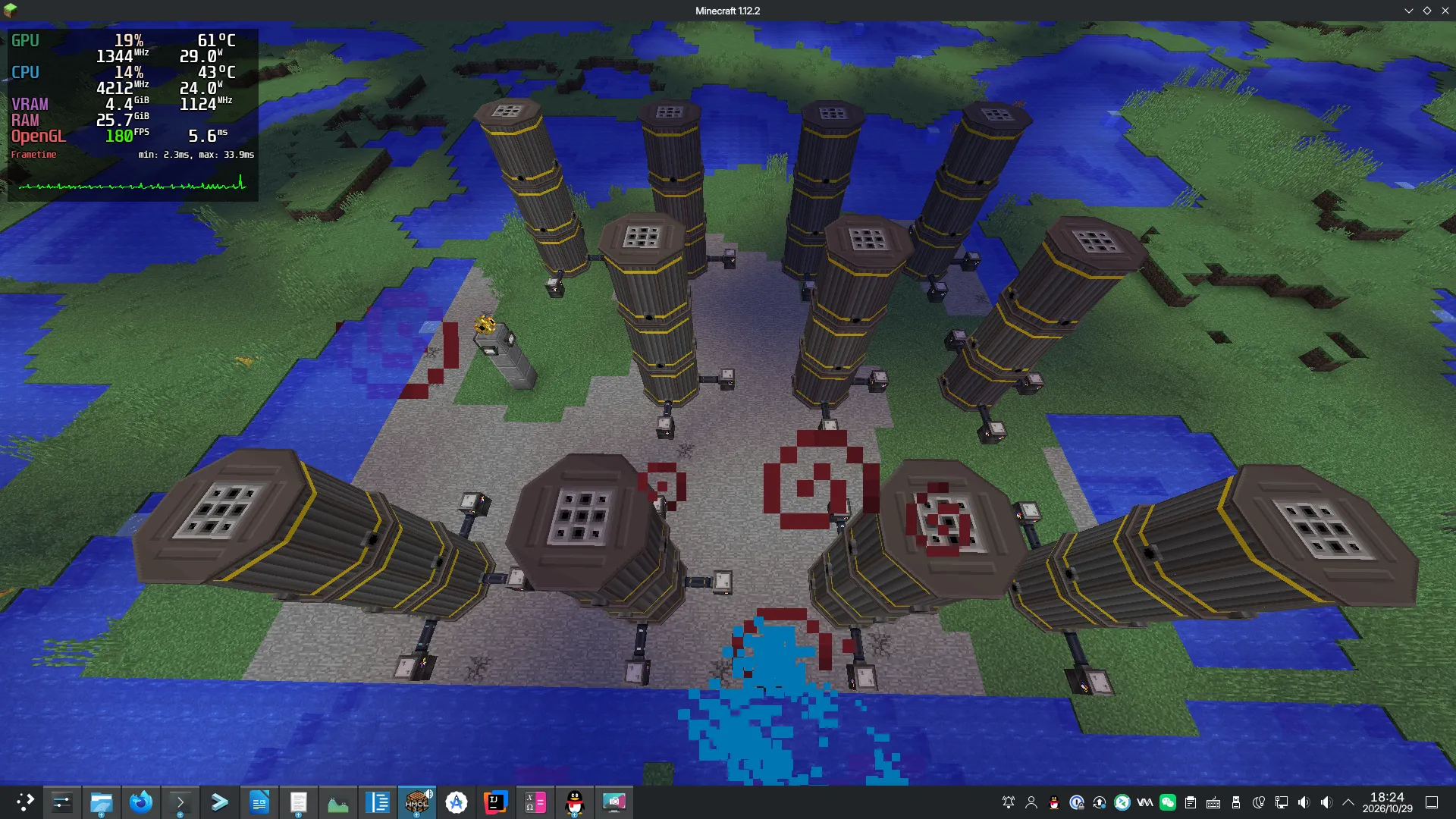
Building a particle accelerator is no easy task; it takes a huge amount of material.
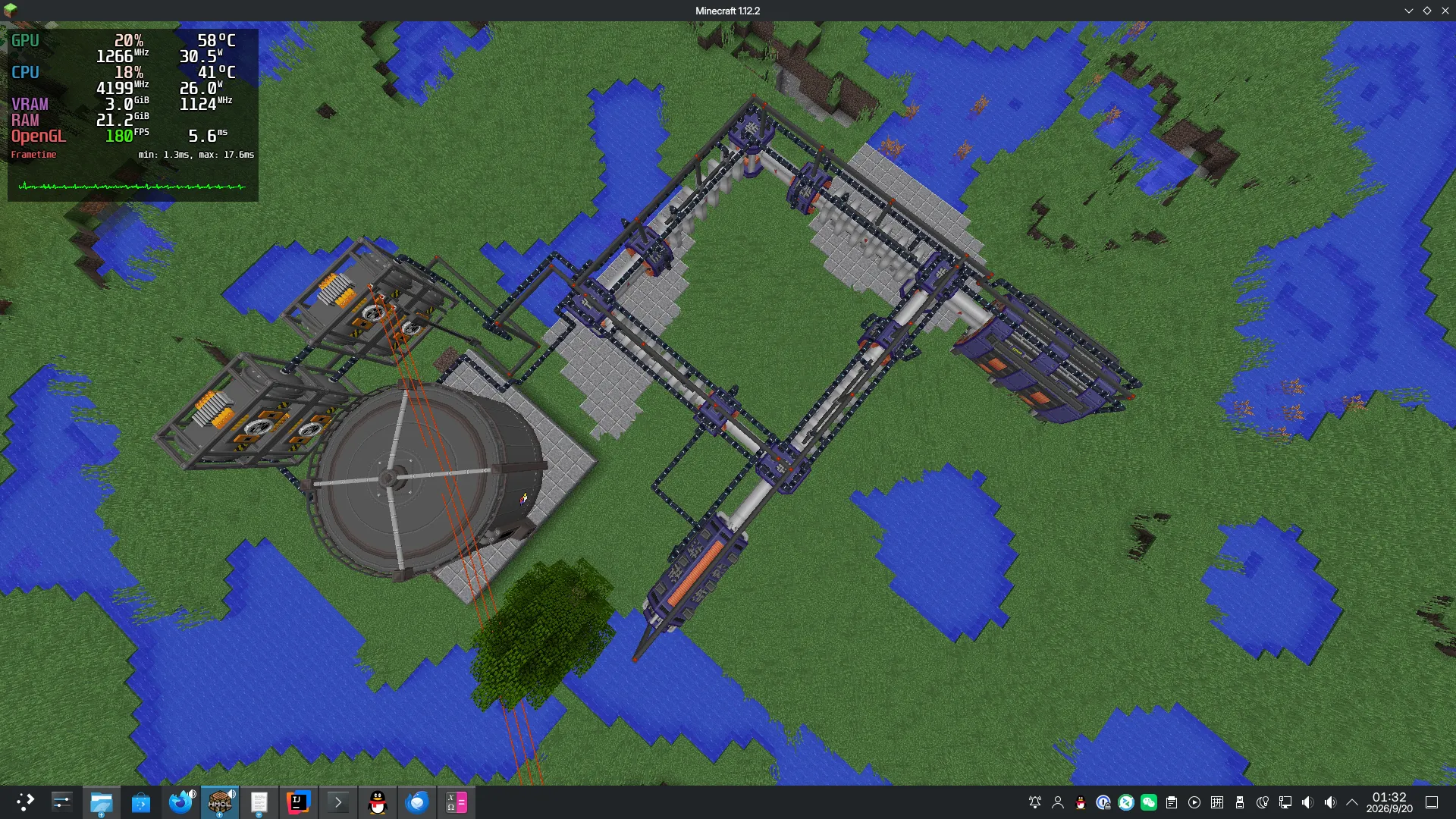
The initial single-stage particle accelerator was enough to produce antimatter.
Producing antimatter in the particle accelerator only takes copper powder, liquid hydrogen and ionized particles, and it uses noticeably less power than the cyclotron.
Not only that, the cyclotron gives at most 150 mB of antimatter per recipe, whereas the particle accelerator produces 1000 mB each time.
But the particles needed to irradiate uranium-238 ingots into Sa326, as well as the DNT the ICF needs, both required expanding the particle accelerator further.
So I kept expanding it, and built a simple redstone selector that uses two levers to represent four states: 00, 01, 10 and 11.
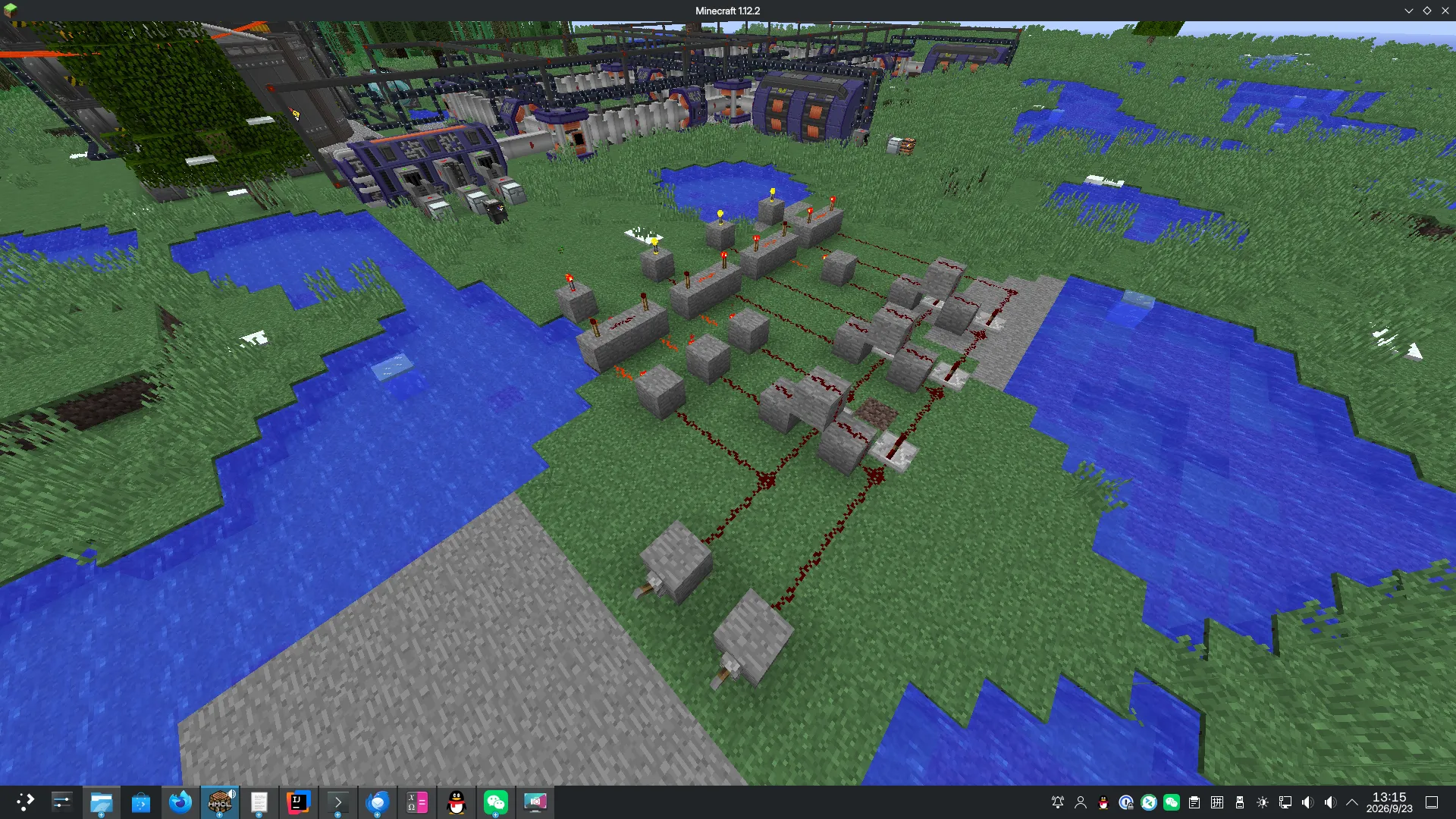
That way, I could decide which stage the particles should exit from.
But then I found a problem: the old redstone selector could only decide which stage the particles exit from; it couldn’t adjust the particles’ target momentum automatically.
This gave me a bit of a headache, because every time I ran a different recipe, I had to adjust the dipole magnets’ target momentum myself, which was a real hassle.
Later I found out that dipole magnets can be controlled by OpenComputers, so I took the chance to explore OpenComputers.
After crafting the parts I needed, I modified the old redstone selector so that a control system decides which line to activate.
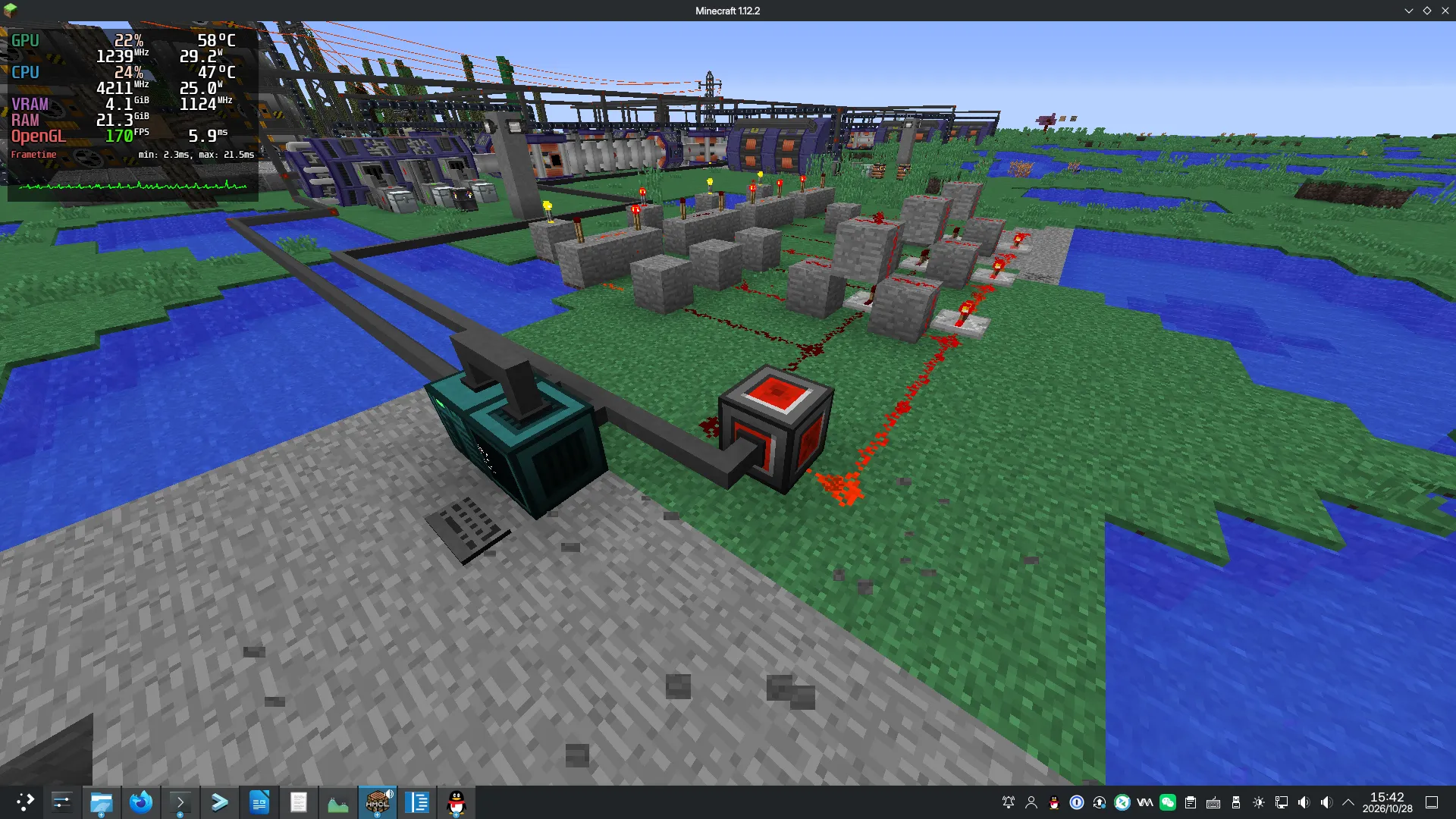
But I’m not familiar with Lua, so I explained what I needed to ChatGPT and had it write the control script for me.
As the actual situation kept changing, I also had ChatGPT revise the control script several times to fit my requirements.
With the control system in place, I only have to enter the target momentum, and it automatically adjusts the dipole magnets’ parameters and operates the redstone selector to decide which stage the particles exit from.
A Puddle of Sludge
Lots of things need CMB steel, and CMB steel needs poisonous mud.
Where does poisonous mud come from? It’s a byproduct of the Watz power plant.
The Watz power plant needs fuel pellets containing Sa326 to start the reaction, while the outer ring can use regular fuel pellets (such as uranium or plutonium) or absorber pellets (such as lead or boron).
The Watz power plant is modeled on the pebble-bed reactor. In the game, it won’t melt down because of coolant circulation problems, but that doesn’t mean it’s perfectly safe.
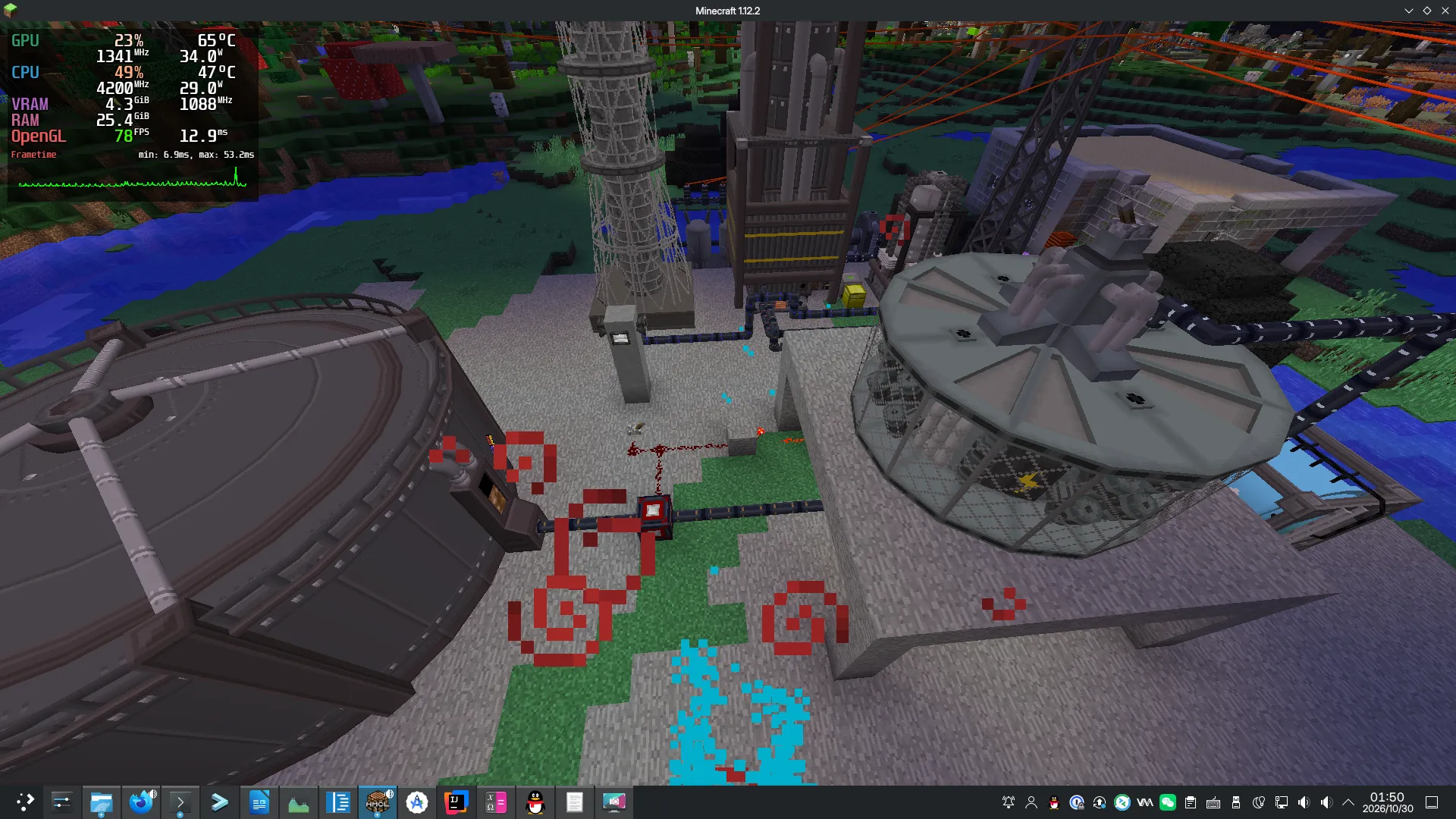
If the poisonous mud overflows, it melts down, spraying poisonous mud everywhere (I call it “the sludge burst”), which is truly nauseating to look at.
Poisonous mud can be used to make CMB steel, or broken down in a gas centrifuge for lead powder and iron powder.
At first I wanted to stockpile poisonous mud, so I left the game running, but I underestimated how fast poisonous mud is produced.
Because I left it running too long, the Watz power plant had a sludge burst.
I took one look and thought: why is there so much disgusting stuff everywhere? I knew something was wrong.
I checked the huge storage tank next to the Watz power plant, and it was already full of poisonous mud.
With no other choice, I had to load a backup.
This time I wouldn’t make the same mistake. When the poisonous mud was about to fill the tank, I pulled the lever next to it.
This switch diverts the poisonous mud to the coker unit, which turns it into solid mud bricks.
And since the conveyor inserter can be set to automatically destroy overflowing items, the problem won’t come back even if the chest fills up.
Another Path to Fusion
The old fusion reactor generated a respectable amount of power, but building the Gerald construction android and DFC components later on also requires stellar flux.
Stellar flux is not only a crafting material for these, but also a fuel for the fusion reactor. Fusing it produces 50 MTU/t of plasma energy, and crafting with it happens to need exactly that much.
That raised a problem: to save all the plasma energy for crafting, I had to remove the MHD generator.
But then where would the power to sustain fusion and run the crafting equipment come from? And how would I get stellar flux in the first place?
The PWR and the RBMK couldn’t meet the power needs for crafting these things, and stellar flux happens to be a byproduct of running the ICF, so I had to bring it out.
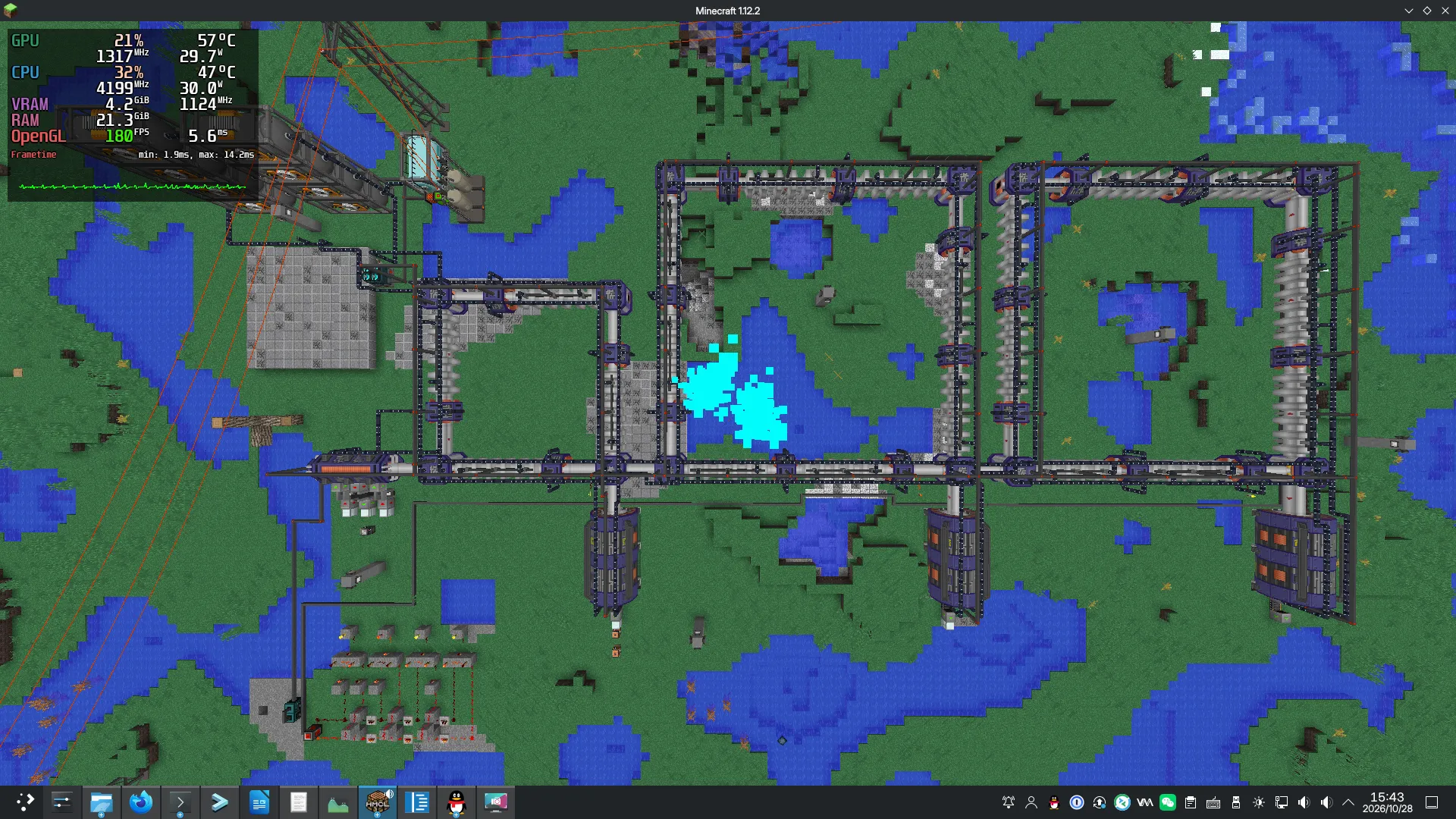
But having the idea wasn’t enough. The ICF is a behemoth, and it takes a lot of material.
The ICF has two parts, the reactor itself and the laser, and neither is easy to deal with.
I spent an afternoon collecting materials and finally managed to piece together the ICF’s reactor and laser.
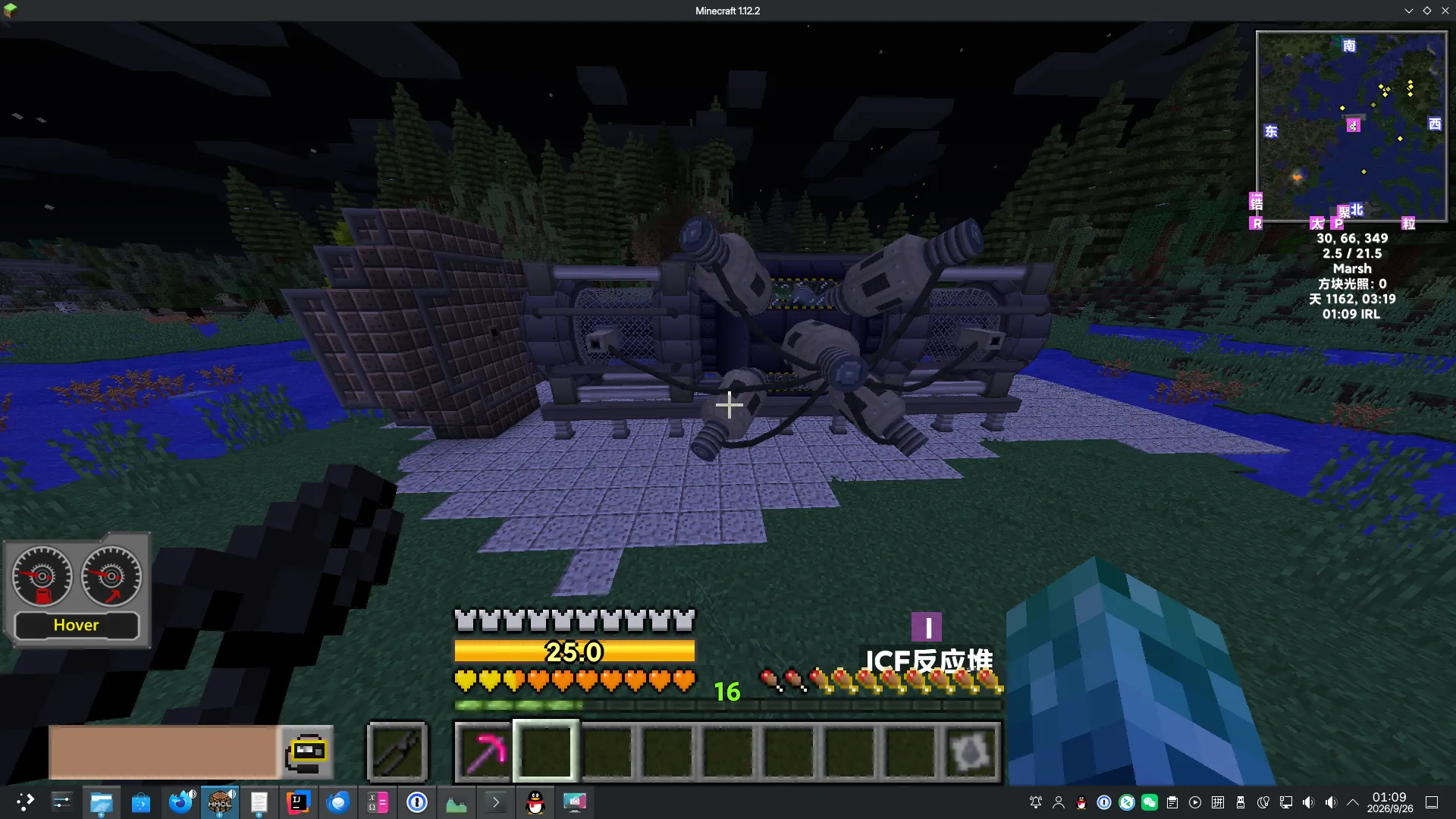
Unlike the old fusion reactor, the ICF mainly produces steam through coolant, heat exchangers and boilers, and then generates power with steam turbines, instead of relying on an MHD generator to convert energy directly.
For the ICF, liquid lead is the best coolant, and I happened to have a lot of lead at home, so I put it into the liquefactor.
But the ICF produces a huge amount of heat and can boil an enormous amount of water. Using cooling towers alone to handle the low-pressure steam from the turbines clearly wasn’t enough.
So I brought in high-power steam condensers.
High-power steam condensers need power to run too, but what’s that compared to the ICF’s output?
The particle accelerator helped a lot as well, because ICF fuel pellets can be catalyzed with muon capsules, which drastically lowers the energy needed for the reaction, and getting muon capsules requires the particle accelerator.
The ICF’s power output isn’t as sustained as the RBMK’s, and much of the time it produces far more power than I actually need. But the fuel in ICF pellets is usually cheap stuff (like deuterium, tritium, lithium, beryllium and boron), so there’s nothing to worry about.
At first, though, the ICF only had a single-layer laser, and its output wasn’t enough to ignite the best boron-sodium pellets.
So I tallied up the materials, spent quite a while on it, and finally gave the ICF two four-layer lasers.
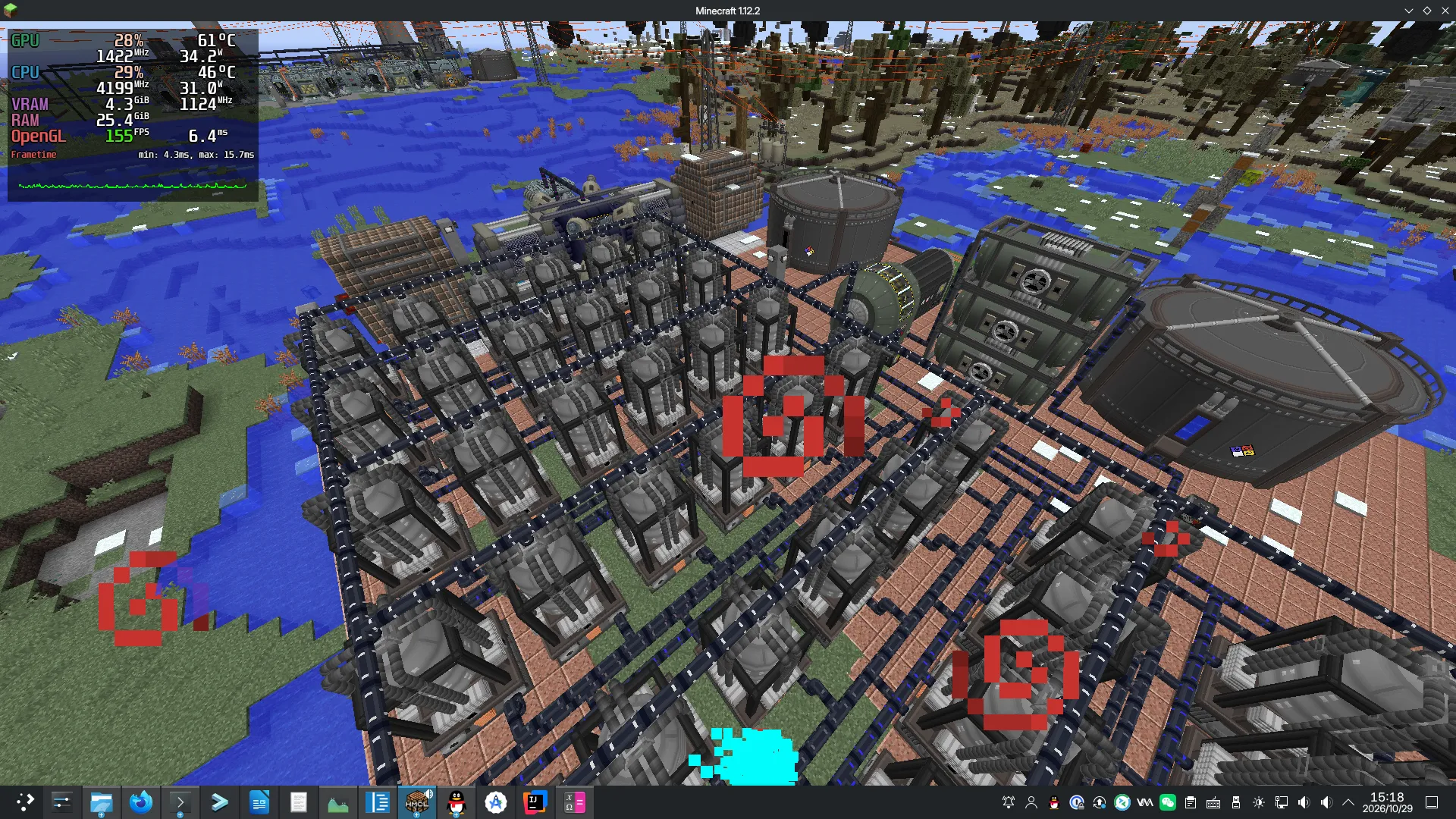
But once the reaction started, I noticed a problem: why wasn’t it generating much power?
I did the math: after subtracting the power used by the two ICF lasers and the high-power steam condensers, there was nowhere near enough to craft the Gerald construction android.
At first, I thought there wasn’t enough liquid lead.
But even after I’d used up almost all the lead at home, the power output barely went up.
Then I used a flow meter to check the flow in the liquid lead pipes, and found it was nowhere near the limit.
But there was so much liquid lead in the tank, so why was the flow so low?
I changed the tank’s I/O mode so it no longer accepted fluids (only output them), and the flow finally hit the limit. Now there was far too much liquid lead.
I had to collect the excess liquid lead in fluid barrels. Luckily, liquid lead can go into the solidifier and turn back into lead ingots.
At last, the ICF generated more than enough power for the crafting.
After that I left the game running next to the ICF for a while and collected enough stellar flux. Next up was collecting the other materials.
A Fresh New Look
After so long spent on industrial construction, I decided to set tech progress aside for a while and spend some time renovating my underground storage and lab.
Nobody was going to nuke the place, but I still used the most blast-resistant material: reinforced CMB steel bricks.
Collecting the materials wasn’t hard. The hard part was redoing huge stretches of walls, floors and ceilings with the new material.
It took a long time, but the lab and the storage were finally renovated, and then I spent a bit more time installing lights in both.
Since the lab is so big, I also built an “internal road” inside it. That was the only thing the bitumen was ever used for.
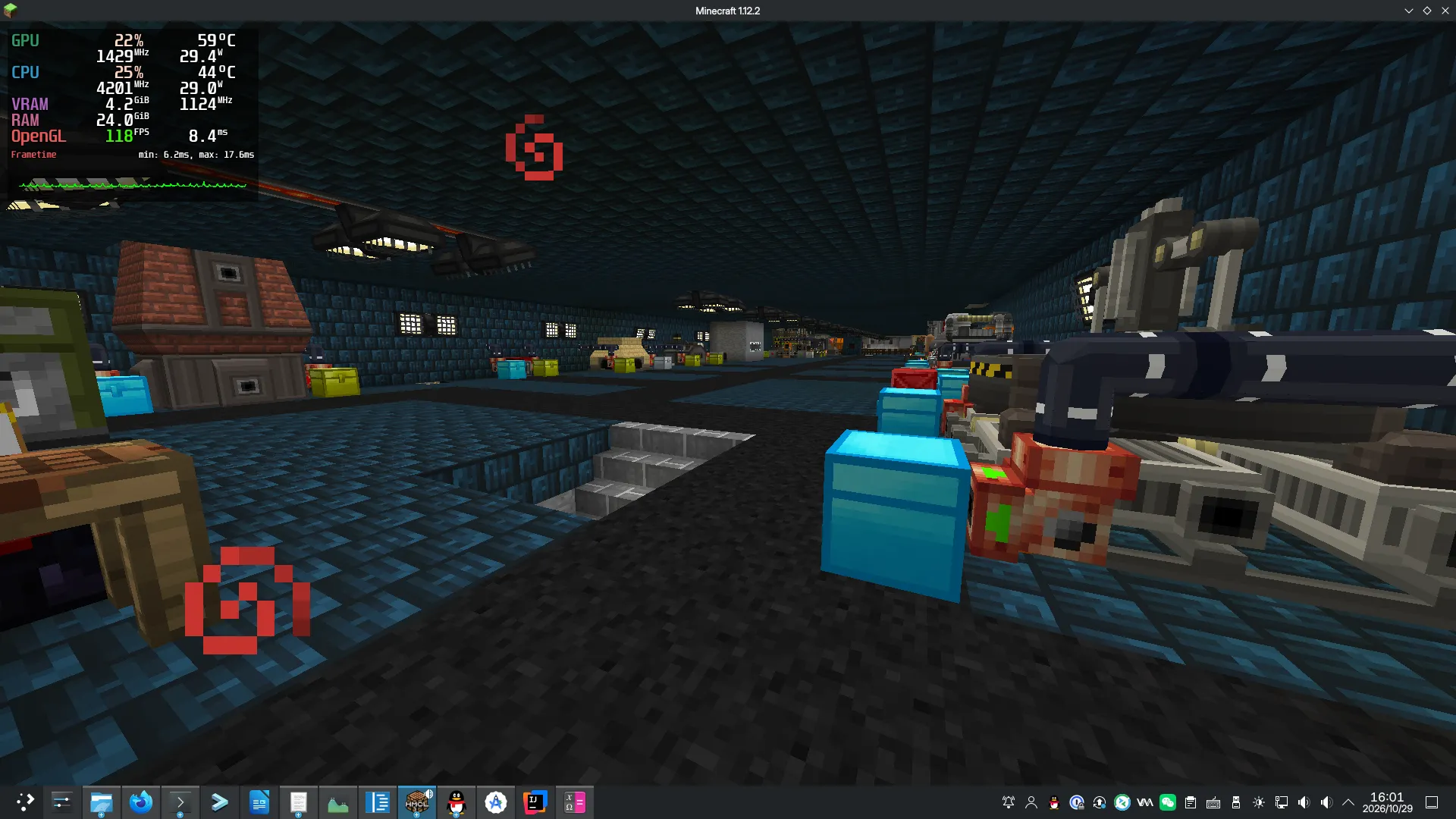
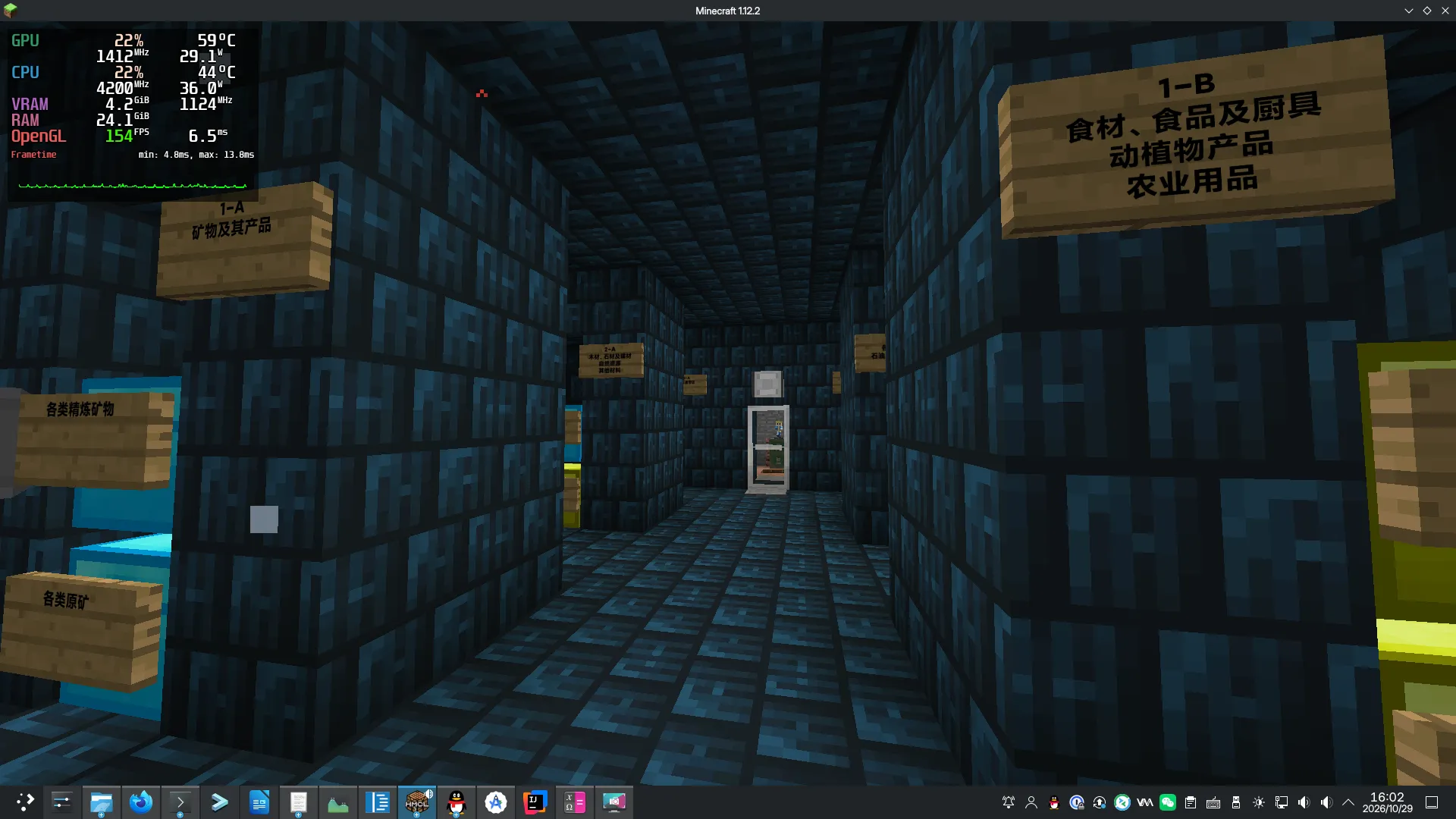
However, since I didn’t have enough building materials, and I wanted to stop while I was ahead, I didn’t renovate the mass-production warehouse or the various sunken workspaces in the lab (every extra-tall machine has one, beneath the lab floor).
The only difference is that the mass-production warehouse also has an “internal road” much like the lab’s.
The Space Program Takes Off
The Gerald construction android is a must in the late game, but it also needs more materials than anything else in HBM’s Nuclear Tech Mod, not just in quantity but in variety too.
The material it needs most is printed silicon wafers.
At first I took the old route: acidize sand into fiberglass, melt that in the electric arc furnace into silicon wafers, and finally press them into printed silicon wafers.
But the old route quickly hit a dead end, because the sand I’d stockpiled was limited, and I needed to keep some for concrete.
And the bedrock ore near my home had too little of the non-metal component, and I had no idea where the next suitable bedrock ore was.
At first I wandered around with a bedrock ore scanner, but it can only tell you the composition of bedrock ore nearby, not where the bedrock ore actually is.
So I fell back on my old trick: digging a deep mineshaft in the area I thought most promising, then tunneling along the bedrock layer in different directions.
But groping around in the dark is inefficient in the end, and it wasn’t a real solution.
So I decided to launch a depth scanning satellite.
Everything else was easy to collect, but I was still missing flight simulation data.
As far as I remembered, last time I played survival you didn’t need this. Looking it up, I found it’s something the new version added, and the rocket recipes changed along with it.
So I built a supercomputer to get flight simulation data.
The supercomputer offers three counterintuitive options. The slowest one (15 minutes) only needs water as coolant but has a 95% success rate, while the fastest one (1 minute) needs helium-4 yet only has a 25% success rate.
Given my usual bad luck, I picked the slowest one.
Whether the success rate was just that high or I wasn’t that unlucky after all, after a long while I had enough flight simulation data, and not a single run had failed.
With all the materials collected, the next step was building the rocket launch pad.
The launch pad is very tall, so before building it I refueled my jetpack, so I wouldn’t fall out of the sky halfway through.
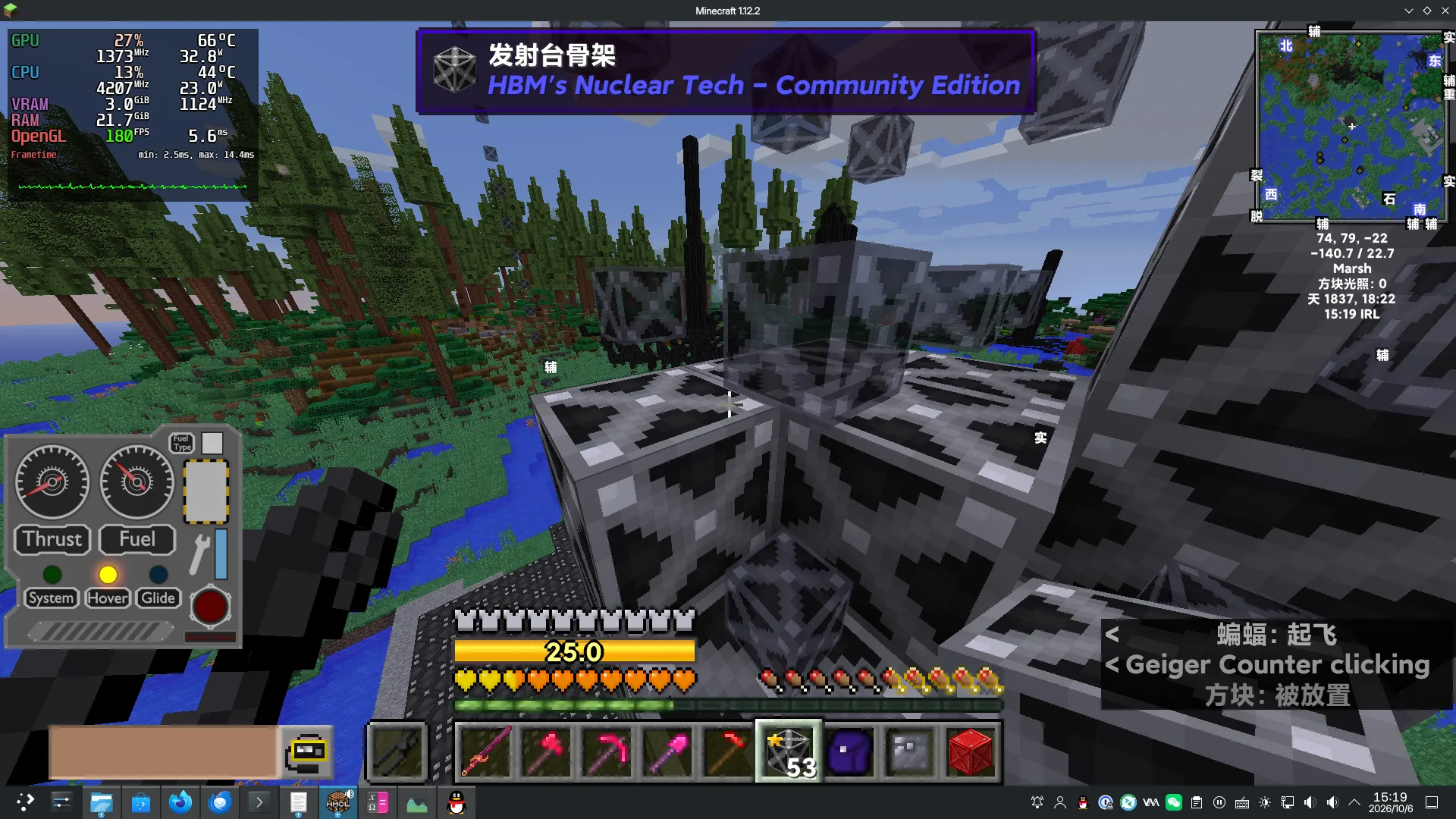
With the launch pad built, it was time for the most exciting moment: launching the rocket.
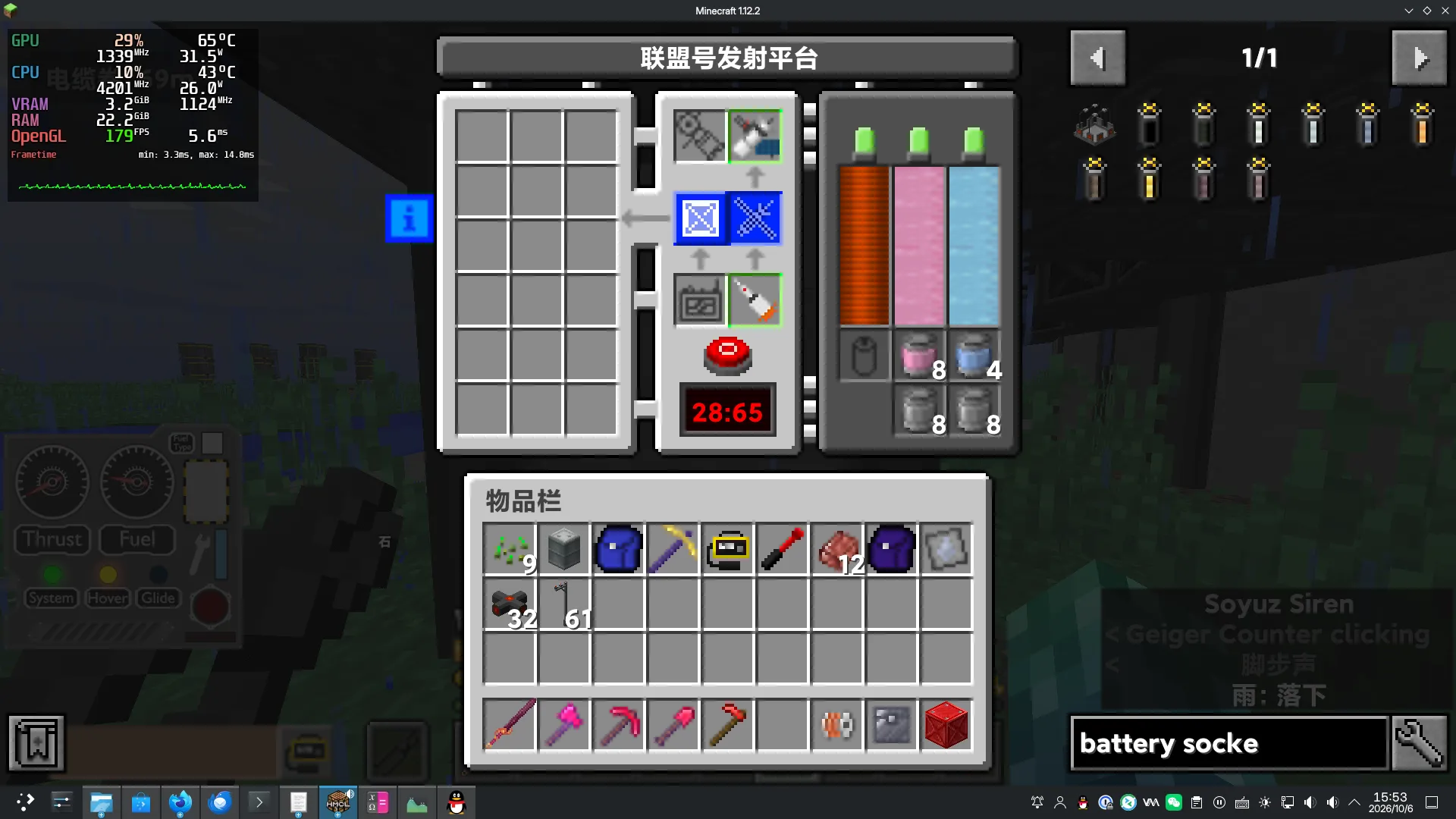
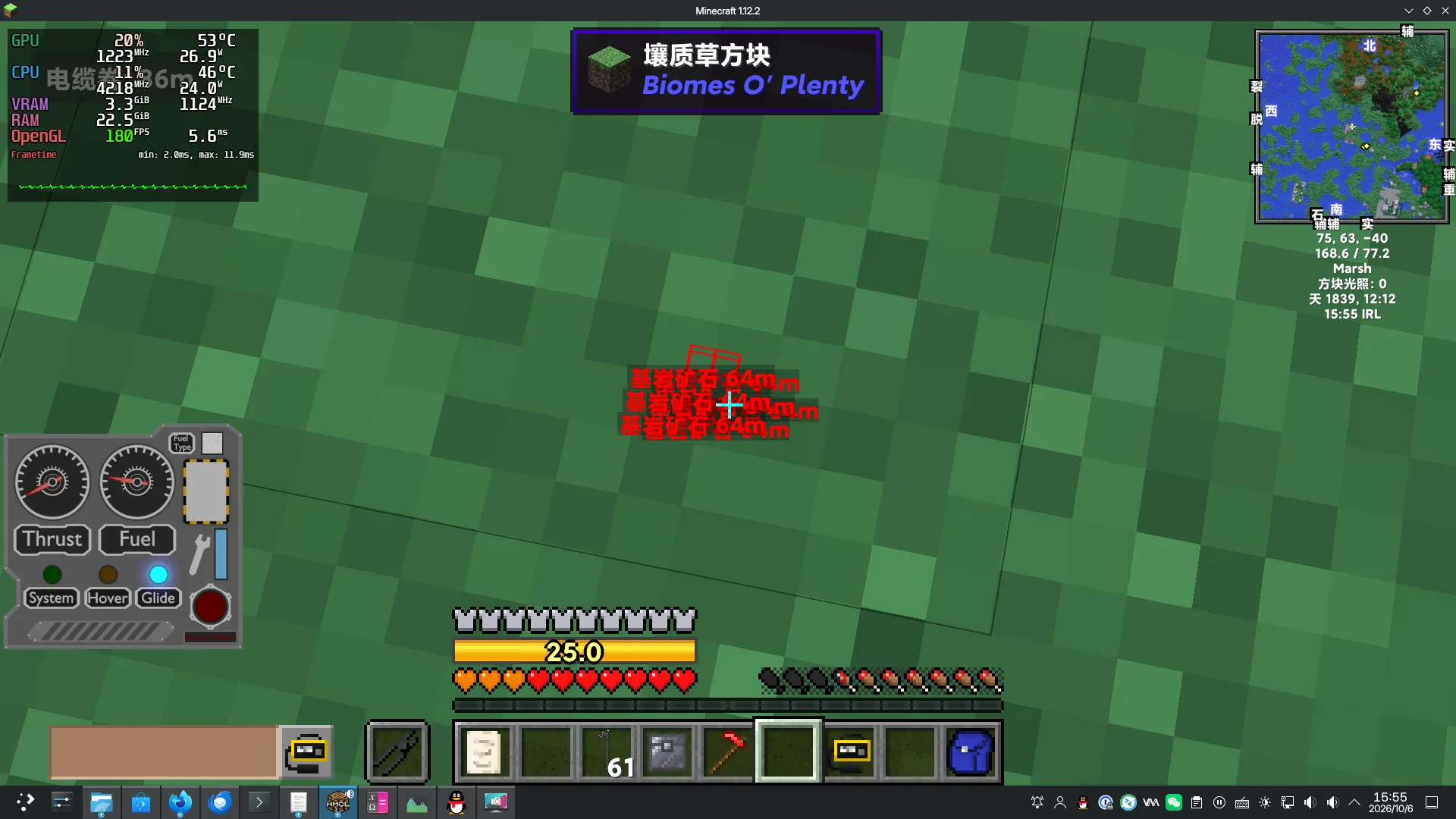
Not long after the launch, I could finally see whether there was bedrock ore under my feet, along with other resources like bedrock oil deposits.
Now I no longer had to dig mineshafts to look for bedrock ore.
Sending the Little Guy into the Sky
With a suitable bedrock ore found, I started collecting that huge batch of materials.
The Gerald construction android is like a massive order where every material is bought by the ton.
I spent a long time tallying up the materials, then sorted them from easiest to hardest.
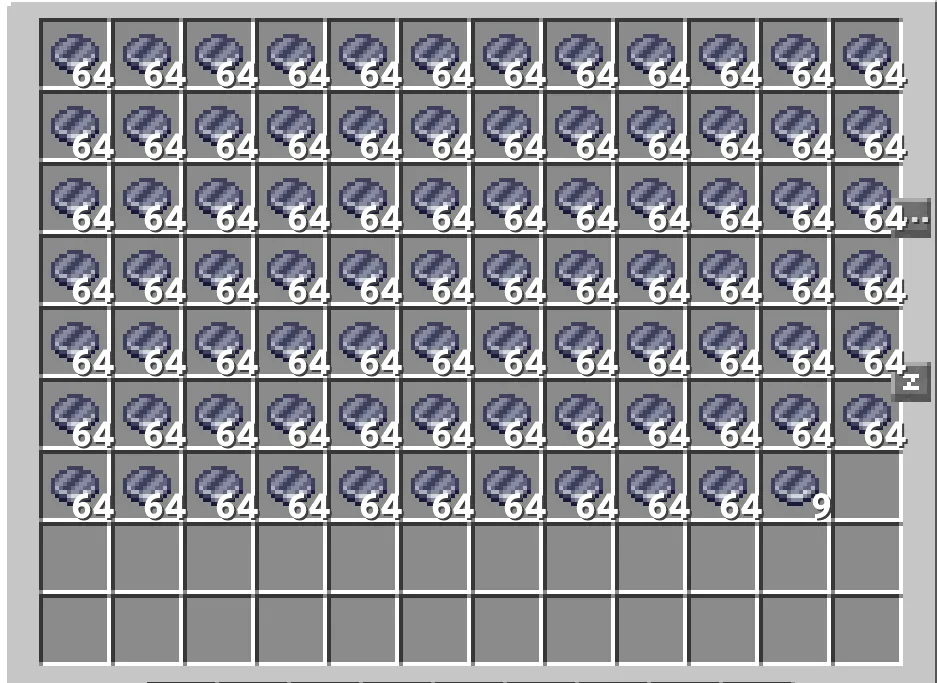
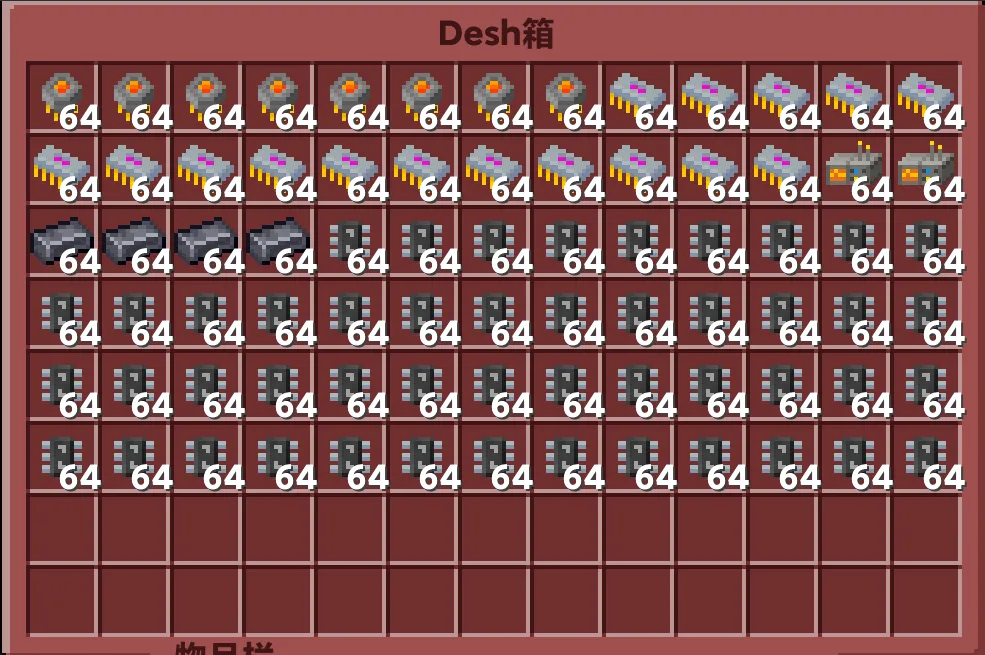
The easy batch was done quickly. Next came the two hardest: nuclear charges and quantum computers.
The whole process was pretty tedious, so I’ll only show part of it.
After a long stretch of preparation, I’d collected every material except the UFO coins.
After that, I defeated the Mask Man, the Balls-O-Tron and the Martian invader ship, one after another, and got the UFO coins.
For the Martian invader ship, I used a trick I learned online: getting it to fight the Balls-O-Tron.
This trick takes a lot of skill, but in the end the Martian invader ship did lose to the Balls-O-Tron, and I finished off the nearly dead worm with my remaining ammo.
At this point, I’d already passed the progress of my last world in less time, and I think the biggest credit goes to my firm resolve this time.
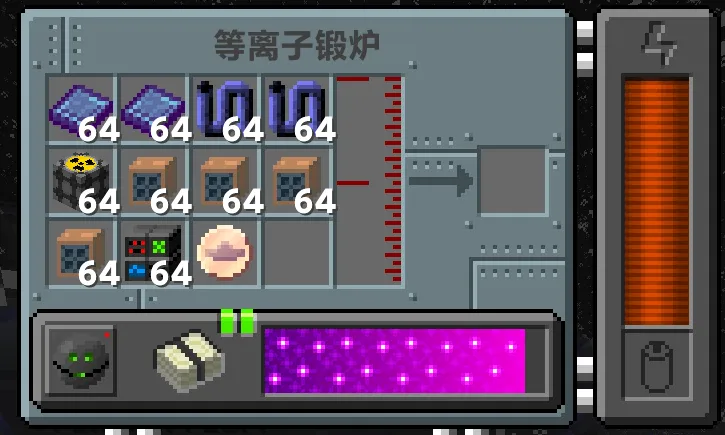
Then I spent a little time (compared with collecting all those materials earlier) collecting materials for the rocket and the orbital module, including flight simulation data, of course.
Finally, the Gerald construction android lifted off.
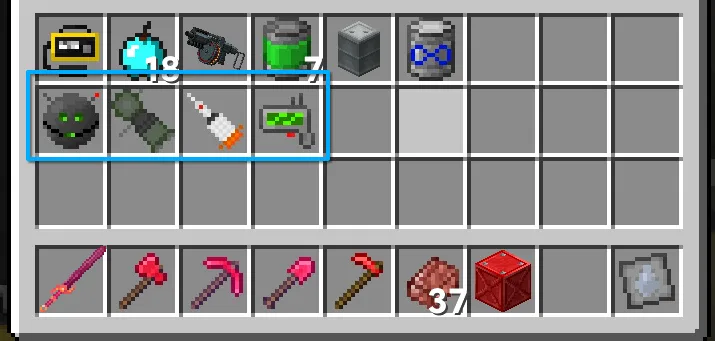
Once it was up there, success awaited me.
Of course, success always comes at a price.
When I called it back (that is, detonated it) from a place far enough from home, a firestorm set me on fire instantly. Putting up with the distorted vision that comes with losing health, I rushed back home in the direction of my base.
Once home, I waited in a pool for 20 minutes for the firestorm to end.
When I went upstairs, I found nothing was left growing around my home, and the wooden structures of the house and the vertical farm had been reduced to ruins.
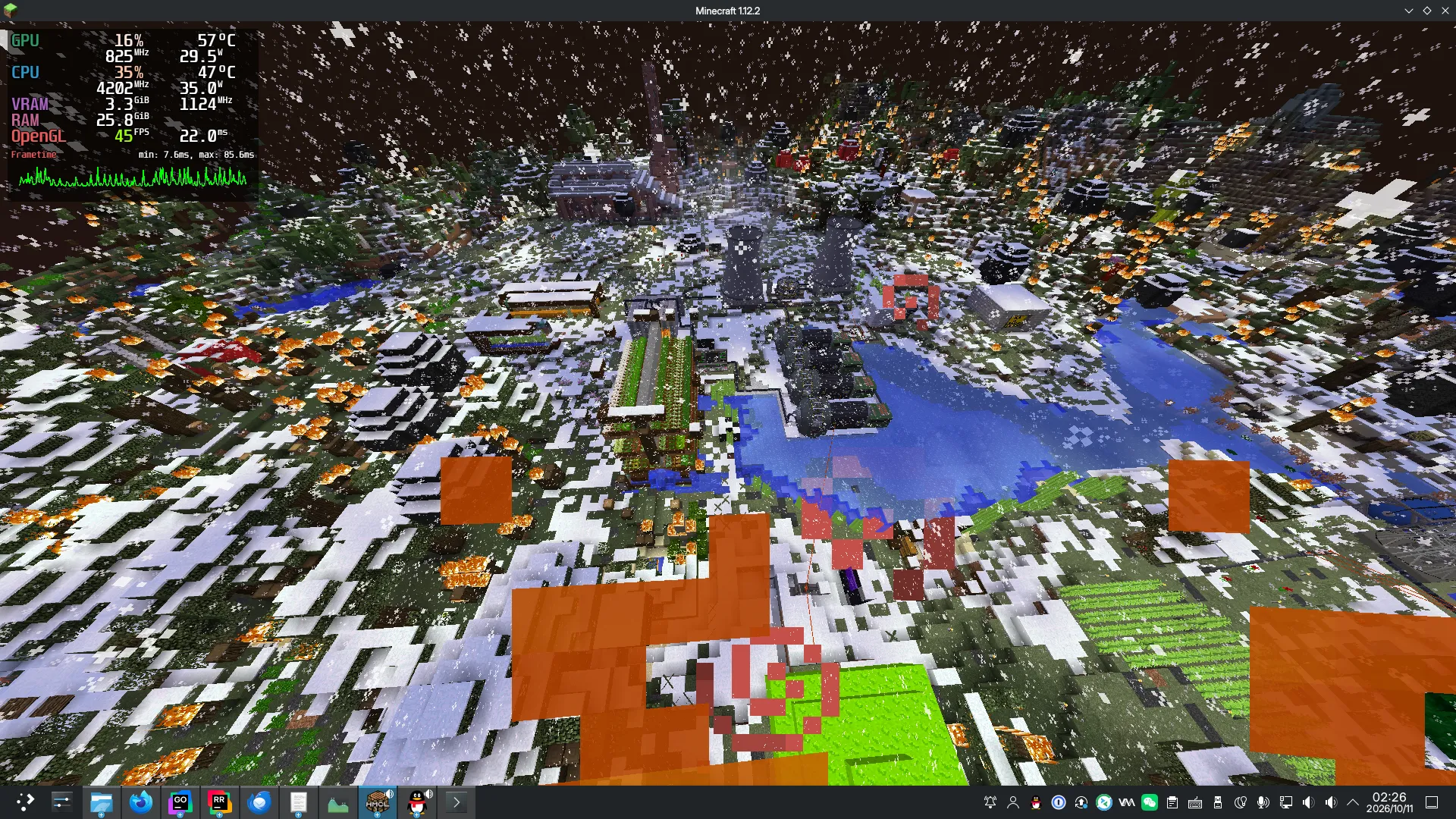
Having learned my lesson the hard way, I decided to rebuild the house and the vertical farm with concrete and laminated glass.
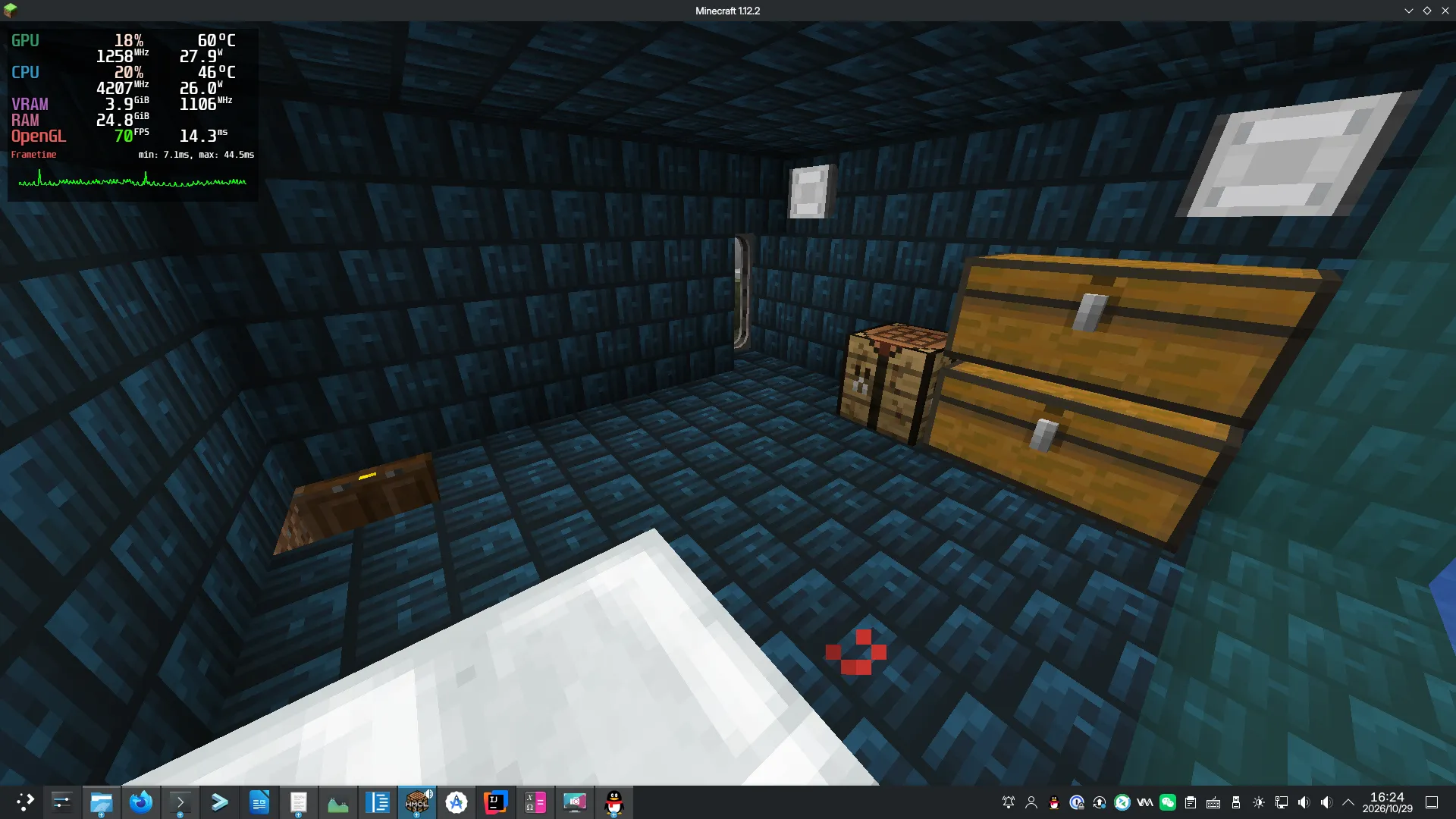
After my renovation, the vertical farm became a “vertical greenhouse”, which seems to look a bit more industrial.
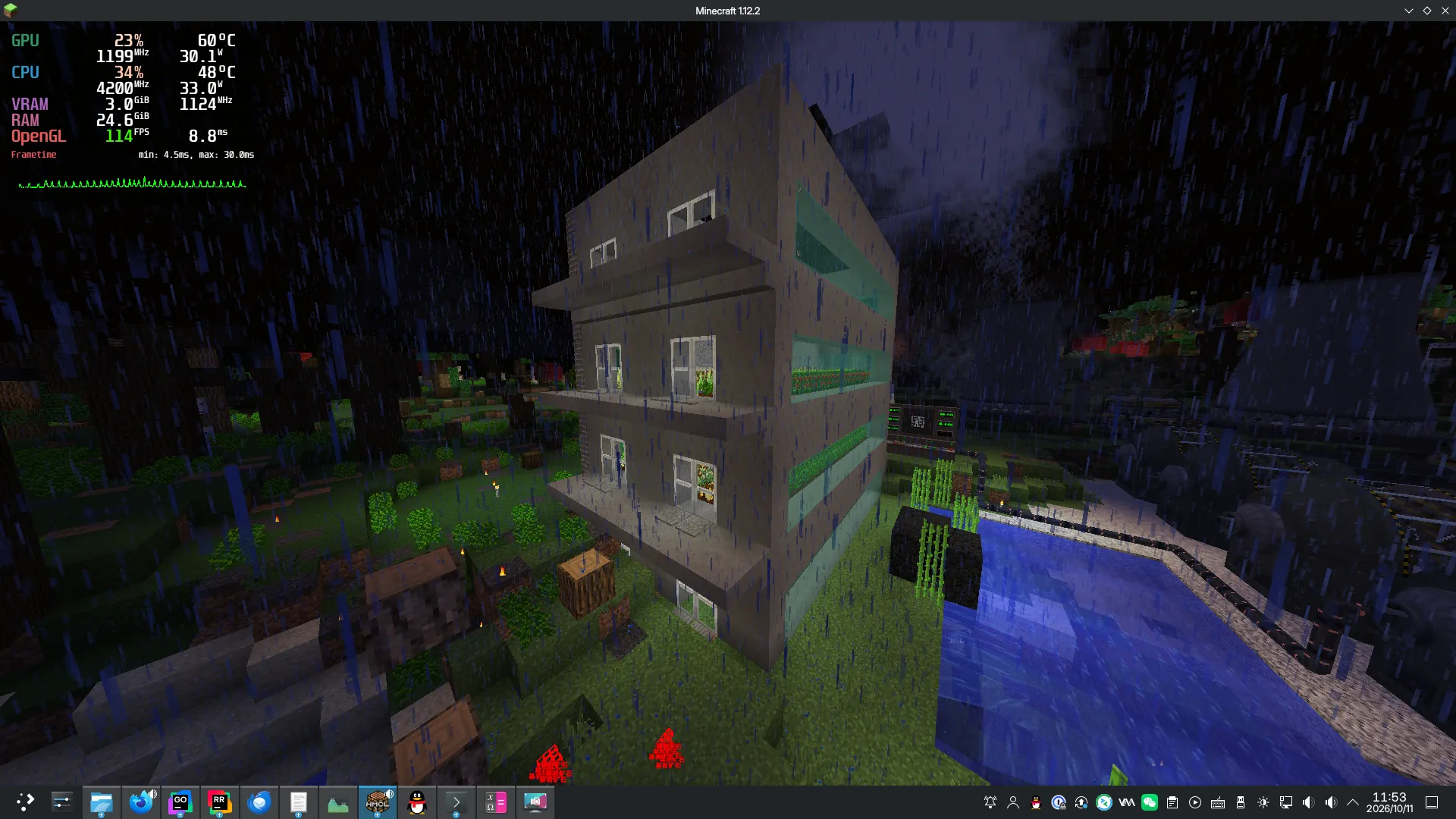
However, the disaster didn’t end there.
What awaited me was several days and nights of “eternal night”, plus burning grass everywhere after the Gerald construction android’s explosion (step on it and you catch fire).
Over those few days, I watched the sky go from pitch black to gradually having distinct days and nights again.
To deal with the pitch-black sky, I installed lighting around my home and other important facilities. That not only made things easier to see, it also made it easier to clean up the burning grass.
Panning for Gold
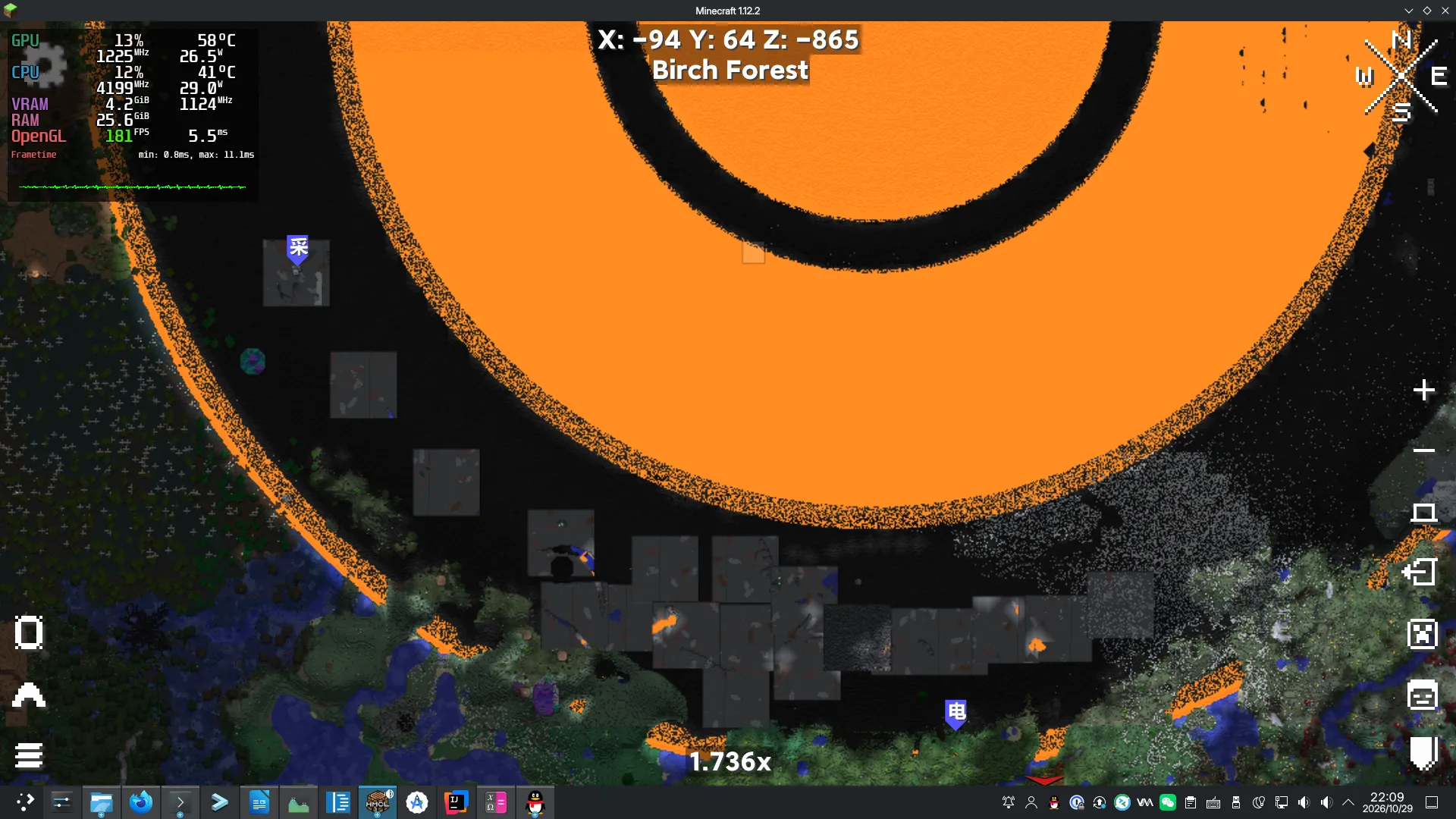
After the Gerald construction android exploded, it left me a giant crater with a radius of 600 m.
The middle of the crater is all lava, and around it is a ring of tektite.
The tektite itself is useless. What’s really useful is the osmiridium-infused tektite mixed in with it.
At first I thought osmiridium-infused tektite showed up fairly often, so I planned to dig it out myself.
But as I dug, I realized it doesn’t show up that often, and in the pitch-black sky it looks so much like ordinary tektite that you simply can’t tell them apart.
Later I built a concrete platform, placed an incinerator (to burn the tektite) and chests (to store the osmiridium-infused tektite) on it, and used conveyor belts to connect a sorter (to separate ordinary tektite from the osmiridium-infused kind) and a mining laser to them.
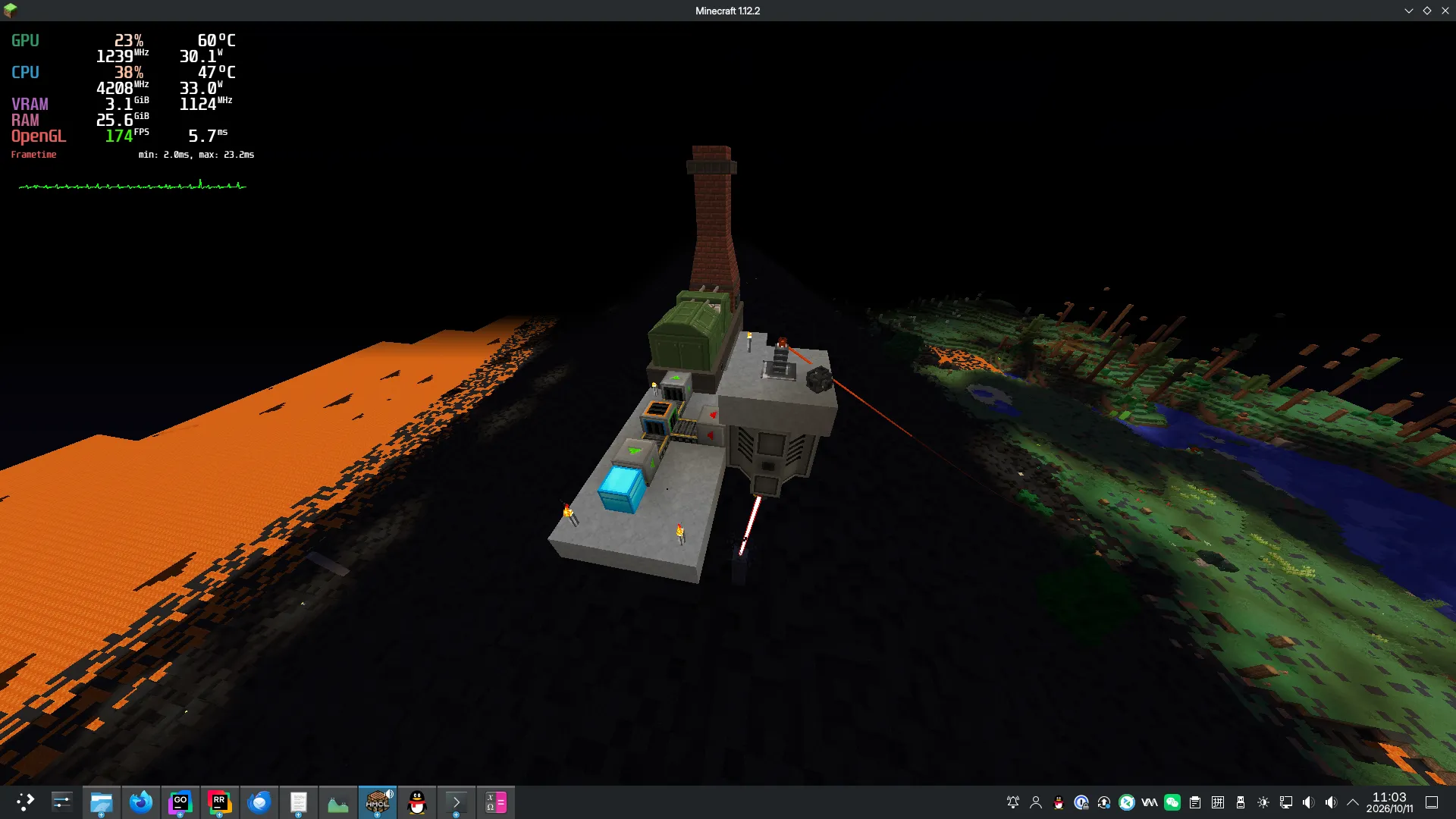
With 4 Green Machine Upgrade Mk.III installed, the mining laser’s range (diameter) reached 51 m, and there was no need to care whether ordinary and osmiridium-infused tektite looked alike. Just mine everything.
So I also placed a chunk loader, which meant I didn’t have to stay next to it the whole time and could go do other things.
After mining out the first 51 × 51 area, I roughly estimated the chance of osmiridium-infused tektite showing up, and found it was only 0.5%.
So I repeated this process several times, each time moving the mining laser and the other equipment and rebuilding the platform.
Finally, I’d collected enough osmiridium-infused tektite.
Turning osmiridium-infused tektite into osmiridium ingots isn’t easy. One of the steps is making paleogenite powder (one of the intermediate products from processing osmiridium-infused tektite) into osmiridic solution.
That involves pressurizing hydrogen peroxide to 5 PU, which takes 5 compressors in series.
But the underground lab couldn’t fit 5 compressors (stacked up, they’re too tall), so I set up an “osmiridic acid plant” near my home.
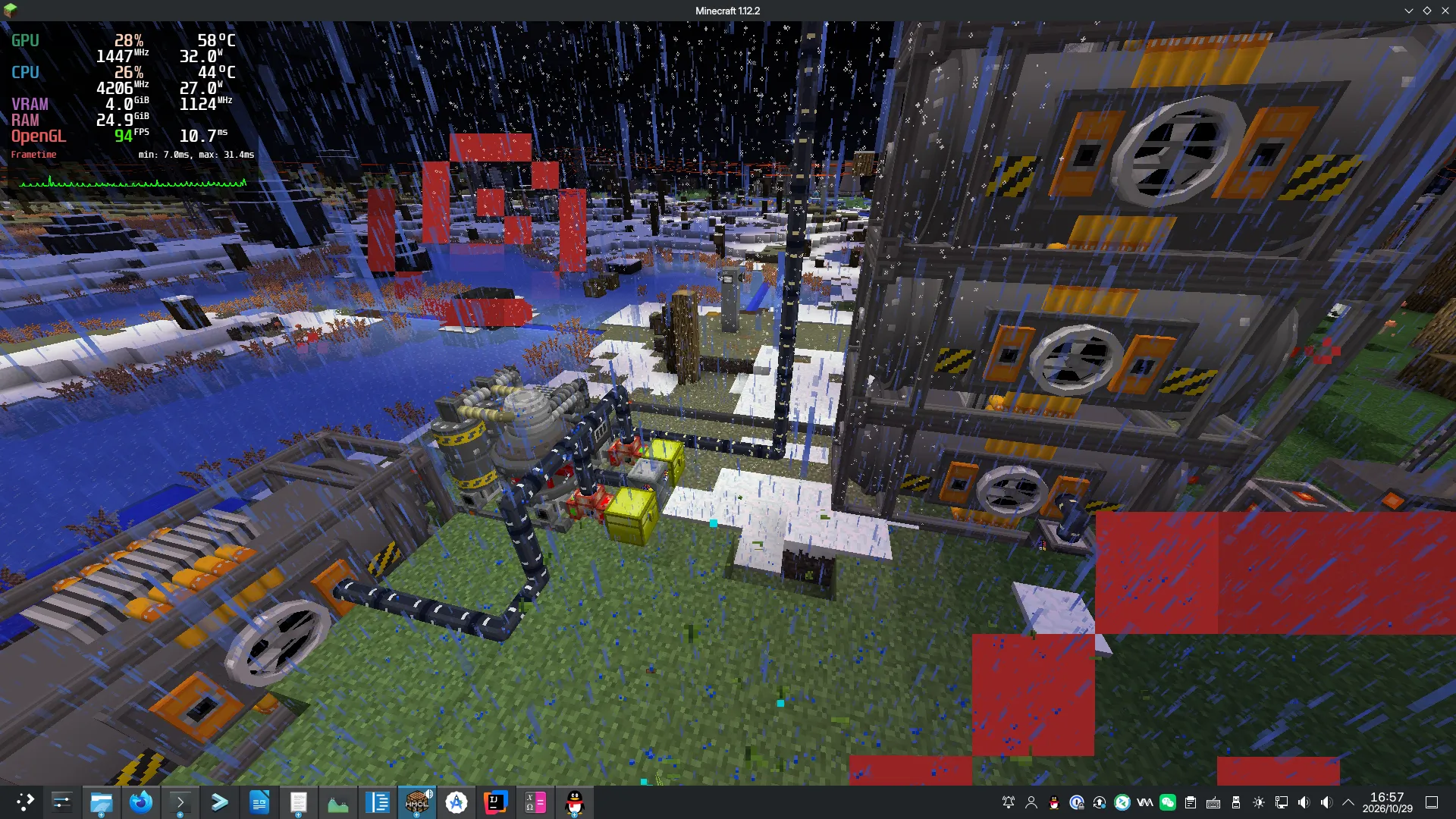
Finally, I had enough osmiridium ingots to get ready to build the DFC.
Endless Energy
The DFC is the most powerful fictional reactor in HBM’s Nuclear Tech Mod.
The DFC is made up of four kinds of components: emitters, a receiver (which can be replaced with a tungsten crate), fuel injectors and stabilizers.
The receiver mainly converts the Spark energy the DFC outputs into electricity. If you replace it with a tungsten crate, it can no longer generate power, but it can turn the polonium billets in the crate into yharonite billets, which late-game gear needs.
The DFC can use lots of fuel combinations (it can even run on a single fuel). I chose antischrabidium and balefire rocket fuel. The former is the strongest fuel for the DFC (2.7× reaction multiplier), and the latter comes right after it (2.5× reaction multiplier), and I happened to have a lot of it at home.
Compared with pure antischrabidium, this combination generates a bit less power, but the DFC’s output is already ridiculous, and this way it uses less antischrabidium.
First, I picked a spot to build the DFC chamber.
A DFC meltdown is a schrabidium explosion, which ignores blast resistance, but I still used the most blast-resistant reinforced CMB steel bricks, so it would at least look impregnable.
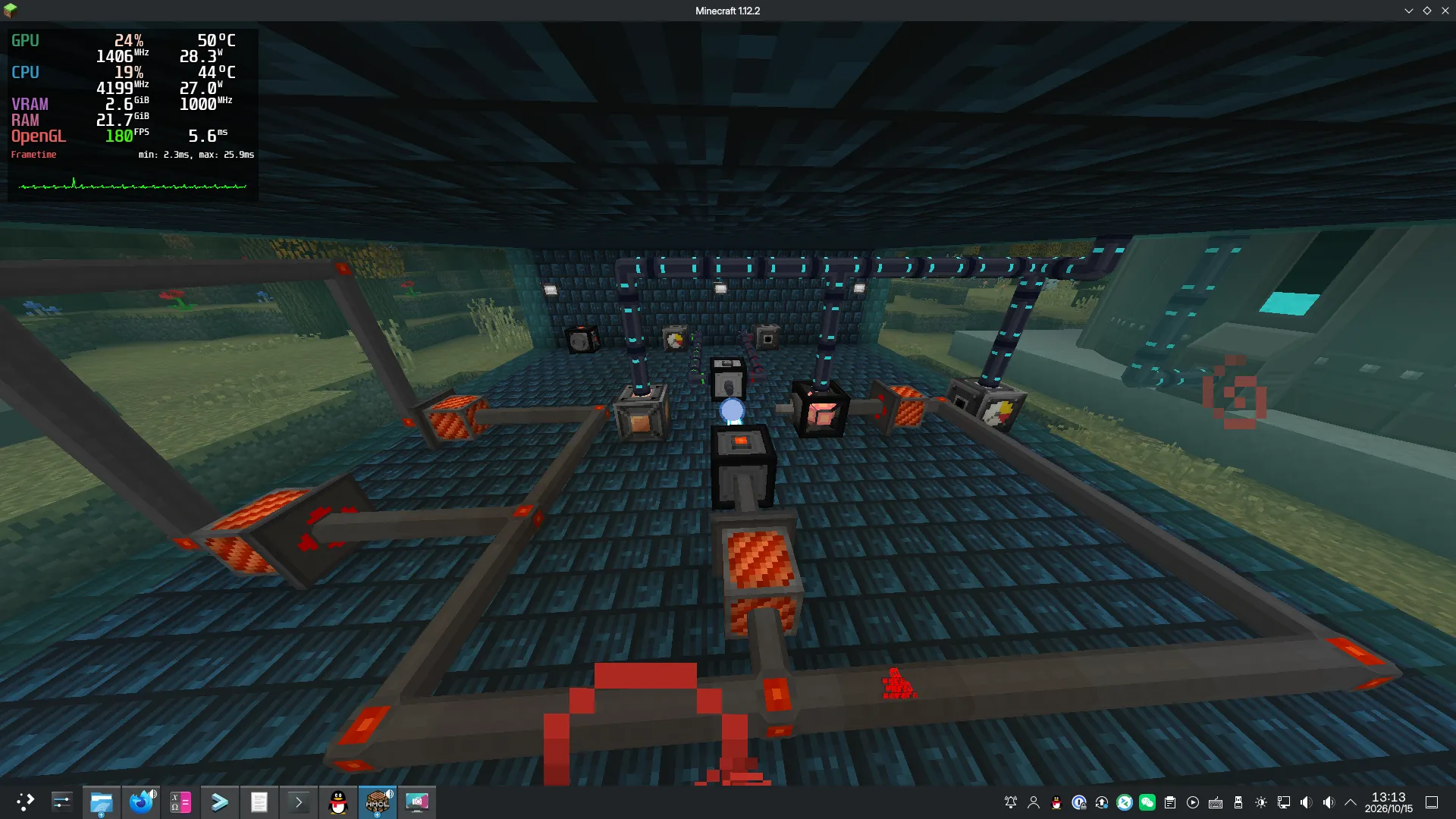
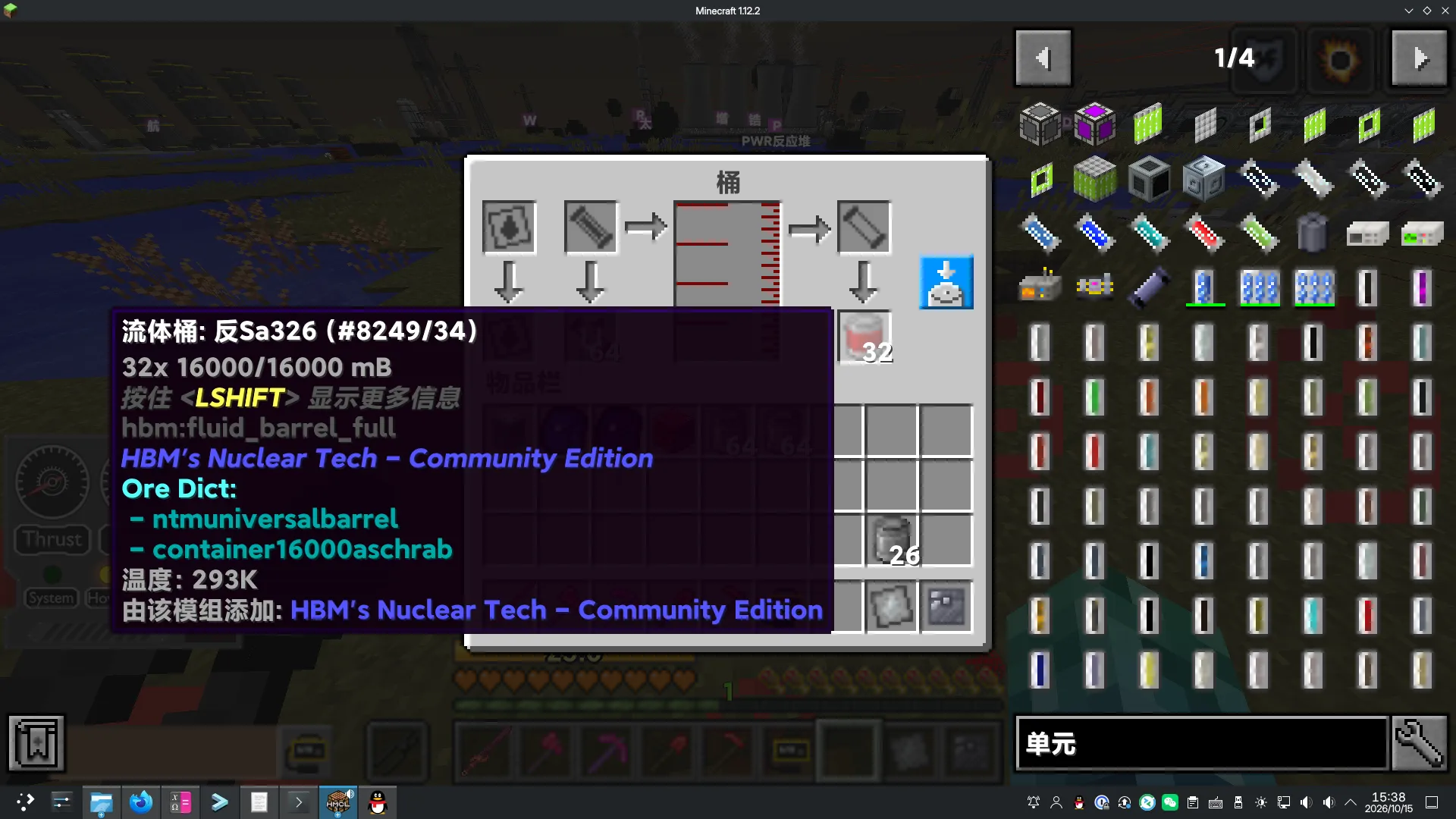
Next, I made several big barrels of cryogel.
Cryogel needs coolant (water + niter) and cryo powder.
Cryo powder is crafted from snowballs, redstone and niter.
It happened to be winter, and it was snowing heavily.
Snowballs weren’t hard to get: just mine the snow on the ground with a Fortune 9 pickaxe.
I already had plenty of redstone at home, so no worries there.
Niter took some time, but luckily I’d found a bedrock ore rich in the non-metal component earlier, so that got sorted out too.
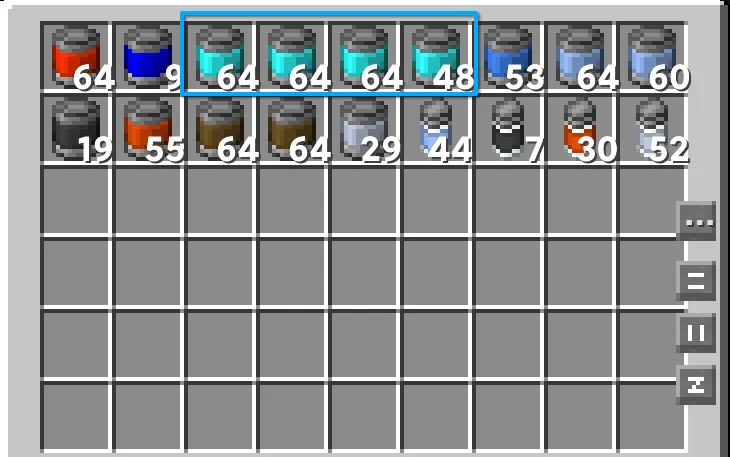
To solve the fuel problem, I went to the particle accelerator to produce some antischrabidium. The process isn’t complicated, just time-consuming: colliding two antimatter cells (2000 mB) produces one antischrabidium cell (1000 mB).
However, I knew late-game gear would need yharonite billets, and I happened to have stockpiled quite a lot of polonium, so I filled the whole tungsten crate and let the DFC convert it.
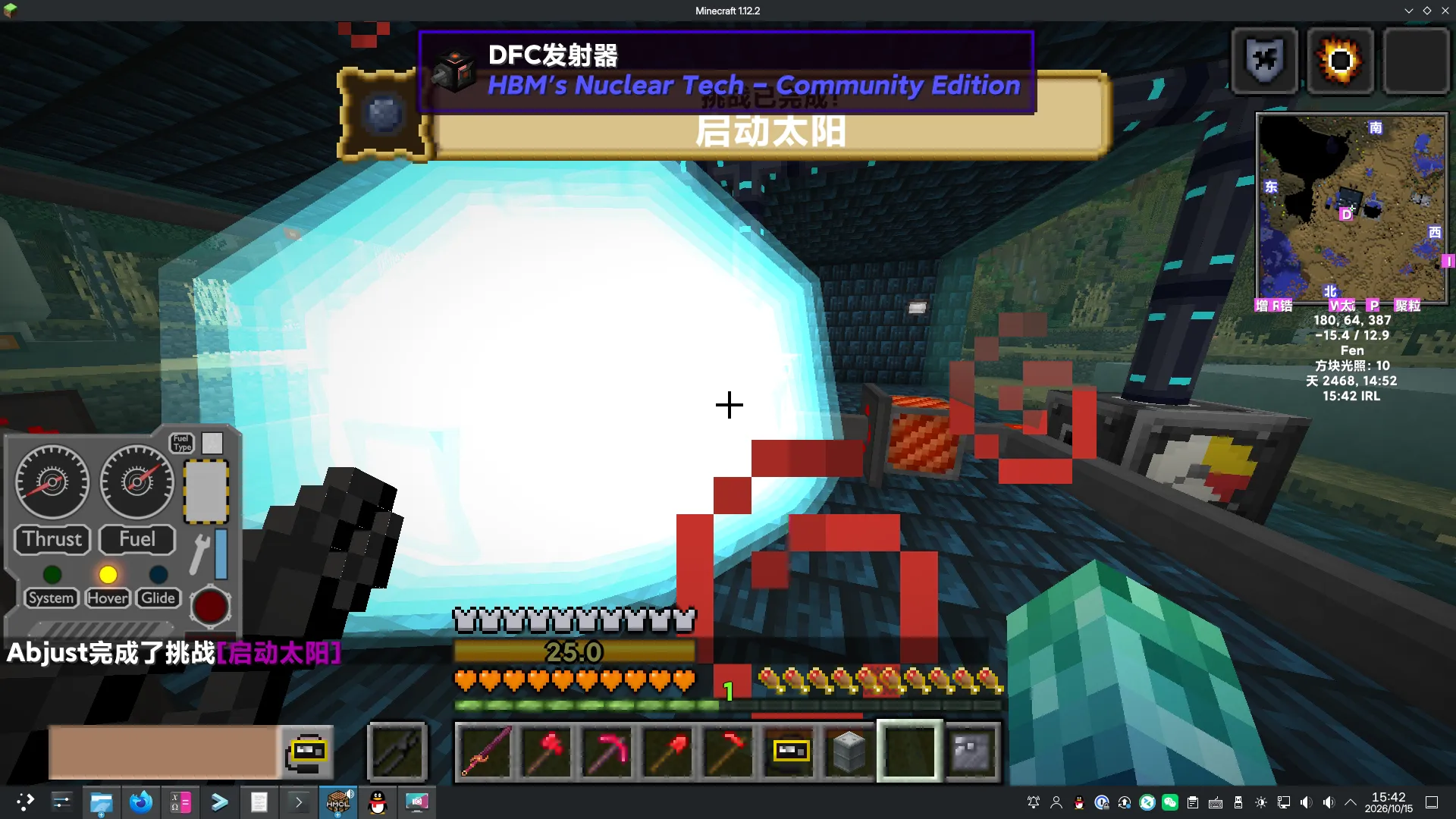
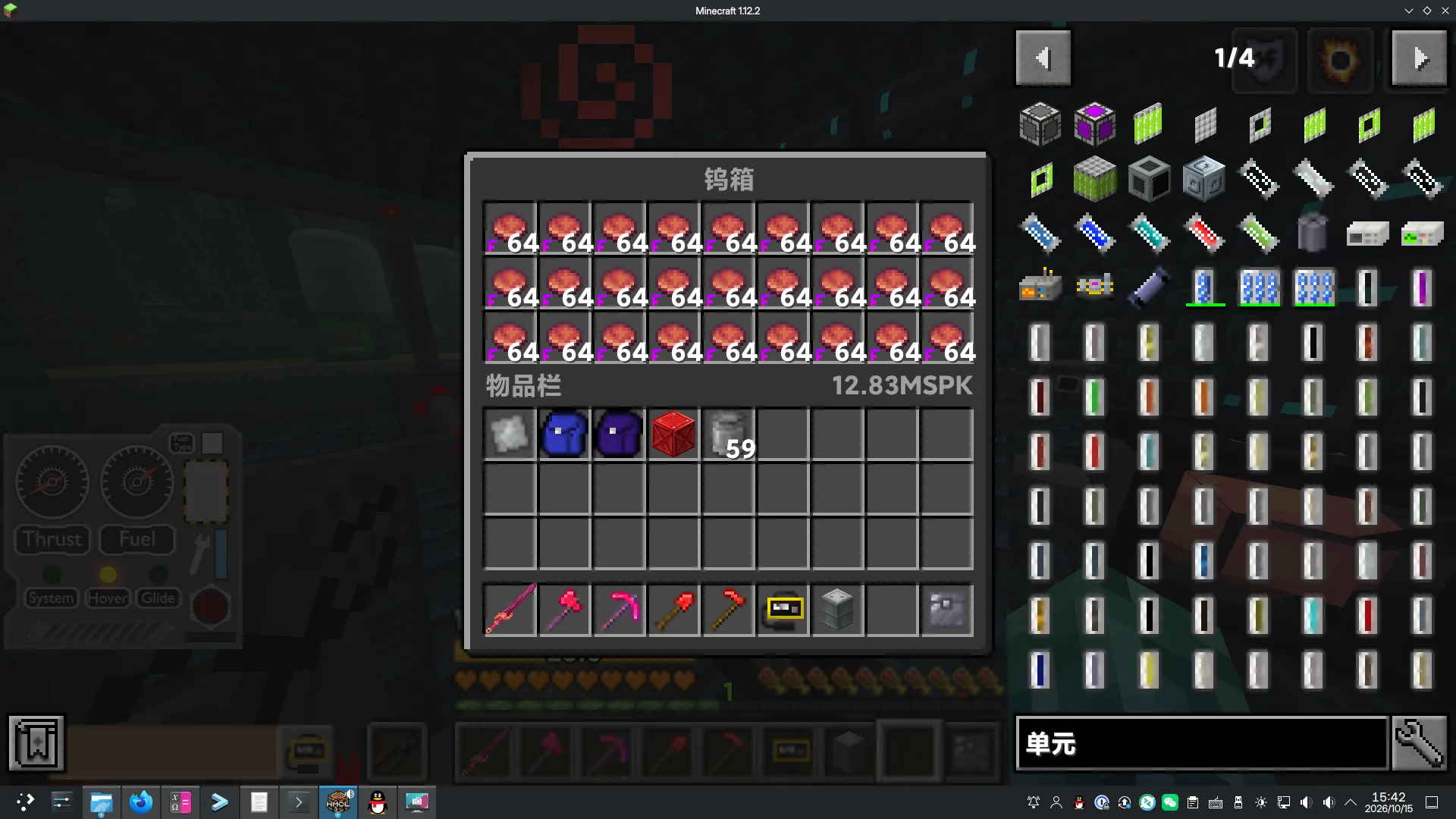
With yharonite billets in hand, the DFC’s power output had no use for the time being, because the batteries at home clearly couldn’t hold that much energy.
All that stood between the DFC and endless energy was a machine that could store infinite power.
Super Armor
Yharonite can make three sets of armor: Fau armor, DNT armor and Ep armor.
But I only made the latter two, because Fau armor is on the weak side.
Of these, I like DNT armor best, because it has rocket boots. They fly slower than a jetpack in glide mode, but they don’t need any fuel.
Since DNT armor is power armor (it needs charging), once I added night vision goggles, I didn’t have to worry about seeing at night either.
Ep armor, on the other hand, makes you immune to all radiation and damage, but it isn’t power armor and is closer to vanilla armor, so it feels a little “boring”.
DNT armor isn’t easy to make.
First, the full set needs 4 heavy chainsteel, and each heavy chainsteel needs 1024 coal powder and steel ingots.
That said, DNT composite plates and Fau armor plates aren’t hard to get, so I won’t go into them here.
Spark particles are a bit tricky; they come from the particle accelerator through an extremely tedious process.
It also needs pulverized enchantment, which you get by throwing enchanted books into the shredder.
In other words, I had to grind XP too.
Still, when I finally put on the full set of DNT armor, I was really excited.
It was a goal I’d only dared to imagine in creative mode and had never achieved in survival.
The Ultimate Energy Storage
Only one last step remained before the world was finished: solving energy storage.
To solve it once and for all, I needed to build the FEnSU, the flywheel that can store infinite energy.
Building it is no easy feat.
Many of the materials are actually fairly easy to get, but not all of them.
It needs a lot of welded osmiridium plates, which means a lot of osmiridium ingots and reformate gas.
On top of that, it also needs some things that can only be found in meteor dungeons.
Meteor dungeons are very hard to find. Each chunk only has a 1/15000 chance of generating one, so I had to explore the map tirelessly and leave no patch of land unchecked.
At last, I found a meteor dungeon, almost 3000 m from home.
Meteor dungeons are very dark, but luckily my night vision goggles helped.
I kept exploring this maze until I finally found the Book of Boxcars and a red crate.
The Book of Boxcars is used to craft some of the materials the FEnSU needs, and the red crate contains the “three elements”, three items that can be used to craft the metastable uranium-238m2 ingot the FEnSU needs.
But the metastable uranium-238m2 ingot has a nasty temper: hold it for more than 10 seconds and it sets off a nuclear explosion with a radius of 350 m.
Another material, the electronium ingot, isn’t much better tempered.
At least it stays calm for 300 seconds, and its blast radius is only 30 m, much smaller than the metastable uranium-238m2 ingot’s.
But to be safe, I didn’t craft them ahead of time.
Later, I spent quite a while mining the crater the Gerald construction android left behind, and collected enough osmiridium ingots.
At last, I could wrap everything up.
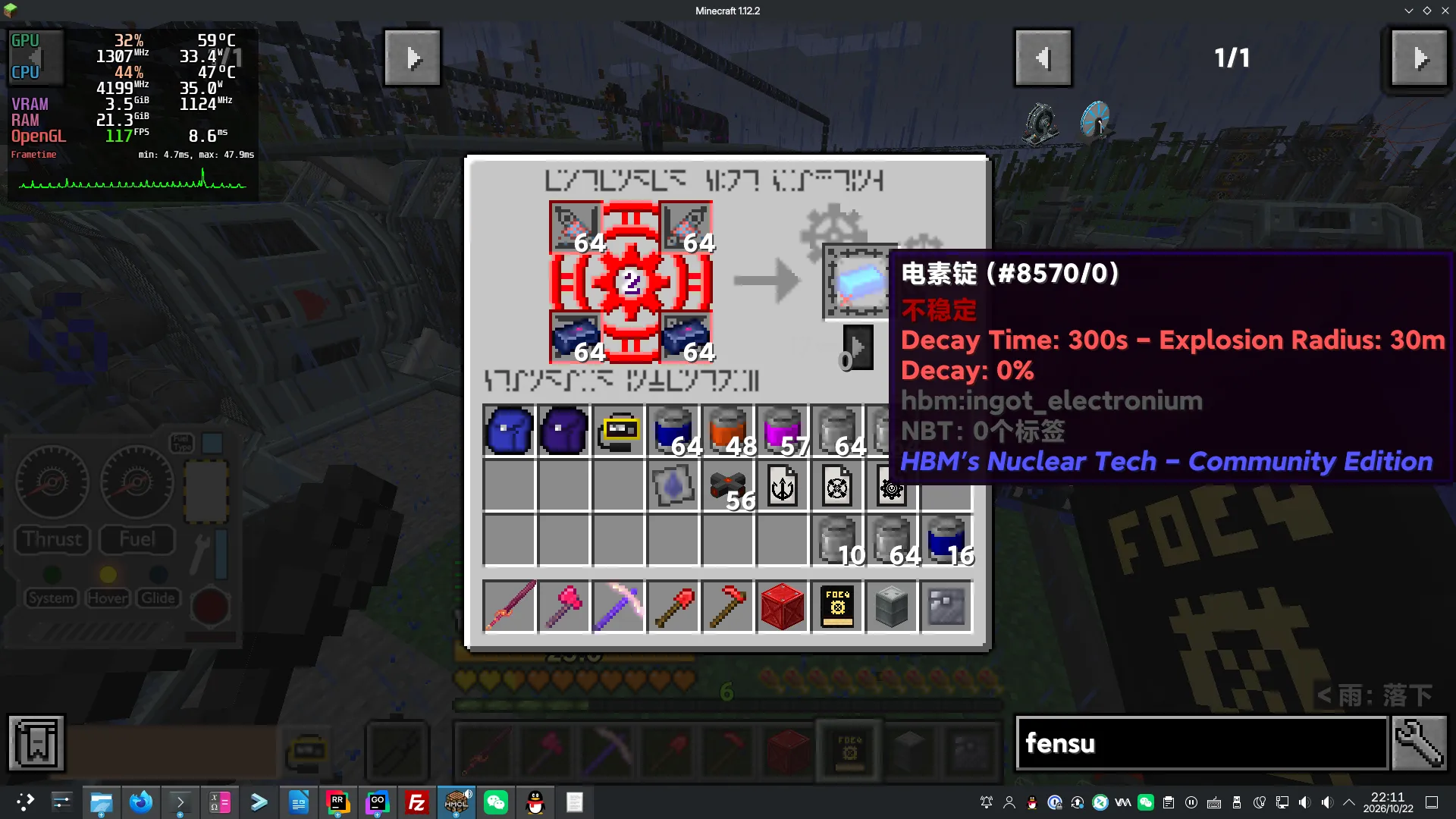
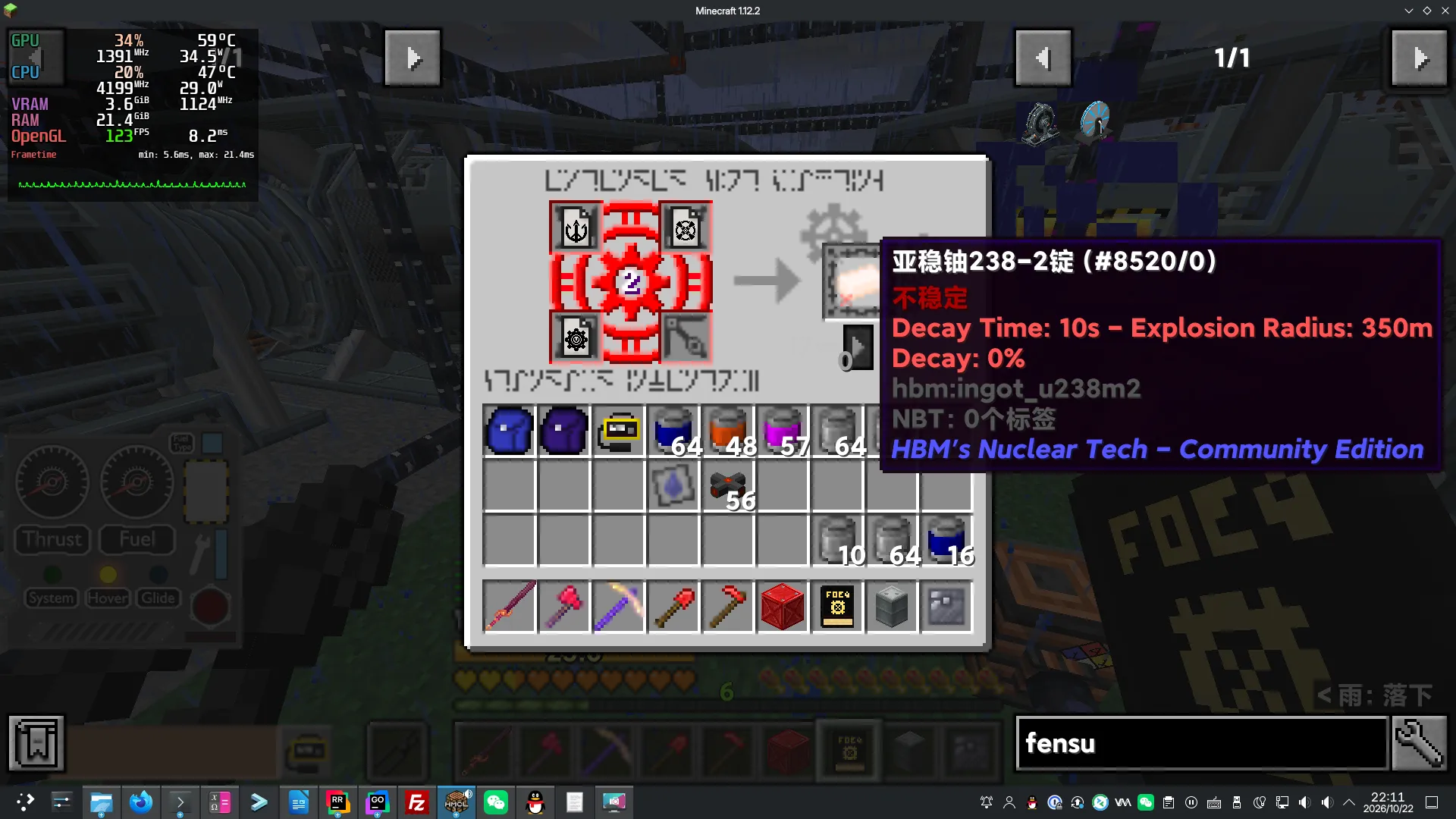
When I put all the materials into the plasma forge, I finally let out a long sigh of relief.
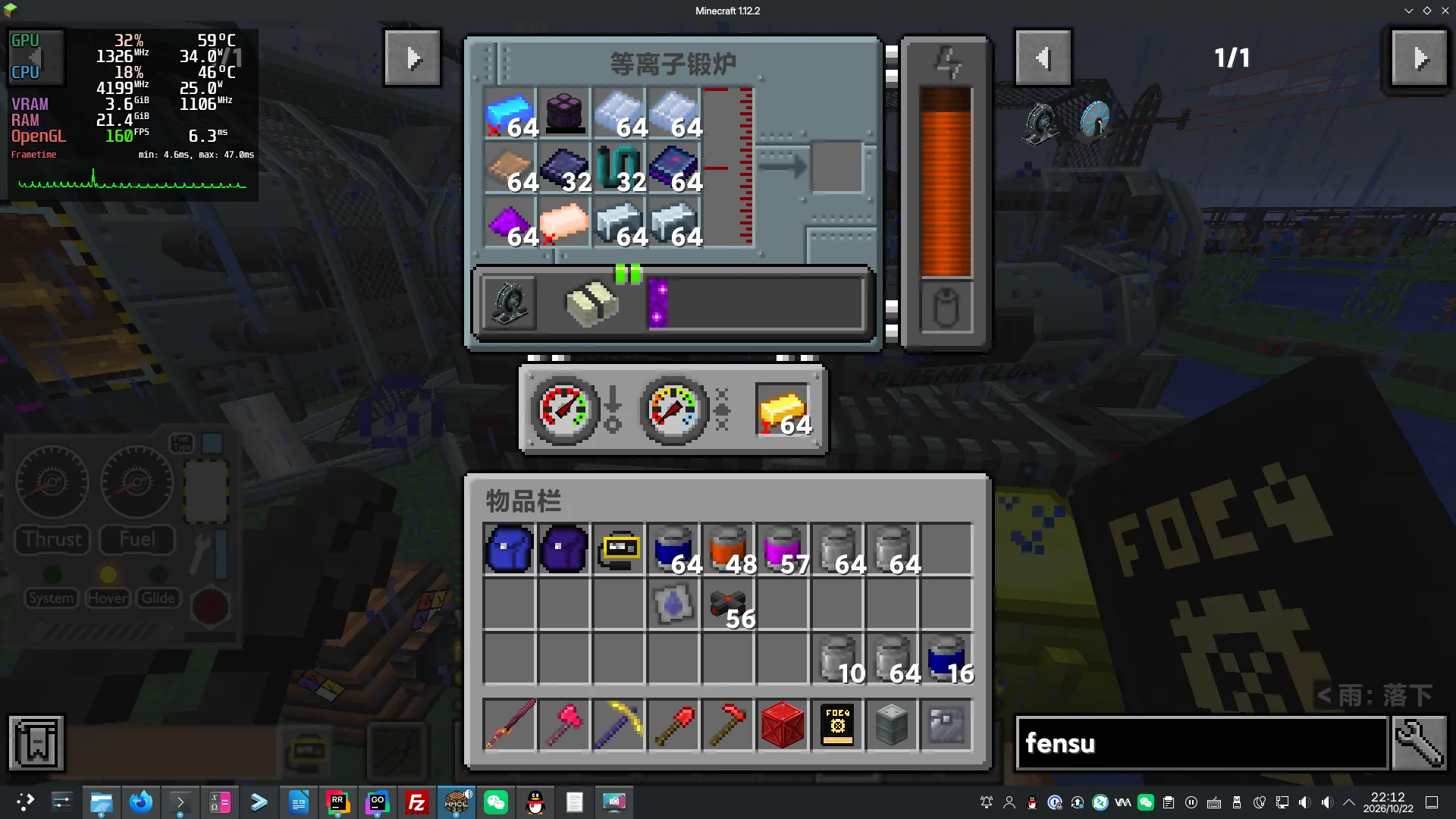
After that, I placed the FEnSU and set about reworking the entire power grid.
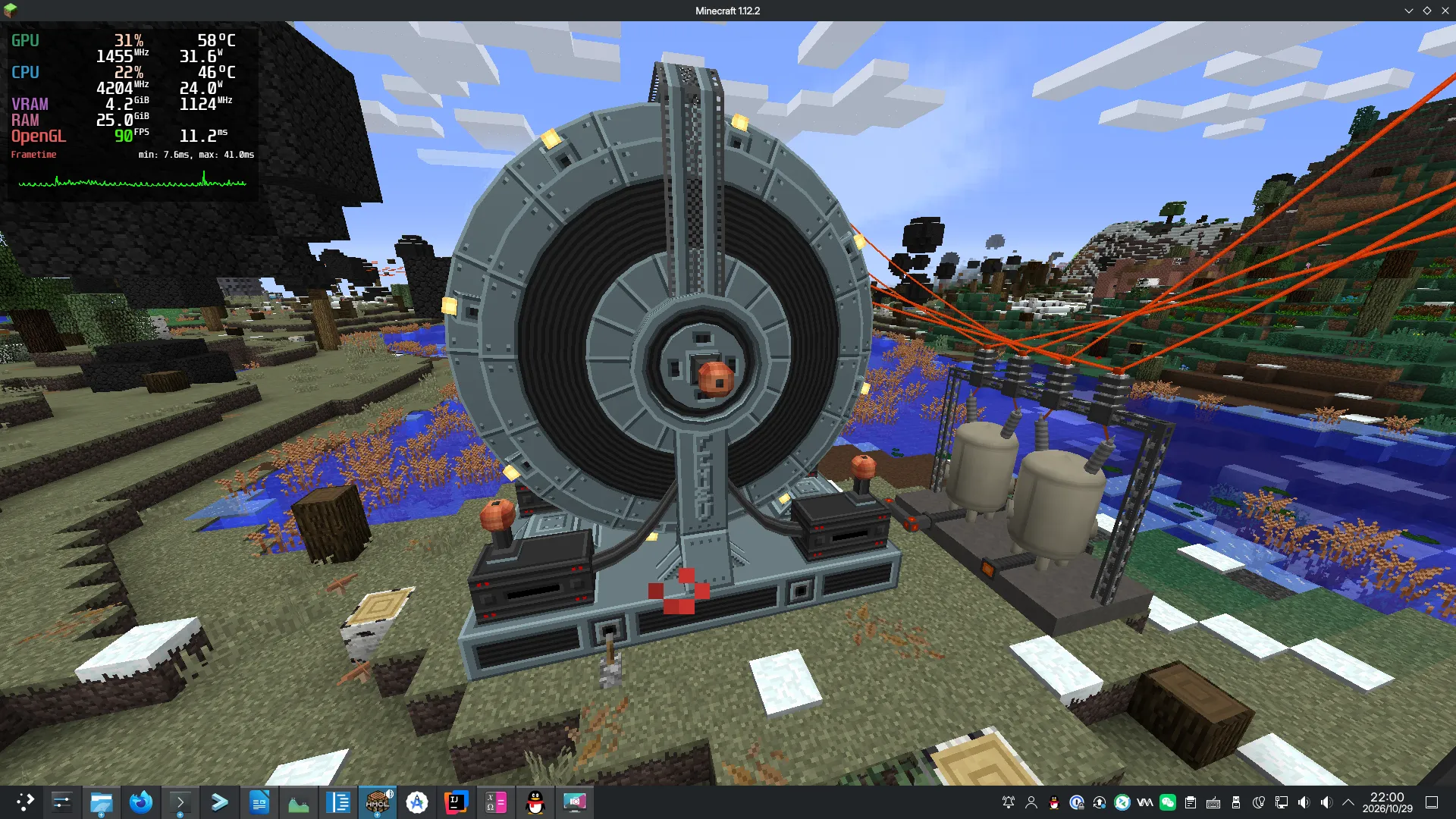
To celebrate the moment, and so I’d never face a power shortage again, I started up the DFC reactor until the FEnSU had stored 2.5 PHE of energy.
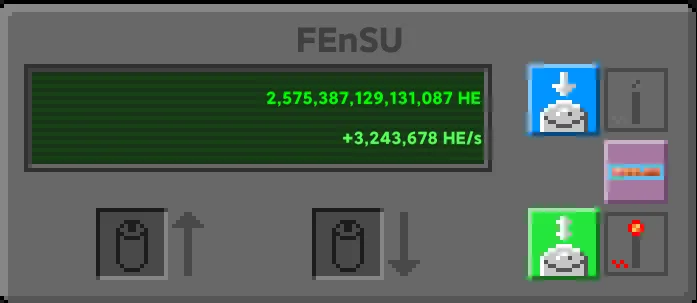
That’s more power than I could use in a lifetime.
From having nothing to having plenty, from facing power shortages time and again and solving them, to never having to worry about power again, it was a far from easy journey.
Although it was mostly about wanting something fresh, the planning problems of my old world were also one reason I started over.
For example, after I updated the mod in my old world, the fluid identifiers got completely scrambled.
I ended up rolling back the version first and stockpiling fluids, but that cost me far too much time and resources.
Second, the storage and lab in my old world were poorly planned: cramped spaces and crowded layouts.
Finally, I’d built the hydraulic fracking tower near my home, and the area around it became an eyesore.
As for the mechanic changes after the game updates, all I can say is they’re a mixed bag.
Some made the early game harder, while others made the endgame easier.
Going from giving up halfway to truly succeeding, I realized that starting over doesn’t mean failing again, and that sticking with it sometimes takes more resolve than starting over.
Starting again isn’t necessarily starting from zero experience. It’s about learning from past lessons and reaching your goals in a better way.
And the goals you have yet to reach are what make your heart race.
Extra 1: Uranium-233 Freedom
After finishing the main storyline of the world, I kept looking for something to do to kill the boredom.
So I followed a tutorial online and built a liquid thorium salt PWR.
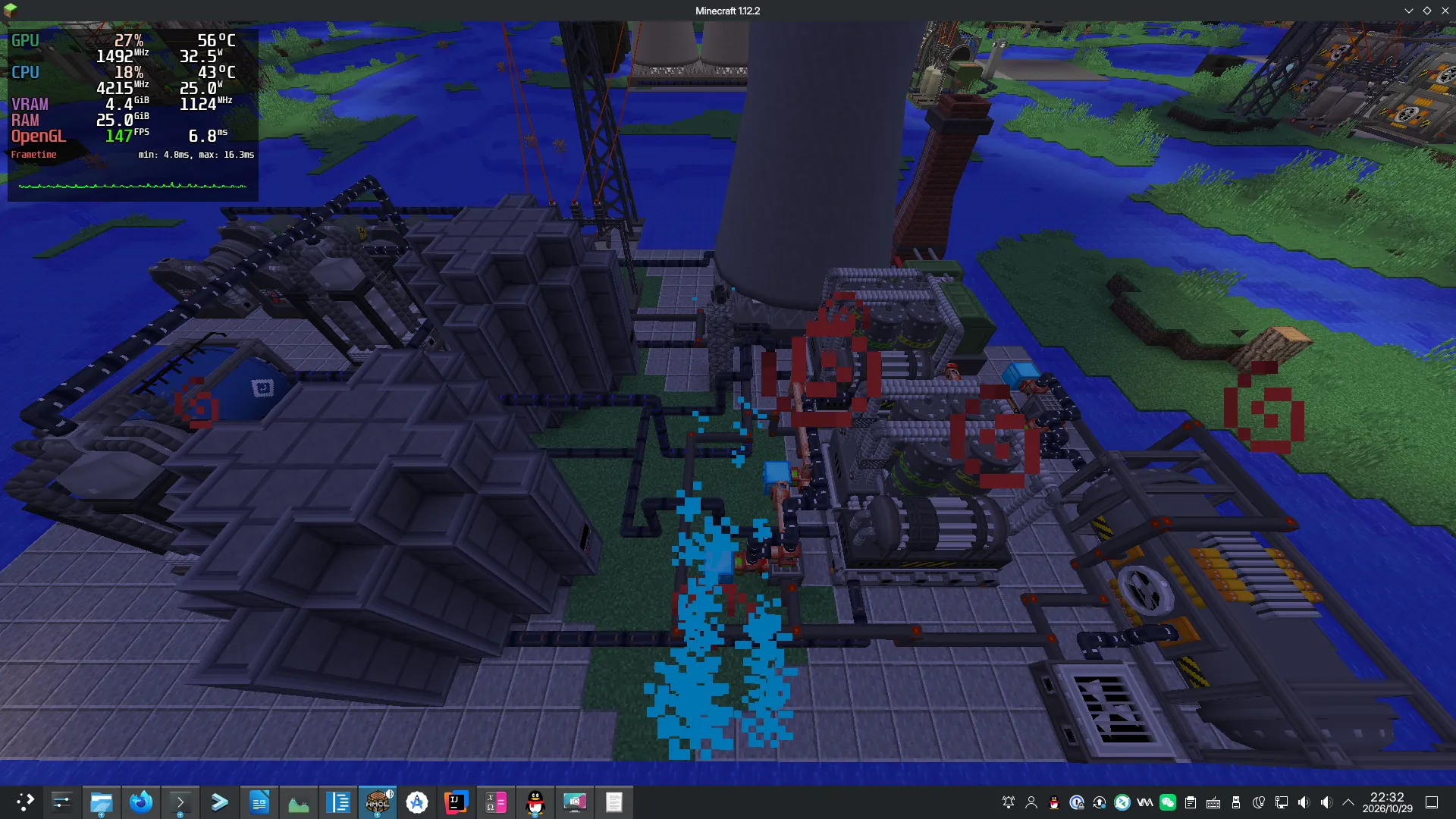
Unlike other coolants, liquid thorium salt becomes depleted liquid thorium salt after absorbing heat in the heat-exchanging heater.
Depleted liquid thorium salt has to be sent into the PUREX, topped up with thorium-232, to turn back into liquid thorium salt.
This process produces a little uranium-233.
I happened to have a lot of thorium-232 at home, so I just used that.
Although uranium-233 production mainly happens while idling, I couldn’t leave it completely unattended, or the thorium-232 in the chest would run out.
Once, I forgot to turn the reactor power down (to slow thorium-232 consumption) before going to class, and when I came back, the reactor had blown up, all because it had run out of thorium-232.
So I had to load a backup, and after that I didn’t dare leave the reactor unattended for long.
But just keeping an eye on the reactor wasn’t a real solution. Since the problem was the thorium-232 supply, the answer was to produce more of it.
So I struck while the iron was hot and went to process actinide bedrock ore.
Unlike before, when I usually processed bedrock ore with liquid hydrogen, this time I chose chlorine to raise the share of the light fraction (thorium).
With the liquid thorium salt PWR running and a steady stream of thorium-232 flowing into it, uranium-233 came out in a steady stream too.
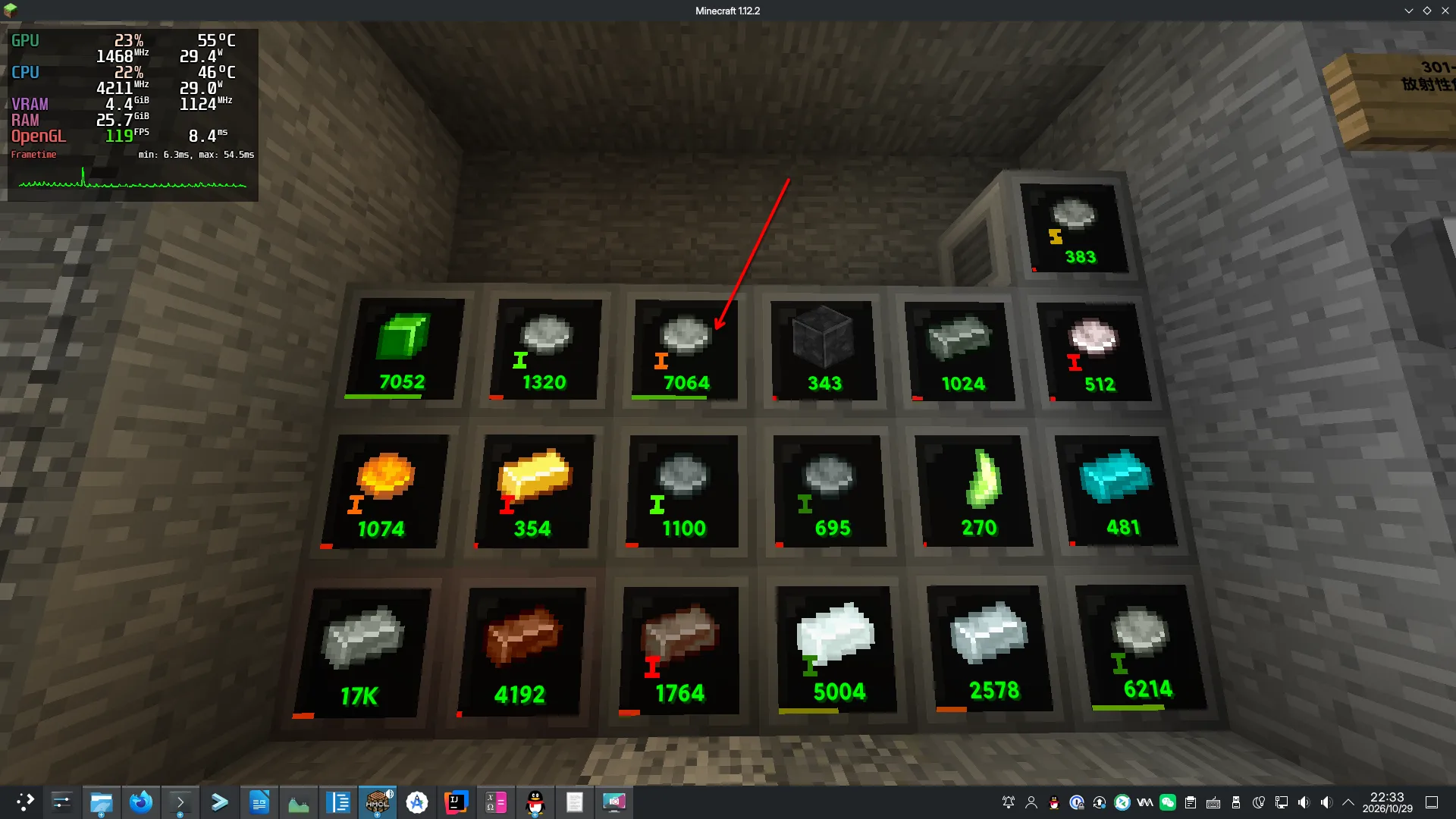
For this, I added a mass storage unit to the “radioactive hazards” zone of the mass-production warehouse, just for uranium-233 billets.
Extra 2: The RBMK’s Road to Revival
Yes, I went looking for something to do again.
I remembered that in my last world I’d built an RBMK “extreme reactor”, using control rods and neutron reflectors to push the reaction power of high-risk fuel rods as far as possible, running the reactor right on the edge of a meltdown.
This time, I planned to recreate that reactor.
Unlike before, though, I planned to add fuel autoloaders to it.
That way, I only have to put new fuel rods into a chest, and the pneumatic tubes deliver them to the autoloaders. The autoloaders take out depleted fuel rods and load new ones, saving me the trouble of swapping them by hand.
Collecting materials was a chore, of course, but compared with everything before, what was this?
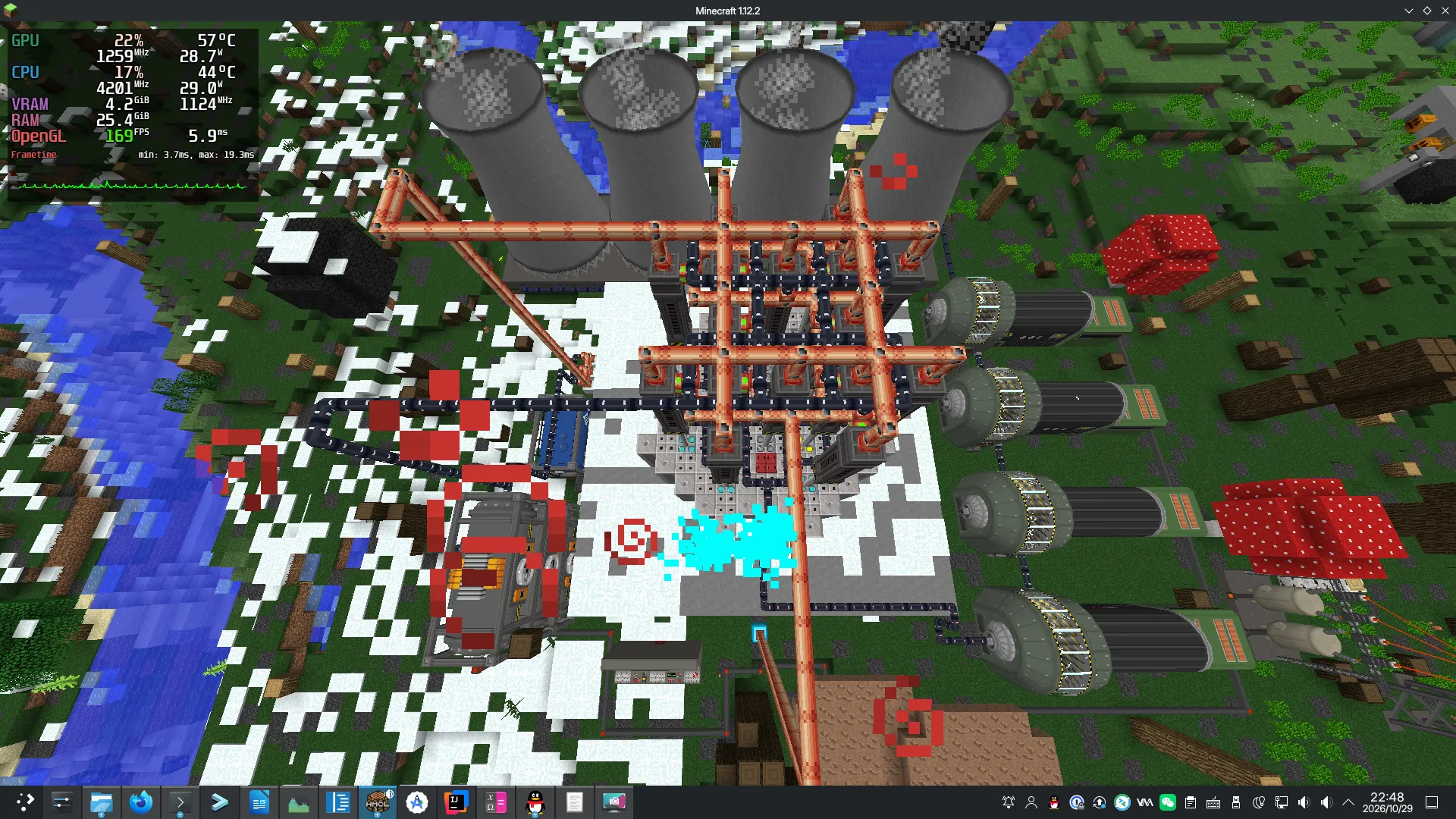
When it was first finished, though, I didn’t notice anything wrong with the reactor.
Only after the first batch of fuel rods was used up did I notice that the two fuel rods in the bottom-left corner were depleting noticeably slower than those in the other three corners.
When I checked, it turned out I’d swapped the positions of the neutron reflector and the neutron absorber in the bottom-left corner, which lowered the reaction power there.
So I figured I’d just fix the column positions without shutting the reactor down; as long as I was fast enough, it’d be fine.
Reality taught me a lesson.
Because of the radiation leak, dead grass covered everything around the reactor, and I had no choice but to load a backup.
After loading the backup, I behaved myself: I took out all the fuel rods first, waited a while, then went to fix the column positions.
This time, everything was fine.
Extra 3: A Gift from the Moon
It’s hard to imagine what people get up to when they’re bored.
Deuterium-tritium fusion and ICF pellets already gave me plenty of helium-4, but it seems I’m a bit insatiable.
So I spent some time building a lunar mining ship and sent it up from the spaceport.
Before long, it brought back a batch of lunar regolith.
Lunar regolith is rich in helium-3, and fusing it as fuel also gives helium-4.
So all I had to do was extract the helium-3 from the regolith.
But this one batch of regolith clearly wasn’t enough, so I placed another chunk loader so the ship could bring back regolith even when I wasn’t around.
Finally, I’d collected 64 big barrels of helium-3, enough to put into the fusion reactor and produce lots of helium-4.
Extra 4: Treasure from the Asteroids
When I’m bored, I like to stockpile stuff.
Same routine as before: I built an asteroid mining ship.
The asteroid mining ship can bring back all sorts of minerals, and my favorites among them are uranium crystals and plutonium crystals.
Since lithium crystals react with water, I built a canopy so that rain wouldn’t cause an explosion while the minerals were being unloaded.
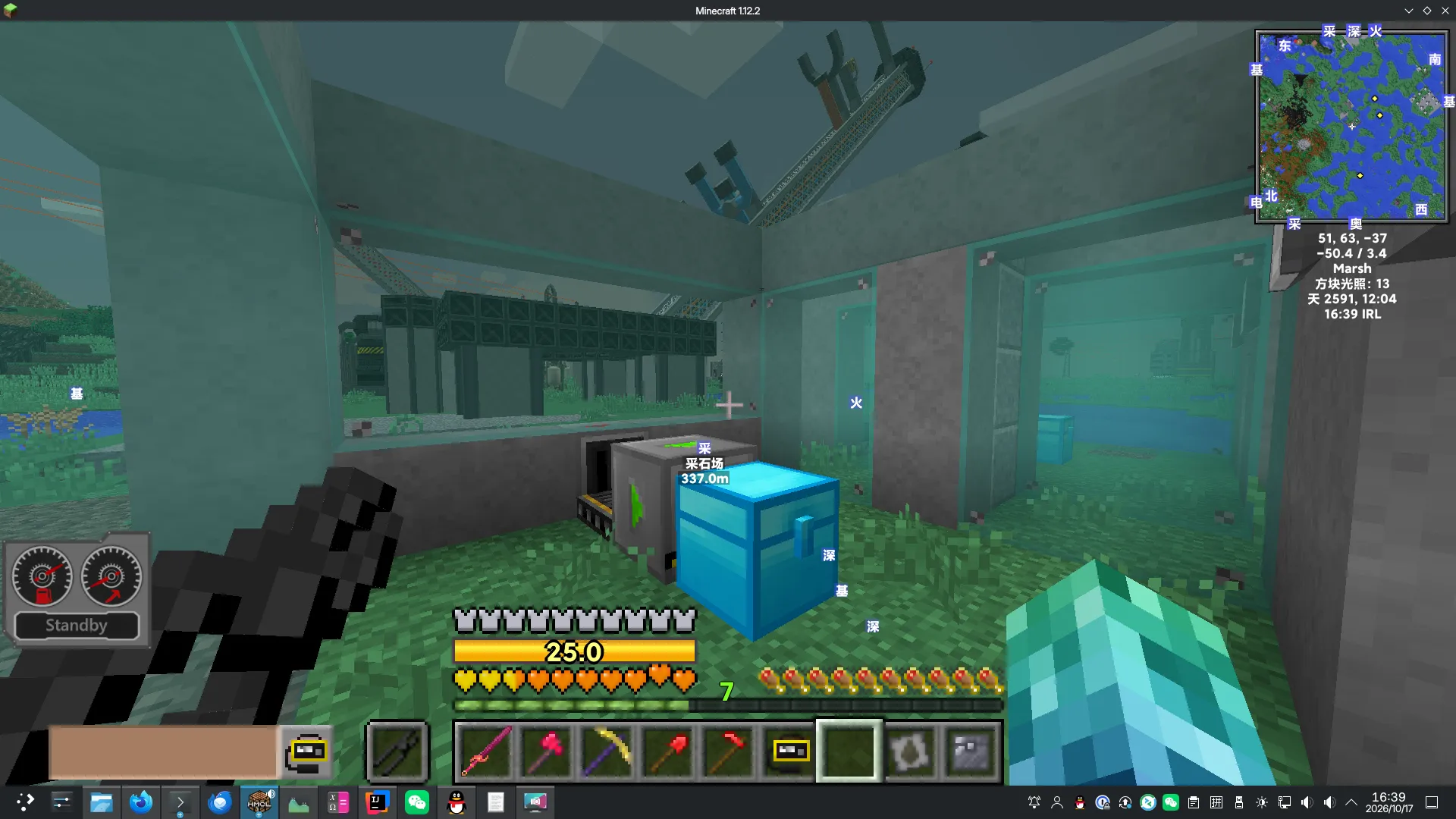
But the asteroid mining ship isn’t very efficient either, and radioactive minerals don’t show up often to begin with, so I left it running while I slept.
Despite all my precautions, the thing I feared most still happened, unexpectedly.
When I woke up, the canopy’s structure was almost intact, but the chests, conveyor belts and everything else were gone, and I knew something terrible had happened.
I checked the 10 most recent backups, taken 15 minutes apart, and found that the unloading facilities had already been blown up in all of them. It seems the accident happened even earlier than I thought.
The only clue I had was that it had been snowing at the time.
Since I hadn’t kept a second copy of the satellite ID chips, even though the ships were still up there, rebuilding the facilities couldn’t make up for the loss.
It’s a shame I never got to say goodbye to the unloading platforms of the two mining ships.
Extra 5: Making the Most of Everything
Looking at the radioactive hazards piled up at home, I wondered: could they be made more useful?
Then it hit me: the breeding reactor I’d built earlier.
With a breeding reactor, radium-226 becomes actinium-227, uranium-238 becomes reactor-grade plutonium, and plutonium-238 becomes plutonium-239.
All of these are very useful.
Actinium-227 can be made into RTG pellets. They don’t put out as much heat as polonium-210 pellets, but at least they last longer.
Maybe relieving my boredom counts as a use too?
Reactor-grade plutonium is 67% plutonium-239 and 33% plutonium-240, and the SILEX can separate them.
Plutonium-240 isn’t good for much; plutonium-239 is what I needed.
The first two breeding reactions are easy: they only need a neutron flux of 900.
But turning quad plutonium-238 rods into quad plutonium-239 rods needs a neutron flux of 3000, which is a real problem.
I looked it up online, and according to other players, since the research reactor (which supplies neutrons to the breeding reactor) had its mechanics changed, it can only reach a neutron flux of 2051 at most.
That’s clearly nowhere near 3000.
With no other option, I had to break the quad plutonium-238 fuel rods down into dual ones, which need a neutron flux of 2000, just barely enough.
I call it making the most of everything, but all I did was store these products. Maybe they’ll come in handy someday?